
Replacing traditional media wholesale is rarely a strategy; it’s a channel decision made without the full picture. Alternatives to traditional advertising include search and social campaigns, public relations, influencer partnerships, community activity and events, but no option is automatically more effective. The right choice depends on who you need to reach, what they need to do next and how long their buying decision takes.
It’s understandable to look for channels that offer clearer measurement or stronger credibility. The challenge is comparing unlike approaches and coordinating them across audiences, markets and languages. A digital campaign may provide faster response signals, while earned coverage or an expert endorsement may help build trust. Neither should be assessed by reach alone.
This article compares established and emerging approaches through a practical framework: audience fit, reach, credibility, control, timing and measurement. You’ll see where each option can contribute, what its limitations are and how to combine channels without fragmenting campaign activity. The aim is a measurable mix aligned with your objectives, whether you’re marketing a consumer brand, supporting a public awareness initiative or reaching B2B buyers across several markets.
Key Takeaways
- Start with the business objective and audience behaviour, then identify which channel roles can support them.
- Assess alternatives to traditional advertising by fit, control, time horizon, resources and the evidence each can provide.
- Distinguish early signals, such as engagement, from outcomes like qualified enquiries or attendance.
- Test a manageable combination of channels, with clear measures and a decision point for what to adjust next.
- Coordinate branding, digital marketing, media buying, public relations and events where they serve a shared objective; integration doesn’t mean using every channel.
Alternatives to traditional advertising: what counts and why consider them?
Traditional advertising usually means paid placements in established media, such as television, radio, print and outdoor advertising. Alternatives to traditional advertising are approaches that complement or differ from those placements. The distinction isn’t simply old versus new: it can involve the strategy behind a campaign, its creative format, how it reaches people or the relationship a brand builds with its audience. Online advertising, for example, covers internet-based formats such as search and social media ads.
There is no universally best alternative: the right approach is the one that fits the audience, objective, buying cycle and evidence needed to judge its contribution. Traditional media can still be effective when the intended audience uses it, the message suits the format and the campaign needs its particular reach or presence. The decision is not whether a channel is modern, but whether it serves a defined role.
What makes a marketing approach an alternative?
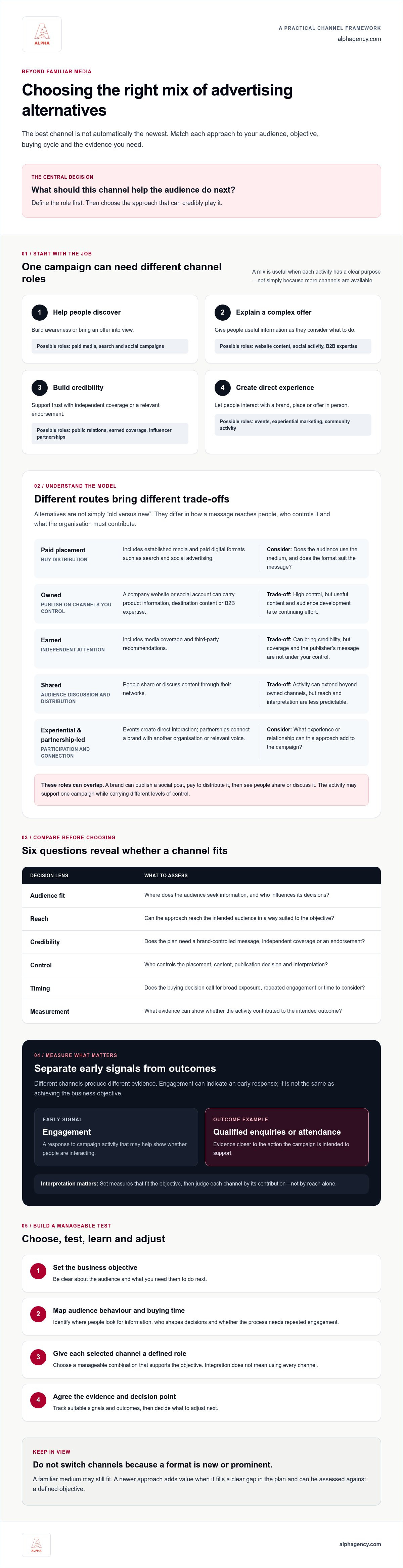
Paid media buys placement; other approaches can rely on different forms of access and participation. Owned activity uses channels a brand controls, such as its website or social accounts. Earned activity comes through independent coverage or recommendations. Shared activity involves people distributing or discussing content, while experiential marketing creates a direct, in-person interaction. Partnership-led activity connects a brand with another organisation or relevant voice.
These categories can overlap. A destination organisation might publish travel content on its website, pay to promote it on social media, work with a creator to share it and host an event that lets visitors experience the offer. Each activity has a different level of control and relationship with its audience, even though all support the same campaign.
When should a business look beyond familiar media?
Review the channel mix when the current plan doesn’t reach the intended audience, when the objective changes, or when the buying process calls for more than one contact. A public awareness campaign may need broad exposure, while a considered B2B purchase may require useful information and repeated engagement over time. For a consumer brand, social content or an event may help people explore an offer, while paid media supports wider distribution.
Audience behaviour matters as much as the objective. Identify where people seek information, who influences their decisions and what they need before acting. Then assess the channel’s role, resources and practical measurement options. Don’t switch simply because a format is new or prominent. A familiar medium may still fit; a newer one may add value only when it fills a clear gap in the plan.
Which alternatives to traditional advertising can support your objectives?
Choose approaches by the role they need to play, not by a ranking of channels. Some help people discover a brand; others explain a complex offer, build credibility or create a direct experience. A useful mix may combine several approaches, provided each has a defined audience, purpose and way to assess its contribution.
How owned, earned, and shared channels differ
Owned channels, such as a company website or its social media accounts, give the organisation the most control over publication and message. They can support product information, destination content or B2B expertise, but require continuing effort to keep content useful and bring the right audience to it.
Earned attention includes independent media coverage and third-party recommendations. It can carry credibility because the organisation doesn’t control the publisher’s message or decision to cover it. That is also its limitation: coverage cannot be guaranteed, and it shouldn’t be planned as if it were fully controllable paid media.
Shared activity involves audiences distributing or discussing content through their networks. It can extend a message beyond owned channels, but reach and interpretation are less predictable. Content and social activity can serve all three roles: a brand creates a post on its own account, pays to distribute it, then sees people share or discuss it.
How experiences, partnerships, and digital activity fit
Events and experiential marketing let people engage directly with a brand, place or issue. A tourism organisation could use an event to help prospective visitors experience a destination; a public awareness initiative might use an interactive activity to make information tangible. These formats depend on access, audience participation and sound execution. Attendance alone may not show whether the experience changed awareness or prompted action.
Influencer collaborations can help reach a defined community or bring a relevant voice to a subject. Fit matters more than follower count alone: assess the audience, the creator’s connection to the topic, the content format and the intended outcome. Agree responsibilities and review disclosure expectations for the relevant platforms and markets before publication.
Digital performance marketing is paid activity, not automatically an alternative to advertising. It can support a specific response, such as a visit to a product page or an enquiry, while owned web content provides information for people assessing the offer. Neither works in isolation: the creative must suit the audience, distribution must reach them, and measurement must connect activity to the objective.
Alpha Agency’s media and communications services include public relations, influencer marketing, digital activity and events. The relevant combination depends on the campaign’s objective and audience.
How to compare advertising alternatives by fit, control, and evidence
Compare each option against the job it needs to do. Evaluate channels against the same objective, not identical metrics. A public relations programme and a paid performance campaign may both support demand, but one may be assessed through relevant coverage and referral activity, the other through qualified enquiries. Treating them as interchangeable would hide their different roles.
| Approach | Typical objective and audience fit | Control and time horizon | Resources and useful evidence |
|---|---|---|---|
| Owned web content | Explain an offer; support people researching a considered purchase. | High message control; takes time to build useful content and reach. | Requires content and website capacity. Assess relevant visits, engagement and actions such as enquiries. |
| Public relations | Build awareness or credibility with audiences reached through relevant media. | Limited control over coverage; timing depends on editorial decisions. | Requires strong materials and follow-up. Track relevant coverage, message inclusion and referral signals. |
| Influencer or partnership activity | Connect with a defined community through a trusted or relevant voice. | Shared control; allow time for selection, agreement and content review. | Requires coordination and clear briefs. Measure audience response and actions tied to the objective. |
| Performance marketing | Prompt a defined action among people likely to respond to an offer. | Paid distribution gives more control over delivery and timing, subject to platform settings. | Needs suitable creative, budget and tracking. Assess clicks alongside qualified actions, not in isolation. |
Which trade-offs should decision-makers assess?
Speed, potential reach, message control, audience trust and ongoing effort vary by approach; none has a universal advantage. Retail activity may need to connect exposure with product consideration or purchase. Tourism campaigns may need to build interest well before travel. Industrial B2B decisions often involve several stakeholders and a longer evaluation period. Public awareness work may prioritise comprehension and action rather than immediate sales.
Check delivery requirements before choosing. Does the team have the creative capacity, subject expertise and approval time the channel needs? Multilingual campaigns add coordination demands, while events depend on access and execution. A channel that looks suitable in theory may be impractical if the organisation can’t sustain it.
What evidence can show whether an approach is working?
Record a baseline and define success measures before launch. Separate leading indicators, such as content engagement, event participation or visits to a relevant page, from outcomes, such as qualified enquiries, registrations or a change in awareness. Choose measures that reflect the objective, then set a review point to decide whether to continue, adjust or stop.
Attribution has limits. A person may encounter several campaign elements before acting, and available data may not isolate each channel’s contribution. Read channel evidence alongside the wider campaign and business context. Alternatives to traditional advertising are most useful to compare when each has a defined role, a realistic measure and a fair chance to influence the outcome.
How to choose, test, and measure the right channel mix
A useful test answers a business decision, not just whether a channel can attract attention. Set the objective first, then choose a manageable mix of alternatives to traditional advertising that your team can deliver and measure within the campaign’s real time horizon.
- Define the outcome and audience. Specify the business objective, the people you need to reach, the relevant market context and the action you want them to take. “Build awareness” needs a clearer audience and measure; “increase consideration among business buyers evaluating a particular service” gives the plan a firmer starting point.
- Shortlist by fit and feasibility. Consider which approaches suit audience behaviour and the buying cycle, then check message control, available resources and the evidence each can provide. A channel may fit strategically but still be unsuitable if you lack the creative capacity or approval time to execute it properly.
- Set the test boundaries. Choose a limited combination of activity that can answer a specific question. For example, a retailer might test whether useful product content, supported by paid digital distribution, leads more people to explore a product page. Keep the scope tight enough to identify what should change next.
- Assign resources and accountability. Agree the budget allocation, creative requirements, publication or buying responsibilities, and who will monitor results. Confirm who owns approvals and measurement before launch, particularly when several teams or markets are involved.
- Record assumptions and decision rules. Set a baseline, define success measures and decide what evidence would justify continuing, adjusting or stopping the test. Document assumptions about audience response and timing so the review can distinguish a weak channel fit from an execution or distribution issue.
How to interpret results and adapt the plan
Review performance against the measures and time horizon agreed in advance. Early engagement may indicate that people noticed or interacted with the activity, but it doesn’t necessarily demonstrate business impact. Compare those signals with the intended outcome, such as qualified enquiries, registrations or product-page actions.
Before assigning cause, consider seasonality, market conditions, changes to the offer and the influence of other campaign activity. A channel may help another perform better, or its contribution may appear later than a direct-response measure captures. Use findings to make a specific decision: refine the audience, revise the creative, adjust distribution or give a longer-term activity more time. Don’t change several elements at once if you need to understand what affected the result.
Alpha Agency’s media and advertising services cover planning, digital activity, public relations and events, which can be coordinated around a campaign objective.
Explore media and advertising services
Build an integrated plan with the right advertising alternatives
A coordinated campaign gives each activity a defined job. Branding establishes the message and identity; public relations can develop relevant coverage; digital marketing can support consideration or action; media buying can extend distribution; and events can create direct interaction. The sequence and emphasis depend on the objective. A public awareness campaign, for example, might use consistent branding across paid media and digital content, with an event providing a practical way to engage with the issue.
Integration doesn’t mean using every available channel. It means aligning the audience, message, timing and measures across the approaches that earn a place in the plan. Without that coordination, teams can duplicate effort, deliver inconsistent messages or assess each activity in isolation. Keep the plan focused: include a channel only when it adds a distinct contribution and the organisation can deliver it well.
When an integrated agency can add practical value
Internal teams may have the strategic direction but need specialist support to connect creative development, media planning, public relations and delivery. An agency can be useful when several disciplines, audiences or markets need coordinated planning, particularly for cross-border or multilingual campaigns where timing and local context matter.
Assess potential support against the actual brief. Look for relevant expertise, clear responsibilities and documented work that demonstrates experience with comparable requirements. Ask how decisions, approvals and measurement will be handled. Alpha Agency is a full-service media and advertising agency with over 25 years of expertise. Its work spans branding and advertising, media and digital, public relations, destination marketing, sport marketing and events. Its campaign portfolio spans multiple countries and industries, which can help readers assess the relevance of its experience.
Turn the channel decision into a clear next step
Before planning begins, capture the business objective, target audience, markets, shortlisted approaches and measures in a concise brief. Add the key assumptions and open questions, such as which audience insight needs validation, what creative materials are required and who will approve activity in each market. This gives internal teams and external specialists a shared basis for decisions.
For a single, well-defined channel test, a clear owner and measurement plan may be enough. For complex work involving several markets or disciplines, focused discussion can help resolve dependencies before budgets and delivery schedules are committed. Alpha Agency’s service information outlines its work across branding and advertising, digital marketing, media planning and buying, public relations and events.
Explore Alpha Agency’s services
Make your next channel decision with confidence
The strongest alternatives to traditional advertising aren’t necessarily the newest or most visible. They’re the approaches that fit your objective, audience and buying cycle, and whose contribution you can assess realistically.
Start with the outcome you need, then compare options by audience fit, control, time horizon, resources and available evidence. Select a manageable mix, assign clear ownership and agree how you’ll measure progress before activity begins. Review results in the context of the wider campaign, rather than expecting one channel to explain every outcome.
Alpha Agency offers services spanning branding and advertising, media and digital, public relations, destination marketing, sport marketing and events. For a campaign involving multiple disciplines or markets, explore how these capabilities could support a coordinated plan.
A clear objective and a considered first test give your team a practical place to begin, and a stronger basis for the decisions that follow.
Frequently Asked Questions
What are the best alternatives to traditional advertising for a business?
The best options depend on your objective, audience and buying cycle. Content and social activity can explain an offer, public relations can build visibility through independent coverage, influencer collaborations can connect with relevant communities, and events can create direct engagement. Digital performance marketing can support a defined action, while owned web content helps people assess a product or service. Select alternatives to traditional advertising for their role and evidence, not because they are popular.
Is influencer marketing considered an alternative to traditional advertising?
Influencer marketing can be an alternative when a collaboration gives a brand relevant access to an audience through a creator’s content and voice. It may also be paid activity, so it isn’t automatically outside advertising. Assess the creator’s audience and subject fit, agree the objective and content responsibilities, and check applicable disclosure expectations before publication. Measure more than views: consider whether the collaboration prompted meaningful engagement or actions connected to the campaign goal.
Can public relations replace paid advertising?
Public relations can support visibility and credibility, but it rarely offers the same control over placement, timing or message as paid advertising. Editors decide whether and how to cover a story, so earned attention can’t be guaranteed. PR may complement paid activity by developing relevant media coverage or communicating organisational information. Choose between them, or combine them, based on the audience, communication objective, required control and the evidence you need.
How do I choose the right marketing channels for my audience?
Start by defining who you need to reach, what they need to know or do, and how they make decisions. Consider where they seek information, who influences them and how long the buying process takes. Then shortlist channels that fit those behaviours and your capacity to execute. For example, considered B2B purchases may need sustained information and multiple contacts, while a public awareness campaign may prioritise broad access and clear communication.
Are digital marketing channels easier to measure than traditional media?
Digital channels can provide direct indicators such as visits, clicks and online actions, but those measures don’t always establish business impact or reveal why someone acted. Traditional media can be assessed through measures suited to its role, although audience response may be less directly observable. Compare channels using evidence relevant to the same objective, rather than expecting identical metrics. Measurement quality also depends on tracking, research design and the time allowed for results to emerge.
How can a business measure whether an advertising alternative is working?
Set a baseline, objective and success measures before activity begins. Match the evidence to the channel’s role: engagement may indicate interaction, while qualified enquiries, registrations or sales relate more directly to outcomes. Note the review period and who will assess results. Interpret performance alongside other campaign activity and relevant external factors, because a person may encounter several messages before acting. Use the findings to decide whether to continue, refine or stop the approach.
Do small businesses need an integrated marketing campaign?
No. A small business doesn’t need to use multiple channels simply to be integrated. A focused activity can be appropriate if it meets the objective and reaches the intended audience. Integration means aligning the message, timing and measures across the channels you do use. If activity spans a website, social media and paid promotion, for example, make sure each supports the same offer and that someone owns coordination and follow-up.
What makes a marketing approach an alternative?
Paid media buys placement; other approaches can rely on different forms of access and participation. Owned activity uses channels a brand controls, such as its website or social accounts. Earned activity comes through independent coverage or recommendations. Shared activity involves people distributing or discussing content, while experiential marketing creates a direct, in-person interaction. Partnership-led activity connects a brand with another organisation or relevant voice. These categories can overlap. A destination organisation might publish travel content on its website, pay to promote it on social media, work with a creator to share it and host an event that lets visitors experience the offer. Each activity has a different level of control and relationship with its audience, even though all support the same campaign.
When should a business look beyond familiar media?
Review the channel mix when the current plan doesn’t reach the intended audience, when the objective changes, or when the buying process calls for more than one contact. A public awareness campaign may need broad exposure, while a considered B2B purchase may require useful information and repeated engagement over time. For a consumer brand, social content or an event may help people explore an offer, while paid media supports wider distribution. Audience behaviour matters as much as the objective. Identify where people seek information, who influences their decisions and what they need before acting. Then assess the channel’s role, resources and practical measurement options. Don’t switch simply because a format is new or prominent. A familiar medium may still fit; a newer one may add value only when it fills a clear gap in the plan. Choose approaches by the role they need to play, not by a ranking of channels. Some help people discover a brand; others explain a complex offer, build credibility or create a direct experience. A useful mix may combine several approaches, provided each has a defined audience, purpose and way to assess its contribution.
Which trade-offs should decision-makers assess?
Speed, potential reach, message control, audience trust and ongoing effort vary by approach; none has a universal advantage. Retail activity may need to connect exposure with product consideration or purchase. Tourism campaigns may need to build interest well before travel. Industrial B2B decisions often involve several stakeholders and a longer evaluation period. Public awareness work may prioritise comprehension and action rather than immediate sales. Check delivery requirements before choosing. Does the team have the creative capacity, subject expertise and approval time the channel needs? Multilingual campaigns add coordination demands, while events depend on access and execution. A channel that looks suitable in theory may be impractical if the organisation can’t sustain it.
What evidence can show whether an approach is working?
Record a baseline and define success measures before launch. Separate leading indicators, such as content engagement, event participation or visits to a relevant page, from outcomes, such as qualified enquiries, registrations or a change in awareness. Choose measures that reflect the objective, then set a review point to decide whether to continue, adjust or stop. Attribution has limits. A person may encounter several campaign elements before acting, and available data may not isolate each channel’s contribution. Read channel evidence alongside the wider campaign and business context. Alternatives to traditional advertising are most useful to compare when each has a defined role, a realistic measure and a fair chance to influence the outcome. A useful test answers a business decision, not just whether a channel can attract attention. Set the objective first, then choose a manageable mix of alternatives to traditional advertising that your team can deliver and measure within the campaign’s real time horizon.
What are the best alternatives to traditional advertising for a business?
The best options depend on your objective, audience and buying cycle. Content and social activity can explain an offer, public relations can build visibility through independent coverage, influencer collaborations can connect with relevant communities, and events can create direct engagement. Digital performance marketing can support a defined action, while owned web content helps people assess a product or service. Select alternatives to traditional advertising for their role and evidence, not because they are popular.
Is influencer marketing considered an alternative to traditional advertising?
Influencer marketing can be an alternative when a collaboration gives a brand relevant access to an audience through a creator’s content and voice. It may also be paid activity, so it isn’t automatically outside advertising. Assess the creator’s audience and subject fit, agree the objective and content responsibilities, and check applicable disclosure expectations before publication. Measure more than views: consider whether the collaboration prompted meaningful engagement or actions connected to the campaign goal.
Can public relations replace paid advertising?
Public relations can support visibility and credibility, but it rarely offers the same control over placement, timing or message as paid advertising. Editors decide whether and how to cover a story, so earned attention can’t be guaranteed. PR may complement paid activity by developing relevant media coverage or communicating organisational information. Choose between them, or combine them, based on the audience, communication objective, required control and the evidence you need.
How do I choose the right marketing channels for my audience?
Start by defining who you need to reach, what they need to know or do, and how they make decisions. Consider where they seek information, who influences them and how long the buying process takes. Then shortlist channels that fit those behaviours and your capacity to execute. For example, considered B2B purchases may need sustained information and multiple contacts, while a public awareness campaign may prioritise broad access and clear communication.
Are digital marketing channels easier to measure than traditional media?
Digital channels can provide direct indicators such as visits, clicks and online actions, but those measures don’t always establish business impact or reveal why someone acted. Traditional media can be assessed through measures suited to its role, although audience response may be less directly observable. Compare channels using evidence relevant to the same objective, rather than expecting identical metrics. Measurement quality also depends on tracking, research design and the time allowed for results to emerge.
How can a business measure whether an advertising alternative is working?
Set a baseline, objective and success measures before activity begins. Match the evidence to the channel’s role: engagement may indicate interaction, while qualified enquiries, registrations or sales relate more directly to outcomes. Note the review period and who will assess results. Interpret performance alongside other campaign activity and relevant external factors, because a person may encounter several messages before acting. Use the findings to decide whether to continue, refine or stop the approach.
Do small businesses need an integrated marketing campaign?
No. A small business doesn’t need to use multiple channels simply to be integrated. A focused activity can be appropriate if it meets the objective and reaches the intended audience. Integration means aligning the message, timing and measures across the channels you do use. If activity spans a website, social media and paid promotion, for example, make sure each supports the same offer and that someone owns coordination and follow-up.