
Selecting a media partner based on the lowest commission rate is the fastest way to erode your brand’s market share in the fragmented 2026 landscape. When vetting a partner, the specific questions to ask a potential media agency must shift from tactical execution to strategic governance of AI and cross-border integration. You likely feel the pressure of managing campaigns across multiple territories where creative output often fails to match media performance, all while navigating a lack of transparency in traditional buying fees. It is a common frustration for brand leaders who need efficiency without sacrificing quality.
This guide equips you with a strategic vetting framework to identify a partner capable of driving integrated 360-degree campaigns. We will move beyond basic metrics to explore how a partner handles first-party data strategies, EU regulatory compliance, and the technical alignment of creative and media pillars. You will gain a clear framework for comparing agency capabilities and the confidence to shortlist partners who can truly scale your operations internationally. By the end, you will understand how to identify a high-performing strategic partner that functions as a professional extension of your own team.
Key Takeaways
- Shift your evaluation from simple ad placement to strategic growth by prioritising partners who integrate media planning with creative strategy.
- Identify the specific questions to ask a potential media agency to ensure they can manage complex multi-market European campaigns without losing local cultural nuance.
- Secure financial and operational transparency by demanding clear fee structures and confirmed ownership of all first-party data and advertising accounts.
- Evaluate agency workflow and talent seniority to ensure your daily lead possesses the expertise needed for integrated, 360-degree campaign success.
- Adopt a holistic partnership model that aligns branding, digital marketing, and PR into a single, cohesive engine for cross-border expansion.
Beyond Tactical Execution: Why Your Vetting Process Needs a Strategic Upgrade
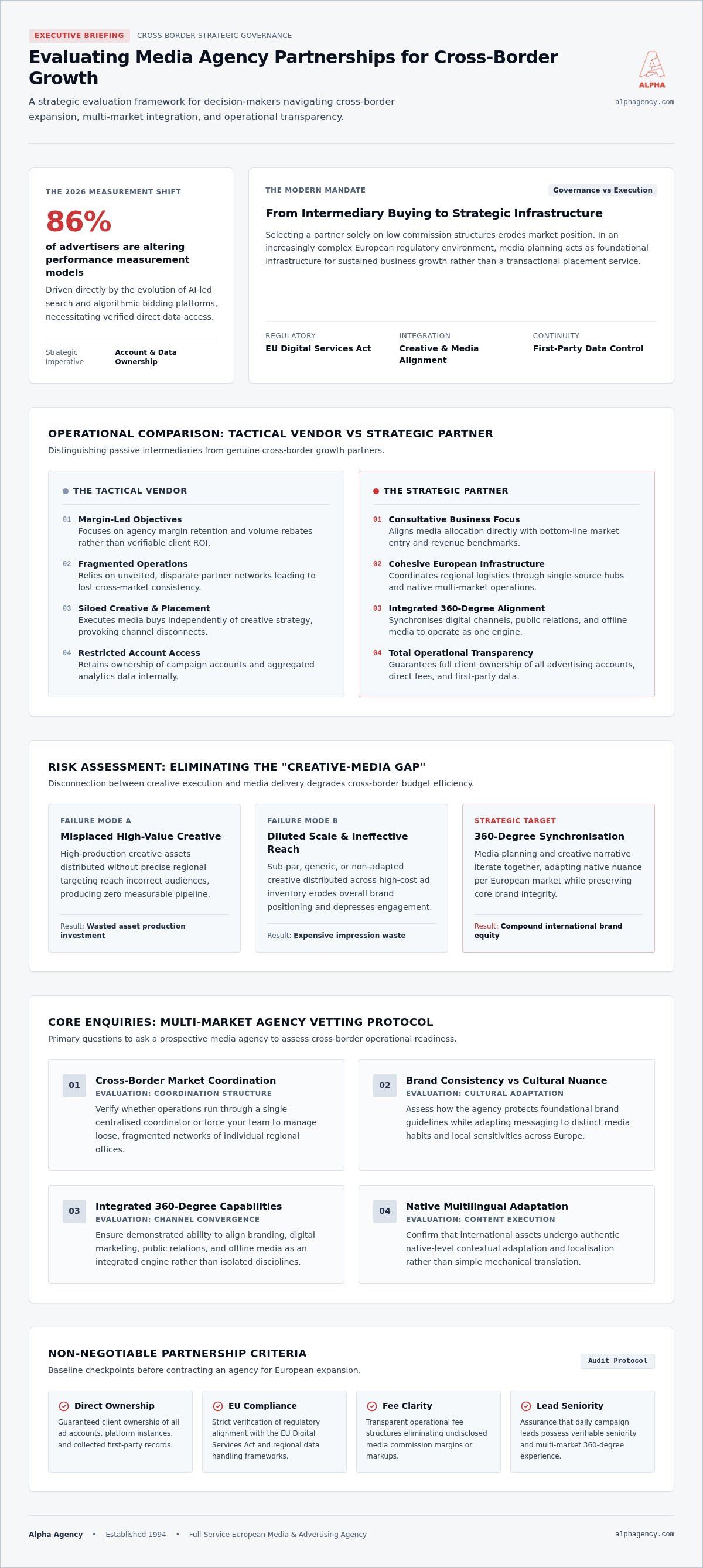
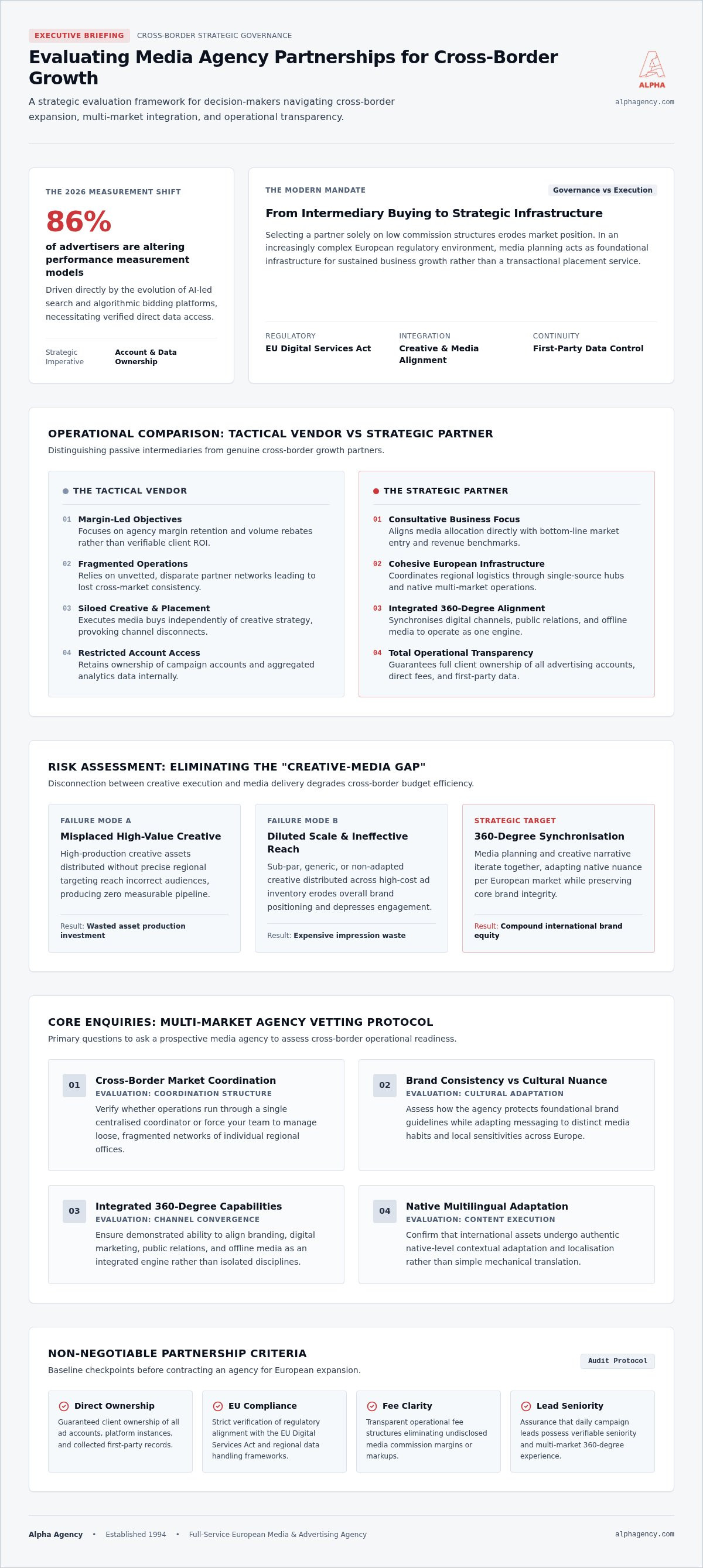
The traditional model of treating a media agency as a mere intermediary for ad placements is obsolete. In 2026, media buying serves as a foundational infrastructure for growth, not just a line item for visibility. If your vetting process relies on static checklists from five years ago, you risk partnering with a vendor that lacks the strategic depth to navigate a landscape defined by AI-driven bidding and strict EU privacy regulations. A strategic upgrade in your selection process is required to ensure your budget isn't wasted on fragmented campaigns that fail to resonate across borders.
Standard queries about agency size or client lists often fail to uncover deep-seated operational limitations. You need specific questions to ask a potential media agency that probe their ability to integrate branding with performance data. Without this alignment, brands often suffer from a "creative-media gap" where high-quality content is delivered to the wrong audience, or low-quality creative erodes expensive reach. The cost of a poor fit is significant, leading to inefficient spend and a diluted brand identity that struggles to adapt to local market nuances in Europe.
The Difference Between a Vendor and a Strategic Partner
Vendors operate as order-takers, executing tasks without questioning the underlying business logic. A strategic partner, like Alpha Agency, acts as a high-level consultant that understands the bigger picture of market presence. You can spot a vendor by their focus on their own margins rather than your ROI. In contrast, a partner ensures that branding and advertising work in tandem from the outset. This holistic approach is essential for integrated 360-degree campaigns where every touchpoint, from OOH to digital marketing, reinforces a single strategic objective.
Setting Your Internal Objectives Before the First Meeting
Before you begin evaluating questions to ask a potential media agency, you must define your internal benchmarks. Determine whether your primary goal is rapid market entry, long-term brand awareness, or performance-led lead generation. This clarity dictates the level of agency involvement you require. Are you looking for hands-on execution or high-level consultative strategy? You must also establish a baseline for data ownership. With 86% of advertisers changing how they measure performance due to AI-driven search, ensuring you own your ad accounts and first-party data is a non-negotiable requirement for long-term stability.
Evaluating Cross-Border and Integrated Capabilities
Managing a brand across the European Union requires more than a central spreadsheet. It demands a sophisticated understanding of varying regulatory environments, such as the EU Digital Services Act, and distinct media consumption habits. Specific questions to ask a potential media agency should focus on their structural readiness for international growth. If an agency relies on a loose network of disparate partners rather than owned offices or a unified strategic hub, your campaign risks becoming fragmented and inefficient.
To identify a partner capable of driving cross-border success, your vetting process must include these four critical enquiries:
- How do you coordinate campaigns across multiple European markets? Look for a central point of contact that manages regional logistics rather than forcing you to communicate with multiple local offices.
- How do you balance global brand consistency with local cultural nuance? A partner must prove they can adapt a core message without losing the brand's identity or violating local norms.
- Can you demonstrate expertise in integrated 360-degree marketing campaigns? Effective strategy requires digital marketing, public relations, and offline media to work as a single engine.
- What is your process for multilingual content production and adaptation? Successful market entry relies on native-level adaptation, not just literal translation of creative assets.
Navigating Regional Nuance and Market Entry
Effective vetting and onboarding agencies involves digging into how they handle regional logistics. You need to know how they manage offline media buying, such as TV and OOH, in markets with vastly different pricing structures and regulations. Alpha Agency leverages 25 years of experience to navigate these complexities, ensuring that your media plan respects local habits while maintaining a broad strategic vision. Distinguishing between an agency's owned offices and their partner locations is vital, as owned infrastructure typically offers higher levels of accountability and data security.
The Power of Integrated Media and Creative
Creative concepts must be built for specific media placements, not adapted as an afterthought. When you consider questions to ask a potential media agency, probe the synergy between their digital teams and their public relations specialists. In a 2026 landscape where AI-driven search influences discovery, your media and creative pillars must be perfectly aligned to maintain authority. Look for evidence of this integration in their previous international work, specifically within destination marketing or retail sectors where multi-channel presence is mandatory. If you are planning a complex expansion, you might want to review how these integrated strategies have delivered measurable growth for other European brands.
Uncovering Transparency in Media Buying and Data Analytics
Transparency is the bedrock of a sustainable partnership. In a market where AI-driven bidding can often feel like a black box, you must ensure that every Euro of your budget is accounted for. The most critical questions to ask a potential media agency revolve around their financial integrity and their technical approach to data. Without absolute clarity on these points, your brand risks hidden markups and a lack of control over its own digital assets.
To verify that an agency operates with your best interests in mind, demand specific answers to these four queries:
- What is your exact fee structure for media planning and buying? You need to know if they use a percentage-of-spend model, flat project fees, or a hybrid approach.
- Who owns the data and the ad accounts at the end of the contract? Your brand should retain full ownership of all platform accounts and historical data.
- How do you handle attribution across digital and offline channels? A partner must explain how they measure the impact of TV or OOH advertising alongside digital marketing metrics.
- What tools do you use for real-time campaign optimisation? Ask for the specific tech stack they use to adjust bids and creative performance on the fly.
Demanding Pricing Clarity
Traditional percentage-of-spend models can sometimes incentivise agencies to increase your budget rather than improve your ROI. You should prioritise partners who offer transparent project fees or clear management costs. Alpha Agency addresses this need through its Campaign Builder, an interactive planner where users select objectives, markets, and services to receive transparent pricing. Because Alpha specialists review every campaign before launch, you get the efficiency of online ordering with the strategic oversight of a seasoned professional. Red flags to watch for include vague "management fees" or a refusal to disclose the net cost of media placements.
Data Ownership and Reporting Standards
Direct access to analytics and platform dashboards is non-negotiable. If an agency insists on providing only curated PDF reports, they are likely obscuring performance gaps. You need custom reporting that aligns with business-level KPIs, not just vanity metrics like impressions. As 71% of brands and agencies are now actively growing their first-party data, your partner must have a robust strategy for a post-cookie environment. Even though Google has maintained third-party cookies in Chrome, the industry's shift toward privacy-first data clean rooms and first-party collection is essential for complying with the EU Digital Services Act and reaching audiences on browsers like Safari and Firefox.
Assessing the Partnership: Talent, Workflow, and Cultural Fit
The human architecture of a partnership is just as vital as the technology powering the campaigns. Even the most sophisticated AI bid-optimisation tools require senior strategic supervision to ensure they align with long-term business goals. When you reach the final stages of your evaluation, the questions to ask a potential media agency must pivot toward the people, processes, and industry-specific wisdom they bring to the table. A failure to vet the team's operational structure often leads to high turnover and fragmented communication, which ultimately erodes campaign performance.
Ensure you gain definitive answers to these four partnership-focused enquiries:
- Who will be the day-to-day lead on our account? You need to know if you're working with a senior strategist or a junior execution staffer.
- How do you manage communication for complex, multi-stakeholder projects? Look for a unified workflow that reduces friction across your branding, media, and PR pillars.
- What is your approach to B2B buying cycles vs. retail consumer brands? The strategy for a long-cycle industrial purchase differs fundamentally from a fast-moving consumer brand.
- How do you handle crisis communication or rapid market shifts? A partner must demonstrate the agility to reallocate budgets or adjust messaging during unforeseen market volatility.
The Seniority Gap: Who is Actually Doing the Work?
A common industry pitfall is the "bait and switch," where senior leaders pitch the business but junior staff execute the daily tasks. You should ask about the specific ratio of senior strategists to execution staff assigned to your account. Alpha Agency maintains a high-touch model where seasoned experts remain involved in the strategic progression of every project. This seniority ensures long-term continuity and prevents the loss of institutional knowledge. A "one-stop-shop" model, which integrates services from media planning and buying to digital marketing, further reduces communication friction by eliminating the need to coordinate between multiple siloed vendors.
Industry-Specific Expertise
Success metrics vary wildly across sectors. In destination marketing for the public sector, success might be measured by intent-to-visit or public awareness; in retail, it's often immediate e-commerce conversion. You need a partner that understands these distinctions. For industrial B2B clients, the agency must grasp complex lead-nurturing journeys that span months, not minutes. Evaluate their past performance in your specific niche to ensure they don't apply a generic retail template to a specialized B2B cycle. This depth of understanding is what separates a tactical service provider from a strategic visionary.
Learn more about our strategic approach
Strategic Next Steps: How Alpha Agency Redefines the Partnership
Alpha Agency's heritage as an independent European strategist provides the foundation for brands seeking more than just ad placements. Established in 1994, we've mastered the complexities of international market entry, ensuring that your branding, media, and PR work as a single, cohesive engine. By addressing the critical questions to ask a potential media agency, you've already identified the need for transparency and strategic depth. Alpha Agency meets these requirements by functioning as a total solution provider, bridging the gap between high-level vision and granular execution.
The Alpha Approach to Cross-Border Growth
Operating from a central strategic hub allows us to maintain absolute control over campaign quality across multiple European territories. We don't just place ads; we coordinate entire ecosystems. Our methodology combines the broad reach of offline media buying with the precision of high-performance digital marketing. This ensures that a brand entering a new market remains culturally relevant while benefiting from the efficiencies of centralised planning. You can explore our full range of capabilities by reviewing our Alpha Agency Services.
Planning Your Next Campaign with Confidence
Modern brand leaders require speed without sacrificing strategic oversight. Our Campaign Builder is designed to provide this balance. It's an interactive planner where you can select specific objectives, target markets, and required services to receive transparent pricing instantly. Unlike fully automated platforms, every campaign drafted in the builder undergoes a specialist review before launch. This human-led governance ensures that the strategic nuances discussed throughout your vetting process are actually implemented. To see how these integrated strategies translate into real-world growth, you can browse our previous projects through Alpha Agency Work.
Identifying the right partner is the first step toward cross-border campaign success. If you're managing several markets or preparing for a complex market entry, the questions to ask a potential media agency should lead you to a partner with proven European expertise. We invite you to begin a deeper discussion about your specific cross-border challenges and how a unified approach to strategy and creativity can drive your brand forward.
Securing Your Brand's Future in the European Market
Vetting a media partner in 2026 requires looking far beyond basic ad placements. It demands a focus on strategic integration, cross-border capability, and absolute financial transparency. By refining your list of questions to ask a potential media agency, you ensure that your chosen partner possesses the depth to navigate complex regulatory environments and AI-driven market shifts. A high-performing partner doesn't just execute orders; they provide the strategic governance necessary to protect your brand's identity across diverse territories.
Alpha Agency provides the stability of 25 years of cross-border expertise combined with modern, transparent tools. Our Campaign Builder eliminates pricing ambiguity, while our full-service model ensures seamless integration from branding to media buying. We're ready to help you transform these strategic insights into measurable growth through a unified approach that respects local nuances while maintaining global authority. Your brand deserves a partner that understands the bigger picture of European expansion and has the proven track record to deliver results.
Plan your next campaign with Alpha Agency
We look forward to helping you navigate the complexities of international growth with confidence and precision.
Frequently Asked Questions
What is the most important question to ask a media agency during a pitch?
The most critical question concerns how the agency aligns media placement with your long-term business strategy rather than just tactical execution. You should ask how they integrate branding and advertising to ensure creative output matches media performance. This inquiry reveals if they're a mere vendor or a strategic partner. It's one of the essential questions to ask a potential media agency to identify a partner capable of driving growth across European markets.
How do media agencies typically structure their fees for international campaigns?
Fee structures for international campaigns typically include strategic planning fees, media buying commissions, or transparent project-based management fees. Many modern agencies now use hybrid models to ensure clarity across borders. Alpha Agency prioritises transparency through our Campaign Builder, which allows leaders to select objectives and markets with clear pricing upfront. This approach avoids the hidden markups often associated with traditional percentage-of-spend models, ensuring every Euro is strategically accounted for.
Should I choose a specialised digital agency or a full-service media agency?
Choosing a full-service media agency is usually superior for brands seeking integrated 360-degree success. While specialised digital agencies excel in narrow tactics, they often lack the breadth to coordinate offline media buying, public relations, and branding under one roof. A full-service partner ensures that your creative concept is built for specific media placements from the start. This integration prevents the fragmented brand identity that often occurs when managing multiple siloed vendors.
How can I verify an agency’s claims about their cross-border reach?
You can verify cross-border claims by examining an agency's documented track record in specific sectors like tourism or retail. Asking for evidence of integrated campaigns that navigated different regulations is one of the key questions to ask a potential media agency. A truly international partner will have a long heritage of managing regional logistics from a central hub. Demand specific case studies showing how they managed campaigns across multiple European borders.
What is the difference between a partner location and a primary agency office?
A primary agency office is an owned location with direct strategic control, while a partner location is an external firm used for local execution. You should prioritise agencies with owned offices in your key markets for higher accountability and data security. Relying on disparate partner networks can lead to communication friction and inconsistent quality. Alpha Agency distinguishes its primary offices from partner locations to ensure clients understand exactly who is managing their strategic assets.
How does an integrated 360-degree campaign differ from standard multi-channel marketing?
Integrated 360-degree campaigns function as a single, unified engine where media planning and creative development happen simultaneously. Standard multi-channel marketing often involves simply placing the same creative assets across different platforms without strategic adaptation. In a 360-degree model, digital marketing, OOH, and PR work in tandem to reinforce a single objective. This holistic approach is vital for complex market entry where consistency and cultural relevance are both mandatory for success.
What role does public relations play in a modern media strategy?
Public relations provides the strategic authority and reputation management that paid media cannot achieve alone. In a modern media strategy, PR acts as a force multiplier, building trust and credibility that improves the performance of your advertising spend. It's particularly effective for destination marketing and public sector communications where public awareness is the primary goal. Integrating PR with your media buying ensures a consistent message across earned, owned, and paid channels.
How often should a media agency provide reporting and optimisation updates?
An agency should provide real-time dashboard access for daily performance monitoring alongside deeper strategic monthly reviews. High-performing partners use real-time campaign optimisation tools to adjust bids and creative assets based on immediate data. This ensures your budget is never wasted on underperforming placements. Regular reporting should focus on business-level KPIs and ROI, providing the transparency needed to make informed decisions about future cross-border expansion and market entry strategies.
The Seniority Gap: Who is Actually Doing the Work?
A common industry pitfall is the "bait and switch," where senior leaders pitch the business but junior staff execute the daily tasks. You should ask about the specific ratio of senior strategists to execution staff assigned to your account. Alpha Agency maintains a high-touch model where seasoned experts remain involved in the strategic progression of every project. This seniority ensures long-term continuity and prevents the loss of institutional knowledge. A "one-stop-shop" model, which integrates services from media planning and buying to digital marketing, further reduces communication friction by eliminating the need to coordinate between multiple siloed vendors.
What is the most important question to ask a media agency during a pitch?
The most critical question concerns how the agency aligns media placement with your long-term business strategy rather than just tactical execution. You should ask how they integrate branding and advertising to ensure creative output matches media performance. This inquiry reveals if they're a mere vendor or a strategic partner. It's one of the essential questions to ask a potential media agency to identify a partner capable of driving growth across European markets.
How do media agencies typically structure their fees for international campaigns?
Fee structures for international campaigns typically include strategic planning fees, media buying commissions, or transparent project-based management fees. Many modern agencies now use hybrid models to ensure clarity across borders. Alpha Agency prioritises transparency through our Campaign Builder, which allows leaders to select objectives and markets with clear pricing upfront. This approach avoids the hidden markups often associated with traditional percentage-of-spend models, ensuring every Euro is strategically accounted for.
Should I choose a specialised digital agency or a full-service media agency?
Choosing a full-service media agency is usually superior for brands seeking integrated 360-degree success. While specialised digital agencies excel in narrow tactics, they often lack the breadth to coordinate offline media buying, public relations, and branding under one roof. A full-service partner ensures that your creative concept is built for specific media placements from the start. This integration prevents the fragmented brand identity that often occurs when managing multiple siloed vendors.
How can I verify an agency’s claims about their cross-border reach?
You can verify cross-border claims by examining an agency's documented track record in specific sectors like tourism or retail. Asking for evidence of integrated campaigns that navigated different regulations is one of the key questions to ask a potential media agency. A truly international partner will have a long heritage of managing regional logistics from a central hub. Demand specific case studies showing how they managed campaigns across multiple European borders.
What is the difference between a partner location and a primary agency office?
A primary agency office is an owned location with direct strategic control, while a partner location is an external firm used for local execution. You should prioritise agencies with owned offices in your key markets for higher accountability and data security. Relying on disparate partner networks can lead to communication friction and inconsistent quality. Alpha Agency distinguishes its primary offices from partner locations to ensure clients understand exactly who is managing their strategic assets.
How does an integrated 360-degree campaign differ from standard multi-channel marketing?
Integrated 360-degree campaigns function as a single, unified engine where media planning and creative development happen simultaneously. Standard multi-channel marketing often involves simply placing the same creative assets across different platforms without strategic adaptation. In a 360-degree model, digital marketing, OOH, and PR work in tandem to reinforce a single objective. This holistic approach is vital for complex market entry where consistency and cultural relevance are both mandatory for success.
What role does public relations play in a modern media strategy?
Public relations provides the strategic authority and reputation management that paid media cannot achieve alone. In a modern media strategy, PR acts as a force multiplier, building trust and credibility that improves the performance of your advertising spend. It's particularly effective for destination marketing and public sector communications where public awareness is the primary goal. Integrating PR with your media buying ensures a consistent message across earned, owned, and paid channels.
How often should a media agency provide reporting and optimisation updates?
An agency should provide real-time dashboard access for daily performance monitoring alongside deeper strategic monthly reviews. High-performing partners use real-time campaign optimisation tools to adjust bids and creative assets based on immediate data. This ensures your budget is never wasted on underperforming placements. Regular reporting should focus on business-level KPIs and ROI, providing the transparency needed to make informed decisions about future cross-border expansion and market entry strategies.