
A polished campaign can still miss the mark if it solves the wrong problem. The brief should define the business decision behind the work, not prescribe every creative move. That’s the principle at the heart of how to write an advertising agency brief that gives an agency clear direction while leaving room for its expertise.
It’s understandable to focus on the creative idea or list the deliverables first. But without agreement on the objective, audience, markets, budget and measures of success, stakeholders can pull the work in different directions, and avoidable rework can follow. For campaigns spanning several markets, unclear language or local requirements can also weaken consistency and relevance.
This article sets out what an effective brief should contain and how to make it decision-ready. You’ll learn how to connect business goals to audience insight, define scope and constraints, clarify approvals, and establish how success will be assessed. The result is a shared foundation for the agency to recommend the right combination of strategy, creativity, media and communications.
Key Takeaways
- Define the business decision the campaign needs to support before listing deliverables or creative preferences.
- When considering how to write an advertising agency brief, connect each section to a clear decision and the evidence the agency needs.
- For cross-border work, specify each market’s audiences, languages and local context while allowing the agency to recommend channel roles.
- Set scope, constraints, approval responsibilities and success measures before work begins to reduce ambiguity and guide evaluation.
- Assess agency recommendations against the brief, then ask about the rationale, trade-offs and how results will be measured.
What an advertising agency brief must achieve before work begins
A brief is useful when it helps people make the same decisions before time and budget are committed. It connects a business need to agency recommendations by setting out the context, boundaries and outcome the work must support. It should clarify the challenge, not assume the client already knows the right campaign, channel or creative idea.
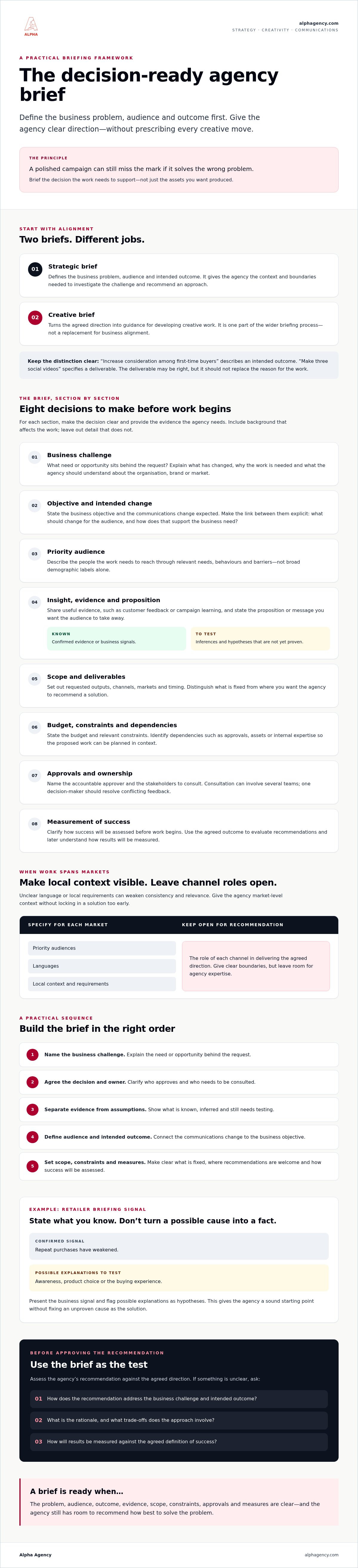
A strategic brief defines the business problem, audience and intended outcome; a creative brief turns that agreed direction into guidance for developing creative work. The Creative brief is therefore one part of the wider briefing process, not a substitute for aligning on what the business needs to achieve.
What does an advertising agency brief do?
A strong brief gives the agency enough information to investigate the challenge, identify gaps and recommend an approach. It distinguishes the desired result from the work that might help deliver it. “Increase consideration among first-time buyers” describes an intended outcome; “make three social videos” specifies a deliverable. The latter may be appropriate, but it shouldn’t replace the reason for doing the work.
An internal project request often records what a team wants produced. A finished concept goes further and prescribes the solution. The agency brief sits between them: it sets clear objectives and constraints, while leaving room for professional judgement. That distinction matters when strategy, advertising, media planning, public relations or digital activity may need to work together.
What to decide before drafting the brief
Before writing, agree on the decision the work must support and who has authority to approve it. Consultation can involve several teams, but one accountable decision-maker should resolve conflicting feedback. Otherwise, the agency may receive competing priorities without knowing which one takes precedence.
- State the business challenge: identify the need or opportunity behind the request.
- Clarify ownership: name the approver and the stakeholders to consult.
- Separate evidence from assumptions: mark what is known, what is inferred and what needs testing.
For example, a retailer might know that repeat purchases have weakened, but not yet know whether the cause is awareness, product choice or the buying experience. The brief should present the confirmed business signal and flag possible explanations as hypotheses, rather than treating one as proven. This gives the agency a sound starting point for recommendations and prevents an early assumption from becoming a fixed execution.
In practice, how to write an advertising agency brief begins with alignment on the problem, the scope of the decision and who will make it. Once these are clear, the brief can guide the work without trying to dictate every step.
The essential sections every advertising agency brief should include
A useful brief is complete enough to support a recommendation, not crowded with background that won’t affect the work. For each section, make a decision and provide the evidence behind it. The AMA Creative Brief Template offers a practical structure to adapt, but tailor it to the decisions your project requires.
Objectives, audience and the evidence behind them
Start with context: what has changed, why the work is needed and what the agency should understand about the organisation, brand or market. Then state the business objective and the communications change expected. A goal such as “grow sales” needs more direction. Specify the intended shift, such as increasing consideration among a defined audience, and explain how that shift supports the business objective.
Describe priority audiences through relevant needs, behaviours and barriers, rather than relying only on broad demographic labels. Include the insight that should shape the work, and the proposition or message you want the audience to take away. Attach useful evidence, such as existing customer feedback or campaign learning, and label assumptions that still need testing. The distinction helps the agency build on what’s known without treating a hypothesis as fact.
Scope, deliverables, budget and measurement
Set out the requested outputs, channels, markets and timing, along with dependencies such as approvals, assets or internal expertise. Make clear which elements are fixed and where recommendations are welcome. If work spans markets, identify the languages and local context that may affect how a common proposition is expressed.
State the approved budget if available. If it hasn’t been agreed, say so and clarify who will decide it and when. Avoid implying a budget that stakeholders haven’t approved. Then define how success will be assessed: name the measures, data sources, reporting owner and points when decisions will be reviewed. Measures should reflect the objective, not simply the activity delivered.
A concise checklist for your internal brief
- Context: What prompted the work, and what background changes the recommendation?
- Objective and audience: What business result and audience response are sought?
- Insight and proposition: What evidence informs the message, and what should the audience understand or do?
- Scope and timing: Which outputs, channels, markets, languages, milestones and dependencies are in scope?
- Budget and measurement: What is approved, how will success be judged, and who owns reporting and decisions?
This structure makes how to write an advertising agency brief a practical alignment exercise, not a form-filling task. Adapt the sections to the scale of the assignment, and explore Alpha Agency’s advertising and media services if you’re considering which disciplines your brief needs to cover.
How to brief an agency across channels and markets without overprescribing
An integrated brief should explain how the work needs to function across channels and markets, without locking the agency into tactics before it has assessed the challenge. Name the objective and audience first. Then describe what each channel needs to contribute, where coordination matters and what the agency is free to recommend.
Briefing an integrated campaign across channels
Give channels a purpose, not just a place in a deliverables list. For example, if a campaign needs to build awareness and then prompt consideration, ask the agency to recommend how advertising, public relations, digital activity or events could support those stages. The brief can identify known requirements, such as an existing website or a fixed event date, while leaving the channel mix open to evaluation.
Flag dependencies early. A media plan may rely on creative assets; digital activity may need a destination page; public relations may require spokespeople or approved information. Ask the agency to explain how its recommendations link to the objective, what trade-offs they involve and how the channels will work together. This keeps the discussion grounded in the brief rather than individual preferences.
What changes when a brief covers several markets?
A single-market brief can focus on one audience and its context. A cross-border brief needs to identify each intended market and the business reason for including it, then make clear what is shared and what may differ. Specify known language needs, audience distinctions, available local input and who approves market-specific work. If some details are unresolved, mark them for investigation rather than presenting assumptions as facts.
Set the boundaries of adaptation. Non-negotiable elements might include the brand name, core proposition or visual identity. Elements such as examples, imagery, wording or channel emphasis may need local consideration. The aim is consistency in what the brand stands for, with enough flexibility for communication to feel relevant to each audience.
| Useful requirement | Premature execution instruction |
|---|---|
| Reach priority audiences across the selected markets. | Use the same media mix and spend split in every market. |
| Keep the core proposition consistent while allowing locally relevant expression. | Translate the master creative word for word. |
| Recommend channels that support awareness and consideration. | Commit to named placements before the agency assesses audience and context. |
| Identify dependencies, approval owners and local inputs. | Assume every market can use identical assets and timelines. |
These distinctions make how to write an advertising agency brief especially important for multi-market work: define the outcome and the guardrails, then invite a reasoned recommendation on execution.
How to write an advertising agency brief in a practical sequence
A brief is easier to approve when it’s built in the right order: start with the business challenge, then define what the agency needs to know and what decisions it should help make. This sequence turns how to write an advertising agency brief into a focused working process, while making gaps visible before they become blockers.
Build the brief from the business problem
Write the problem in plain language before listing deliverables. Separate one primary objective from secondary aims, and support the challenge with evidence or clearly labelled assumptions. For example, replace “Create a set of social posts” with “Help more first-time buyers consider our online store”. The posts may still be useful, but the agency can now assess whether they are the right response.
- 1. Frame the challenge. Explain what has prompted the work and why it matters to the organisation now.
- 2. Set the objective. Choose the main business outcome and describe the change communications should support. List secondary objectives separately.
- 3. Define the audience. Identify who the work needs to reach, what they need or do, and what evidence supports that view.
- 4. Set scope and constraints. Record markets, required outputs, timing, budget status, dependencies and approval responsibilities. Mark what is fixed and where the agency can recommend an approach.
- 5. Agree measurement. Specify how success will be assessed, which data sources are available and who will review results.
Not every question needs an answer before the agency conversation. Add an “open questions” list for gaps such as unconfirmed audience behaviour, market differences or available data. For each, note who can provide an answer, when it is needed and whether the agency should help investigate it. This keeps uncertainty visible without disguising it as fact or holding up useful discussion.
Review the brief before sharing it
Check that the parts work together. A fixed launch date should align with the approval schedule; the scope should reflect the budget’s status; and each success measure should have a data source and owner. Remove subjective directions such as “make it more exciting” unless you can explain what audience response or brand requirement sits behind them. Before sending, ask the accountable decision-maker and relevant stakeholders to confirm that they agree on the objective, scope and approval route.
For an overview of the disciplines that can support a campaign, see Alpha Agency’s advertising and media services.
How to use the brief for a productive agency partnership
A brief is also a reference point for evaluating recommendations. Use it to test whether the proposed direction responds to the business challenge, speaks to the intended audience and respects the agreed constraints. The strongest discussion focuses on the reasoning behind the recommendation, not whether it matches an early preference for a particular deliverable.
Evaluate recommendations, not just proposed deliverables
Ask the agency to connect its strategic choices to the brief: why this audience, why these channels, and how will the work contribute to the objective? Check what evidence supports the recommendation and which assumptions need validation. If the agency proposes a different scope from the one requested, ask what the change enables and what it leaves out.
Trade-offs deserve a clear conversation. A plan may prioritise reach over depth, or consistency across markets over extensive local variation. Neither is automatically right. Compare the implications with your objectives, audience needs, timing and budget constraints before approving the scope or creative direction. Alpha Agency’s documented work can provide context on its projects, but judge any recommendation against the requirements of your own brief.
Agree the next steps with the agency
Once the direction is agreed, confirm who makes decisions, who provides feedback and how that feedback will be consolidated. Record immediate dependencies, such as access to brand assets, market input or measurement data, and agree when each is needed. This gives both teams a practical basis for moving from recommendation to delivery.
Discovery may reveal that an assumption was wrong or that important information is missing. Treat that as a reason to revisit the brief together, not as a reason to press ahead with an outdated premise. Update the objective, scope or measures where needed, and make sure the decision owner approves material changes. A brief should keep the work aligned as understanding develops.
For integrated assignments, the relevant capabilities may span branding and advertising, media and digital, public relations, destination marketing, sport marketing and events, or below-the-line activity. Alpha Agency offers integrated services across these disciplines, which can help organisations consider how different parts of a campaign fit together. Understanding how to write an advertising agency brief is only the start; a productive partnership depends on testing recommendations together and keeping decisions clear.
To discuss your project with Alpha Agency, use the services overview below.
Turn a clear brief into better agency decisions
A strong brief connects a business challenge to a measurable objective, gives the agency relevant audience and market context, and sets clear boundaries without prescribing every execution. It also makes responsibilities and open questions visible, so client and agency can evaluate recommendations against shared criteria.
Knowing how to write an advertising agency brief means being precise about the outcome and flexible about the route. That balance matters even more across channels or markets, where consistent brand direction must work alongside local audience needs. Use the brief as a working agreement, and revisit it together if discovery changes the assumptions or scope.
Alpha Agency is a full-service media and advertising agency offering branding and advertising, media and digital, public relations, destination marketing, sport marketing and events, and below-the-line marketing. Its integrated services can support campaigns that bring several disciplines together.
With clear decisions at the centre, your brief can give the partnership a practical starting point and help move the work forward with purpose.
Discuss your project with Alpha Agency
Frequently Asked Questions
What is an advertising agency brief?
An advertising agency brief is a working document that explains the business problem, intended audience, objectives, scope and constraints behind a project. It gives the agency enough context and evidence to assess the challenge and recommend an approach. A good brief sets direction without dictating every creative choice. It also identifies how the client and agency will judge whether the work has succeeded, so recommendations and results can be assessed against agreed criteria.
What should I include in an advertising agency brief?
Include business context, the problem or opportunity, objectives, priority audiences, supporting evidence, the desired response, scope, markets, timing, budget status, constraints, stakeholders and success measures. Add existing brand or campaign materials if they affect the work. Explain which details are confirmed and which remain assumptions. The aim of how to write an advertising agency brief is to give the agency decision-relevant information, not an archive of background documents that don’t change the recommendation.
How long should an agency brief be?
There’s no fixed length for an effective agency brief. Keep it concise, but include the context, evidence and decisions the agency needs to respond thoughtfully. A short document can still be unclear if it omits audience needs or constraints; a long one can obscure priorities by repeating background. For integrated or multi-market work, attach supporting material and signpost the specific information that affects decisions rather than placing every detail in the main brief.
Can one brief cover several markets or languages?
Yes, one brief can cover several markets or languages if it distinguishes shared requirements from local differences. Identify the intended markets, languages, audience considerations, available local input and known approval needs. State which brand elements must remain consistent and where local expression may need to change. Don’t assume audiences or communication needs are identical across markets. Flag unknowns clearly and ask the agency to identify what should be investigated before recommendations are finalised.
Should an advertising agency brief include a budget?
Yes, include the approved budget if it’s available, and clarify what it covers, such as media, creative work or other project requirements. If the budget hasn’t been approved, state that clearly and explain any constraints on the decision. This helps the agency assess whether the proposed scope is workable and develop relevant recommendations. An unsupported industry benchmark isn’t a substitute for your organisation’s own budget planning or approval.
What is the difference between an agency brief and a creative brief?
An agency brief sets out the wider business and campaign context, including objectives, audiences, markets, scope, constraints and measures of success. A creative brief translates an agreed strategy into direction for a specific creative task. The two documents may overlap, depending on the project. The practical distinction is to establish the business problem and intended outcome before settling on a creative solution, so execution serves a clear purpose.
What does an advertising agency brief do?
A strong brief gives the agency enough information to investigate the challenge, identify gaps and recommend an approach. It distinguishes the desired result from the work that might help deliver it. “Increase consideration among first-time buyers” describes an intended outcome; “make three social videos” specifies a deliverable. The latter may be appropriate, but it shouldn’t replace the reason for doing the work. An internal project request often records what a team wants produced. A finished concept goes further and prescribes the solution. The agency brief sits between them: it sets clear objectives and constraints, while leaving room for professional judgement. That distinction matters when strategy, advertising, media planning, public relations or digital activity may need to work together.
What changes when a brief covers several markets?
A single-market brief can focus on one audience and its context. A cross-border brief needs to identify each intended market and the business reason for including it, then make clear what is shared and what may differ. Specify known language needs, audience distinctions, available local input and who approves market-specific work. If some details are unresolved, mark them for investigation rather than presenting assumptions as facts. Set the boundaries of adaptation. Non-negotiable elements might include the brand name, core proposition or visual identity. Elements such as examples, imagery, wording or channel emphasis may need local consideration. The aim is consistency in what the brand stands for, with enough flexibility for communication to feel relevant to each audience. These distinctions make how to write an advertising agency brief especially important for multi-market work: define the outcome and the guardrails, then invite a reasoned recommendation on execution. A brief is easier to approve when it’s built in the right order: start with the business challenge, then define what the agency needs to know and what decisions it should help make. This sequence turns how to write an advertising agency brief into a focused working process, while making gaps visible before they become blockers.
What is an advertising agency brief?
An advertising agency brief is a working document that explains the business problem, intended audience, objectives, scope and constraints behind a project. It gives the agency enough context and evidence to assess the challenge and recommend an approach. A good brief sets direction without dictating every creative choice. It also identifies how the client and agency will judge whether the work has succeeded, so recommendations and results can be assessed against agreed criteria.
What should I include in an advertising agency brief?
Include business context, the problem or opportunity, objectives, priority audiences, supporting evidence, the desired response, scope, markets, timing, budget status, constraints, stakeholders and success measures. Add existing brand or campaign materials if they affect the work. Explain which details are confirmed and which remain assumptions. The aim of how to write an advertising agency brief is to give the agency decision-relevant information, not an archive of background documents that don’t change the recommendation.
How long should an agency brief be?
There’s no fixed length for an effective agency brief. Keep it concise, but include the context, evidence and decisions the agency needs to respond thoughtfully. A short document can still be unclear if it omits audience needs or constraints; a long one can obscure priorities by repeating background. For integrated or multi-market work, attach supporting material and signpost the specific information that affects decisions rather than placing every detail in the main brief.
Can one brief cover several markets or languages?
Yes, one brief can cover several markets or languages if it distinguishes shared requirements from local differences. Identify the intended markets, languages, audience considerations, available local input and known approval needs. State which brand elements must remain consistent and where local expression may need to change. Don’t assume audiences or communication needs are identical across markets. Flag unknowns clearly and ask the agency to identify what should be investigated before recommendations are finalised.
Should an advertising agency brief include a budget?
Yes, include the approved budget if it’s available, and clarify what it covers, such as media, creative work or other project requirements. If the budget hasn’t been approved, state that clearly and explain any constraints on the decision. This helps the agency assess whether the proposed scope is workable and develop relevant recommendations. An unsupported industry benchmark isn’t a substitute for your organisation’s own budget planning or approval.
What is the difference between an agency brief and a creative brief?
An agency brief sets out the wider business and campaign context, including objectives, audiences, markets, scope, constraints and measures of success. A creative brief translates an agreed strategy into direction for a specific creative task. The two documents may overlap, depending on the project. The practical distinction is to establish the business problem and intended outcome before settling on a creative solution, so execution serves a clear purpose.