
A PR agency isn’t the answer to every communications problem. The right time to ask when to hire a PR agency is when a defined need, such as entering a new market, managing a reputational issue or sustaining media activity, calls for expertise or capacity your team can’t reliably provide.
It’s reasonable to hesitate. An external team needs to understand your organisation, audiences and priorities, and the work needs a clear scope and ways to assess progress. Without those foundations, even experienced support can miss the mark. The decision isn’t simply agency or in-house: the right fit may be an internal hire, a focused agency brief or a hybrid arrangement.
This practical framework will help you identify when external PR expertise could add value, compare agency support with internal and hybrid options, and clarify objectives, responsibilities and success measures before approaching a provider. It also considers how PR can connect with wider brand, media and digital activity when your brief spans markets or channels.
Key Takeaways
- Consider when to hire a PR agency by checking whether a specific, ongoing communications need exceeds your team’s capacity or expertise.
- Define the agency’s remit around your objectives, audience and required support before discussing tactics or media coverage.
- Compare agency, in-house and hybrid models against your needs for specialist expertise, continuity, workload and flexibility.
- Before requesting proposals, document the scope, internal owner and how you’ll evaluate progress, then give each agency the same brief.
- Check whether PR needs to connect with wider brand, media or digital activity, particularly when communicating across markets or languages.
When to hire a PR agency: recognise the communications need
Hire a PR agency when a defined communications need exceeds your organisation’s internal capacity or expertise. That need might be an ongoing challenge reaching relevant media or stakeholder audiences, a launch that requires coordinated communications, or entry into a market where your team lacks relationships or local insight.
The key distinction is whether communications supports an ongoing business objective or whether the organisation simply wants more publicity. A temporary desire for attention may not justify agency support. A persistent gap, with a clear audience and business reason behind it, is a stronger case. Public relations (PR) is a planned form of communication with publics, so start with what the organisation needs to communicate and why, not with a request for coverage alone.
Which communications problems call for outside PR support?
Outside support may be useful when relevant media or stakeholders remain difficult to reach despite consistent effort, or when an announcement needs careful planning and delivery. Market entry, a product or destination launch, a complex organisational change and a reputation issue can all create a need for specialist input. The scope will vary: an urgent challenge calls for defined, immediate support, while an ongoing strategic need requires sustained planning. A high-profile moment alone doesn’t prove either is necessary.
When is the problem an internal capacity gap?
Look for repeated delays: communications planning, media outreach or follow-up keeps slipping because the responsible people have other priorities. A skills gap can also limit the work, for example when a team lacks experience in media relations, stakeholder messaging or communicating across languages and markets. But workload alone isn’t a reason to hire externally. First check whether priorities, ownership or internal processes can be adjusted.
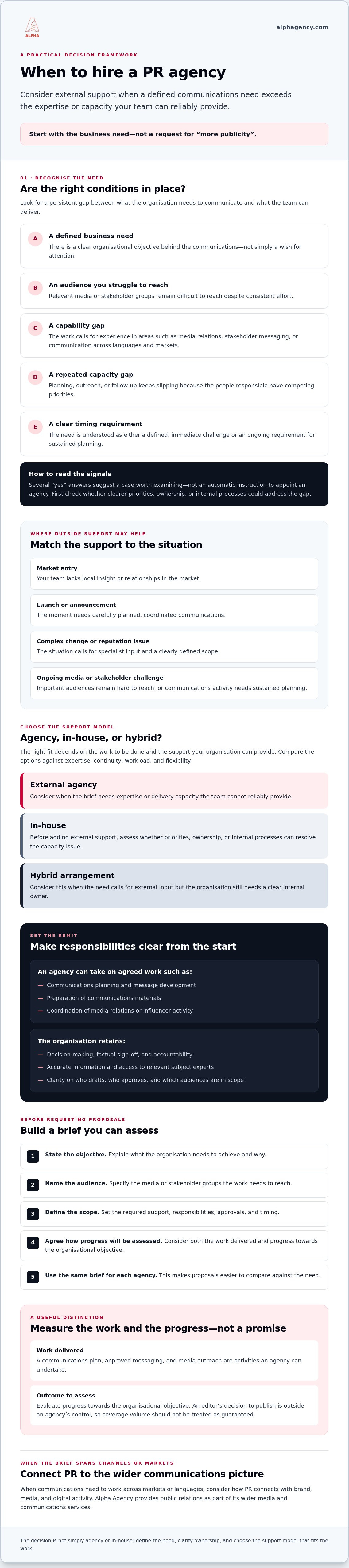
Signals are more meaningful in combination. Use this quick checklist to decide whether the need is substantial enough to assess further:
- Business need: Is there a defined objective beyond “more publicity”?
- Audience gap: Are important media or stakeholder groups consistently out of reach?
- Capability gap: Does the work require expertise your team doesn’t have?
- Capacity gap: Is essential communications work repeatedly delayed or dropped?
- Timing and continuity: Is this a short-term challenge or a continuing need?
Several “yes” answers suggest a case worth examining, not an automatic instruction to appoint an agency. Next, define what support should cover and how it could fit with internal ownership. Use the readiness framework below to turn these signals into a brief you can assess against agency, in-house and hybrid options.
What a PR agency does, and where its remit begins
A PR agency provides external communications support against agreed organisational objectives. Understanding this remit helps answer when to hire a PR agency: an agency can bring planning, specialist skills and delivery capacity, but it cannot replace the organisation’s knowledge or authority.
Depending on the brief, work may include strategic communications, media relations, reputation management and influencer coordination. The mix should reflect the objective and audience. An organisation announcing a market entry, for example, may need a clear narrative and media engagement across markets. A public sector organisation communicating a complex change may need consistent messages for distinct stakeholder groups.
What can a PR agency take responsibility for?
Within the agreed scope, an agency can plan communications activity, develop messages, prepare materials and coordinate media relations or influencer activity. Responsibilities should be explicit: who drafts, who approves, which audiences are in scope, and what work is included. Alpha Agency offers public relations as part of its wider media and communications services, which can connect with branding, media and digital activity when the brief calls for it.
Agree deliverables separately from outcomes. A communications plan, approved messaging and media outreach are activities an agency can undertake. An editor’s decision to publish is not within its control. A sound brief therefore evaluates both the work delivered and progress towards the organisational objective, without treating coverage volume as a guaranteed result.
What should stay with the organisation?
The organisation retains decision-making, factual sign-off and accountability for what it communicates. It must provide accurate information and access to people with relevant subject expertise, including senior or technical spokespeople where needed. An agency can shape a message, but it cannot validate internal facts or make business decisions on the organisation’s behalf.
Timely approvals matter. If several teams must review every statement but no one owns the final decision, activity can stall, especially around a launch or sensitive announcement. Appoint one internal point of contact, identify who has approval authority and agree how reviews will work. External support should extend the organisation’s capability, not stand in for its knowledge.
Before appointing an agency, write down the objective, audiences, expected deliverables, approval process and internal owner. Then compare that scope with Alpha Agency’s public relations capabilities to see whether the service fits the requirement.
PR agency vs in-house team: choose the right support model
The decision about when to hire a PR agency is also a decision about where communications expertise should sit. An agency offers external capacity and specialist input; an in-house team brings continuous organisational context; a hybrid model combines the two. The right choice depends on how steady the workload is, which skills are needed and how closely communications must connect to daily operations.
Agency support
Best suited to: A defined project, specialist requirement or workload that varies over time.
Trade-off: The team must be briefed and kept close to internal decisions. Organisational knowledge needs to be shared rather than assumed.
In-house communications
Best suited to: Sustained activity embedded in daily operations that needs frequent access to colleagues and decision-makers.
Trade-off: One employee may not cover every specialist skill or be able to absorb peaks in workload.
Hybrid support
Best suited to: An internal owner who needs external strategic or delivery support for specific audiences, markets or periods of demand.
Trade-off: Responsibilities must be clear, or both teams may duplicate work or leave gaps.
When does an in-house communications hire make more sense?
An internal hire may fit when communications is a continuing operational function, not an occasional project. Daily access to leadership and subject experts can help someone build detailed organisational context and coordinate work across teams. But wanting more media coverage, by itself, isn’t a sound reason to recruit. First define the ongoing responsibilities and the skills the role must cover.
When is a hybrid PR arrangement worth considering?
Hybrid support can work when an internal communications lead manages priorities and approvals, while an agency provides agreed strategic or execution capacity. For example, a team entering multiple markets may need support for particular audiences or languages without outsourcing all communications. Cross-border or multilingual activity adds coordination needs, but doesn’t automatically mean external support is necessary.
Set decision rights before work begins: who owns the brief, who drafts and contacts media, who approves messages, and who reports progress? A clear handover keeps the internal lead informed while giving the agency a defined remit. Alpha Agency’s public relations services may fit where external PR support meets that requirement.
How to assess PR readiness before hiring an agency
Before deciding when to hire a PR agency, turn the communications need into a brief that an agency can respond to and your organisation can evaluate. Start with the business challenge, then define the audiences, intended outcome, scope and internal owner. This keeps conversations focused on what needs to change, rather than jumping straight to press releases or coverage targets.
What should a useful PR brief include?
Keep the first brief concise, but specific enough to expose gaps and constraints. Include:
- The challenge: What has happened, or what organisational objective requires communications support?
- Audiences and outcome: Who needs to understand or act, and what should they know, feel or do?
- Evidence and access: Which facts are confirmed, and which spokespeople can provide expertise or represent the organisation?
- Scope and ownership: What work are you asking the agency to consider, and who will lead internally and approve materials?
- Constraints: Note timing, approval capacity, available evidence, sensitive issues and dependencies on other teams.
If the work spans markets, specify each priority market and language. A message that is clear in one context may need different emphasis or review elsewhere. Be direct about what is known and what remains uncertain; agencies need both to propose a realistic scope.
Define success before choosing tactics
Decide what useful progress would look like before discussing coverage volume. Depending on the objective, you might assess whether priority stakeholders understand a change, whether a launch reaches relevant audiences, or whether agreed communications materials and outreach are delivered on time. Separate measures the agency can influence from wider organisational outcomes that depend on other factors.
Then assess readiness honestly. Can your team supply evidence, make decisions and review work within the required timeframe? If approvals are slow or facts are incomplete, resolve that constraint or include it in the brief. A focused initial scope can help clarify an uncertain need, provided its purpose, boundaries and review point are agreed in advance. It should test a defined requirement, not serve as a promise of results.
Assess agency fit and value
Ask each agency to explain how its proposed scope addresses your stated need, what it will deliver, what your team must provide and how progress will be reviewed. Compare responses against the same brief. Look for relevant, documented experience and a clear division of responsibilities, rather than relying on broad claims or treating coverage volume as the only measure. Review Alpha Agency’s services as part of your due diligence.
What to do next: scope the right PR support
Once you’ve decided when to hire a PR agency, make the first conversation specific. Put the organisational need, priority audience, intended outcome and requested scope in writing. Name the internal owner and describe how progress will be evaluated. This gives agencies a shared starting point and helps you compare proposals on their relevance, not just their list of activities.
Keep the brief realistic. Include the evidence and spokespeople available, approval capacity, timing and any market or language requirements. If those constraints limit delivery, say so. An agency can then explain what is feasible within the brief and what would depend on your team.
Questions to ask before appointing a PR agency
Use the discussion to test how the proposed working relationship would function, not simply whether the agency agrees with your objectives. Ask:
- Which parts of the brief would you lead, and what input or decisions do you need from us?
- Who would be our day-to-day contact, and how would updates and approvals work?
- What deliverables and review points are included, and how would a change in scope be handled?
- Can you share documented examples relevant to our audience, sector or communications challenge?
- How would you assess progress beyond counting media coverage?
Request examples to understand the agency’s experience and approach, not as a promise that another organisation’s outcome will be repeated. Compare proposals against the same brief, including the people and approval time your organisation can realistically provide.
Connect PR to the wider brief where it helps
PR may need to work alongside branding, digital marketing or media planning when the objective depends on consistent messages across channels. For example, a market-entry brief could require earned communications to align with a brand’s positioning and paid media activity. That coordination is useful only if it serves the audience and objective; adding services without a clear role can dilute focus and complicate ownership.
Alpha Agency provides public relations as part of its wider media and advertising services. Use the scope you’ve defined to assess whether its services align with your organisation’s requirements.
Make the next step a clear one
The decision about when to hire a PR agency comes down to fit: does a defined communications need require expertise or capacity your organisation cannot provide consistently? An agency, an in-house hire or a hybrid model may each be right, depending on how continuous the work is, the skills required and the level of internal ownership available.
Before approaching providers, document the objective, audiences, scope, internal lead and evaluation approach. Compare proposals against the same brief, check how responsibilities and approvals will work, and distinguish agreed deliverables from outcomes no agency can guarantee. Clear expectations make it easier to assess both the support and the working relationship.
Alpha Agency offers public relations alongside branding and advertising, media and digital, and other communications services. Explore its services to see whether they align with your brief.
Explore Alpha Agency’s public relations and communications services
With a well-defined need and shared expectations, you can choose support that strengthens your communications while keeping your organisation’s priorities in view.
Frequently Asked Questions
When should a company hire a PR agency?
Hire when a defined communications need exceeds your team’s available capacity or expertise. The case is stronger if you’re repeatedly struggling to reach relevant media or stakeholders, or need specialist support for a launch, market entry or complex announcement. The question of when to hire a PR agency shouldn’t be decided by a temporary wish for more publicity alone. Start with the business objective, audience and support gap.
Is a PR agency worth it for a small or growing business?
A PR agency can be worthwhile for a small or growing business if it needs communications expertise or delivery capacity it cannot sustain internally. Company size alone doesn’t settle the question. Consider whether the objective is clear, whether the work needs specialist input, and whether your team can provide facts and timely approvals. If the need is occasional or still uncertain, define a focused scope before committing to broader support.
Should I hire a PR agency or build an in-house team?
Choose an in-house team when communications is continuous, closely tied to daily operations and dependent on constant internal context. An agency may suit specialist work or demand that changes over time. A hybrid model can pair internal ownership with external strategic or delivery support. Compare the options by workload, required expertise, continuity and flexibility. Don’t recruit simply to pursue more coverage; first define the role and ongoing responsibilities.
What does a PR agency do for a business?
A PR agency provides external communications support within an agreed brief. Depending on the need, it may help with strategic communications, media relations, reputation management or influencer coordination. The agency can lead agreed planning and delivery, but your organisation remains responsible for factual accuracy, decisions and approvals. Editorial coverage is not guaranteed, so define deliverables and assess progress against the business objective rather than relying only on coverage volume.
Can a PR agency help with a product launch or market entry?
Yes. A PR agency can help plan communications around a product launch or entry into a new market, including developing messages and engaging relevant media or stakeholder audiences. Clarify which markets and languages are in scope, what evidence is available, and who can approve and speak on behalf of the organisation. If launch communications also rely on branding, digital marketing or media planning, agree how those activities should coordinate.
How do you know if a PR agency is the right fit?
A good fit can explain how its proposed scope addresses your objective, what it will lead, and what it needs from your organisation. Look for clear responsibilities, realistic measures of progress and relevant, documented examples. Ask how communication, approvals and scope changes will work. Examples can help you judge experience, but they don’t predict the same outcome for your organisation. Compare proposals using the same brief and constraints.
What should you prepare before contacting a PR agency?
Prepare a short brief covering the organisational need, priority audiences, intended outcome, proposed scope and internal owner. Include confirmed facts, available spokespeople, approval responsibilities, timing and constraints. If the work crosses markets, identify the markets and languages involved. Decide how you’ll evaluate progress before discussing tactics or coverage targets. A clear brief helps agencies respond to the actual requirement and makes their proposals easier to compare.
Which communications problems call for outside PR support?
Outside support may be useful when relevant media or stakeholders remain difficult to reach despite consistent effort, or when an announcement needs careful planning and delivery. Market entry, a product or destination launch, a complex organisational change and a reputation issue can all create a need for specialist input. The scope will vary: an urgent challenge calls for defined, immediate support, while an ongoing strategic need requires sustained planning. A high-profile moment alone doesn’t prove either is necessary.
When is the problem an internal capacity gap?
Look for repeated delays: communications planning, media outreach or follow-up keeps slipping because the responsible people have other priorities. A skills gap can also limit the work, for example when a team lacks experience in media relations, stakeholder messaging or communicating across languages and markets. But workload alone isn’t a reason to hire externally. First check whether priorities, ownership or internal processes can be adjusted. Signals are more meaningful in combination. Use this quick checklist to decide whether the need is substantial enough to assess further: Several “yes” answers suggest a case worth examining, not an automatic instruction to appoint an agency. Next, define what support should cover and how it could fit with internal ownership. Use the readiness framework below to turn these signals into a brief you can assess against agency, in-house and hybrid options. A PR agency provides external communications support against agreed organisational objectives. Understanding this remit helps answer when to hire a PR agency: an agency can bring planning, specialist skills and delivery capacity, but it cannot replace the organisation’s knowledge or authority. Depending on the brief, work may include strategic communications, media relations, reputation management and influencer coordination. The mix should reflect the objective and audience. An organisation announcing a market entry, for example, may need a clear narrative and media engagement across markets. A public sector organisation communicating a complex change may need consistent messages for distinct stakeholder groups.
What can a PR agency take responsibility for?
Within the agreed scope, an agency can plan communications activity, develop messages, prepare materials and coordinate media relations or influencer activity. Responsibilities should be explicit: who drafts, who approves, which audiences are in scope, and what work is included. Alpha Agency offers public relations as part of its wider media and communications services, which can connect with branding, media and digital activity when the brief calls for it. Agree deliverables separately from outcomes. A communications plan, approved messaging and media outreach are activities an agency can undertake. An editor’s decision to publish is not within its control. A sound brief therefore evaluates both the work delivered and progress towards the organisational objective, without treating coverage volume as a guaranteed result.
What should stay with the organisation?
The organisation retains decision-making, factual sign-off and accountability for what it communicates. It must provide accurate information and access to people with relevant subject expertise, including senior or technical spokespeople where needed. An agency can shape a message, but it cannot validate internal facts or make business decisions on the organisation’s behalf. Timely approvals matter. If several teams must review every statement but no one owns the final decision, activity can stall, especially around a launch or sensitive announcement. Appoint one internal point of contact, identify who has approval authority and agree how reviews will work. External support should extend the organisation’s capability, not stand in for its knowledge. Before appointing an agency, write down the objective, audiences, expected deliverables, approval process and internal owner. Then compare that scope with Alpha Agency’s public relations capabilities to see whether the service fits the requirement. The decision about when to hire a PR agency is also a decision about where communications expertise should sit. An agency offers external capacity and specialist input; an in-house team brings continuous organisational context; a hybrid model combines the two. The right choice depends on how steady the workload is, which skills are needed and how closely communications must connect to daily operations. Agency supportBest suited to: A defined project, specialist requirement or workload that varies over time.Trade-off: The team must be briefed and kept close to internal decisions. Organisational knowledge needs to be shared rather than assumed. In-house communicationsBest suited to: Sustained activity embedded in daily operations that needs frequent access to colleagues and decision-makers.Trade-off: One employee may not cover every specialist skill or be able to absorb peaks in workload. Hybrid supportBest suited to: An internal owner who needs external strategic or delivery support for specific audiences, markets or periods of demand.Trade-off: Responsibilities must be clear, or both teams may duplicate work or leave gaps.
When does an in-house communications hire make more sense?
An internal hire may fit when communications is a continuing operational function, not an occasional project. Daily access to leadership and subject experts can help someone build detailed organisational context and coordinate work across teams. But wanting more media coverage, by itself, isn’t a sound reason to recruit. First define the ongoing responsibilities and the skills the role must cover.
When is a hybrid PR arrangement worth considering?
Hybrid support can work when an internal communications lead manages priorities and approvals, while an agency provides agreed strategic or execution capacity. For example, a team entering multiple markets may need support for particular audiences or languages without outsourcing all communications. Cross-border or multilingual activity adds coordination needs, but doesn’t automatically mean external support is necessary. Set decision rights before work begins: who owns the brief, who drafts and contacts media, who approves messages, and who reports progress? A clear handover keeps the internal lead informed while giving the agency a defined remit. Alpha Agency’s public relations services may fit where external PR support meets that requirement. Before deciding when to hire a PR agency, turn the communications need into a brief that an agency can respond to and your organisation can evaluate. Start with the business challenge, then define the audiences, intended outcome, scope and internal owner. This keeps conversations focused on what needs to change, rather than jumping straight to press releases or coverage targets.
What should a useful PR brief include?
Keep the first brief concise, but specific enough to expose gaps and constraints. Include: If the work spans markets, specify each priority market and language. A message that is clear in one context may need different emphasis or review elsewhere. Be direct about what is known and what remains uncertain; agencies need both to propose a realistic scope.
When should a company hire a PR agency?
Hire when a defined communications need exceeds your team’s available capacity or expertise. The case is stronger if you’re repeatedly struggling to reach relevant media or stakeholders, or need specialist support for a launch, market entry or complex announcement. The question of when to hire a PR agency shouldn’t be decided by a temporary wish for more publicity alone. Start with the business objective, audience and support gap.
Is a PR agency worth it for a small or growing business?
A PR agency can be worthwhile for a small or growing business if it needs communications expertise or delivery capacity it cannot sustain internally. Company size alone doesn’t settle the question. Consider whether the objective is clear, whether the work needs specialist input, and whether your team can provide facts and timely approvals. If the need is occasional or still uncertain, define a focused scope before committing to broader support.
Should I hire a PR agency or build an in-house team?
Choose an in-house team when communications is continuous, closely tied to daily operations and dependent on constant internal context. An agency may suit specialist work or demand that changes over time. A hybrid model can pair internal ownership with external strategic or delivery support. Compare the options by workload, required expertise, continuity and flexibility. Don’t recruit simply to pursue more coverage; first define the role and ongoing responsibilities.
What does a PR agency do for a business?
A PR agency provides external communications support within an agreed brief. Depending on the need, it may help with strategic communications, media relations, reputation management or influencer coordination. The agency can lead agreed planning and delivery, but your organisation remains responsible for factual accuracy, decisions and approvals. Editorial coverage is not guaranteed, so define deliverables and assess progress against the business objective rather than relying only on coverage volume.
Can a PR agency help with a product launch or market entry?
Yes. A PR agency can help plan communications around a product launch or entry into a new market, including developing messages and engaging relevant media or stakeholder audiences. Clarify which markets and languages are in scope, what evidence is available, and who can approve and speak on behalf of the organisation. If launch communications also rely on branding, digital marketing or media planning, agree how those activities should coordinate.
How do you know if a PR agency is the right fit?
A good fit can explain how its proposed scope addresses your objective, what it will lead, and what it needs from your organisation. Look for clear responsibilities, realistic measures of progress and relevant, documented examples. Ask how communication, approvals and scope changes will work. Examples can help you judge experience, but they don’t predict the same outcome for your organisation. Compare proposals using the same brief and constraints.
What should you prepare before contacting a PR agency?
Prepare a short brief covering the organisational need, priority audiences, intended outcome, proposed scope and internal owner. Include confirmed facts, available spokespeople, approval responsibilities, timing and constraints. If the work crosses markets, identify the markets and languages involved. Decide how you’ll evaluate progress before discussing tactics or coverage targets. A clear brief helps agencies respond to the actual requirement and makes their proposals easier to compare.