
The Strategic Shift: From Using AI Tools to Executing AI Functions
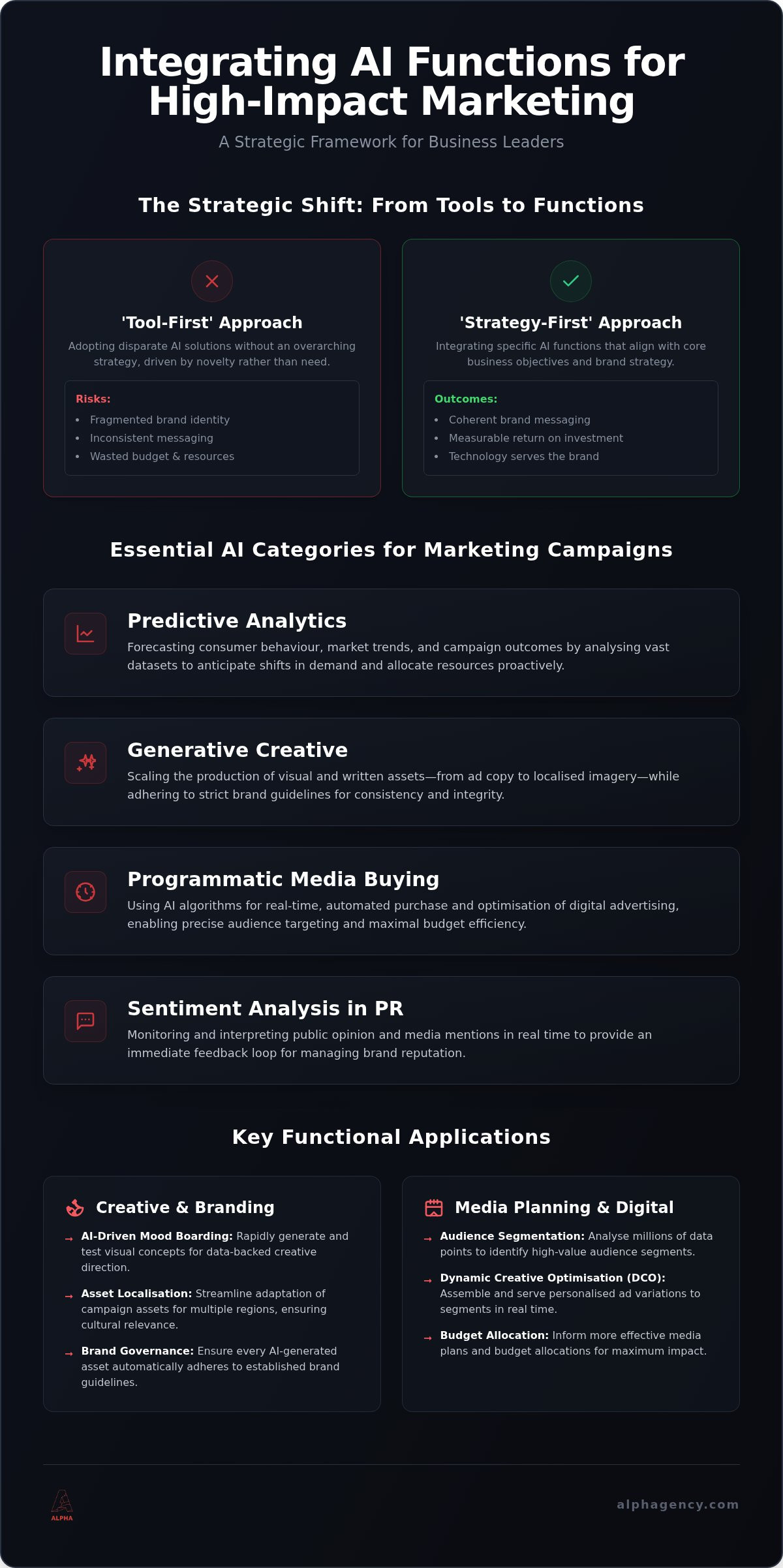
The conversation surrounding Artificial Intelligence in Marketing is maturing. The initial excitement over standalone generative tools is giving way to a more pragmatic discussion about integrating specific AI functions into a coherent brand strategy. For business leaders, the critical question is no longer "Which AI tool should we use?" but "Which AI functions will deliver a measurable return and strengthen our core business objectives?"
This marks a necessary shift from experimental adoption to strategic execution. An AI function is an integrated capability within your marketing ecosystem, designed to perform a specific task–such as analysing consumer sentiment or optimising media spend. In contrast, a tool is merely the delivery mechanism. This distinction is vital; focusing on functions forces a strategy-first approach, ensuring technology serves the brand, not the other way around. At Alpha Agency, we view artificial intelligence not as a replacement for professional expertise, but as a powerful extension of it, enabling our teams to deliver more intelligent and efficient results.
The Evolution of Artificial Intelligence in Branding
In its early stages, AI in branding was limited to basic chatbots and rudimentary automation. Today, the technology has evolved into sophisticated systems capable of emulating a brand's voice, maintaining creative consistency across complex multi-channel campaigns, and generating nuanced marketing collateral. The true value of modern AI lies in its ability to operate at scale while adhering to meticulously defined brand parameters.
This evolution demands a new definition. AI functionality is the intersection of high-speed data processing and disciplined creative execution. It is where analytical power meets brand strategy, enabling organisations to make smarter decisions and deploy creative assets with unprecedented speed and precision.
Why Strategy Must Precede Tool Adoption
A 'tool-first' approach to marketing is a significant risk. Adopting disparate AI solutions without an overarching strategy leads to a fragmented brand identity, inconsistent messaging, and wasted budget. When technology choices are driven by novelty rather than need, the result is a collection of disconnected tactics that fail to support the primary business objective.
A 360-degree perspective is essential. Before any tool is selected, a brand must have a clear understanding of its market position, audience, and commercial goals. This human-led strategic foundation ensures that any adopted AI function directly contributes to the overall mission. In a market saturated with AI-generated content, the brands that succeed will be those guided by distinct, human-led creative concepts, using technology as an accelerator, not a source of inspiration.
Essential AI Categories for High-Impact Marketing Campaigns
To move beyond tactical applications, marketing leaders must understand the core categories of AI functions that drive high-impact campaigns. These are not just tools for efficiency; they are strategic capabilities that can provide a significant competitive advantage when integrated correctly.
- Predictive Analytics: Forecasting consumer behaviour, market trends, and campaign outcomes by analysing vast datasets. This allows brands to anticipate shifts in demand and allocate resources proactively.
- Generative Creative: Scaling the production of visual and written assets without compromising brand integrity. This includes everything from ad copy variations to localised imagery, all generated within strict brand guidelines.
- Programmatic Media Buying: Using AI algorithms for the real-time, automated purchase and optimisation of digital advertising. This function enables precise audience targeting and maximises budget efficiency, particularly for cross-border campaigns.
- Sentiment Analysis in PR: Monitoring and interpreting public opinion and media mentions in real time. This provides an immediate feedback loop for managing brand reputation and responding to market conversations.
Creative and Branding Functions
In the creative domain, AI functions are transforming ideation and execution. AI-driven mood boarding can rapidly generate and test visual concepts, providing data-backed insights into which creative directions will resonate most strongly with target audiences. For brands operating in multiple regions, AI offers a streamlined solution for adapting and localising campaign assets, ensuring cultural relevance while maintaining a consistent global brand identity. The most critical function, however, is governance: ensuring every AI-generated asset, from a social media post to a video script, automatically adheres to established brand guidelines for tone, voice, and visual style.
Media Planning and Digital Optimisation
In media, AI provides a level of precision that was previously unattainable. Algorithms can analyse millions of data points to identify high-value audience segments across social media, search, and display networks. This insight informs more effective media plans and budget allocations. Dynamic Creative Optimisation (DCO) takes this a step further, using AI to assemble and serve personalised ad variations to different audience segments in real time, significantly improving engagement and conversion rates. Integrating these advanced AI functions is a core component of the media planning and digital optimisation services offered by a modern agency. Discover more about how we integrate these capabilities into our full-service media solutions.
Strategic Selection: A Framework for Business Decision-Makers
Choosing the right AI solutions requires a disciplined evaluation framework. Instead of being swayed by impressive product demonstrations, decision-makers should assess potential tools based on their strategic fit and long-term value. This involves a rigorous analysis of performance, risk, and cost.
- The ROI Framework: Evaluate every potential tool based on three core criteria: scalability (can it support growth and cross-border needs?), integration (does it connect with our existing technology stack?), and accuracy (is the output reliable and verifiable?).
- Identifying 'Black Box' Risks: Many AI models operate as 'black boxes', making it difficult to understand their decision-making processes. It is crucial to ensure any tool complies with data privacy regulations and ethical standards, avoiding potential reputational and legal damage.
- Cost-Benefit Analysis: Compare the total cost of ownership for various solutions. This includes not only SaaS subscription fees but also the internal resources required for implementation and management versus the efficiency and expertise gained from an agency-led proprietary solution.
- The 'Alpha' Test: The ultimate question is simple: does this tool or function enhance our core value proposition and help us serve our customers better? If the answer is no, it is a distraction, not a strategic asset.
Evaluating Scalability and Integration
For ambitious organisations, scalability is non-negotiable. A tool that works for a single-market campaign may fail when deployed across multiple countries with varying languages and consumer behaviours. Decision-makers must ask whether a potential solution can handle the complexities of cross-border campaign requirements. Equally important is its ability to integrate with existing CRM, analytics, and marketing automation platforms. A tool that creates another data silo is a liability. Future-proofing your AI investments means choosing flexible, API-friendly platforms that can evolve with your business.
Human Oversight: The Non-Negotiable Component
Technology cannot replace strategic judgment. Every AI output, whether a piece of ad copy or a media budget allocation, requires a 'human-in-the-loop' for quality control, ethical review, and strategic alignment. The most effective marketing teams define clear roles: AI systems are tasked with processing data and executing repetitive tasks, while human experts are responsible for interpreting the data, developing creative concepts, and making the final strategic decisions.
To ensure this balance is maintained, we recommend implementing a formal review process. A Strategic AI Audit should be a mandatory quarterly process for modern brands, designed to evaluate the performance, ethics, and business impact of all integrated artificial intelligence functions.
Implementation Challenges: Navigating the Integration Gap
Successfully integrating AI into a marketing strategy involves more than just purchasing software. Organisations face several common challenges that can undermine the potential return on investment, from technical hurdles to cultural resistance.
Common pitfalls include an over-reliance on automation, which can lead to generic, soulless content that falls into the 'uncanny valley'. Data silos remain a significant barrier, preventing predictive analytics models from accessing the comprehensive information they need to be effective. Furthermore, a persistent talent gap means many teams are trained to use tools but not to lead an AI-driven strategy. Finally, in automated media buying environments, ensuring brand safety–preventing ads from appearing alongside inappropriate content–requires constant vigilance and sophisticated controls.
Overcoming Brand Dilution
The greatest risk of poorly managed AI is brand dilution. When efficiency is prioritised over originality, the result is a sea of homogenous content that fails to capture attention or build an emotional connection. To counter this, human creativity must remain at the core of the content production process. AI should be used as an assistant for research, data analysis, and first-draft generation, but the final product must be infused with original thinking and brand personality.
Public relations plays a vital role in humanising a brand that uses heavy automation, telling the stories behind the technology and highlighting the people who guide the strategy. This balance is key to creating campaigns that are both technologically advanced and emotionally resonant, a principle demonstrated in our portfolio of work for leading brands.
Managing Data Privacy and Compliance
As AI becomes more powerful, so do the responsibilities associated with its use. Brands operating internationally must navigate a complex web of regional data regulations, such as GDPR, when using global AI platforms. The ethical implications of AI-driven consumer profiling require careful consideration to avoid crossing the line from personalisation to intrusion.
Building and maintaining consumer trust is paramount. This can be achieved by developing transparent AI usage policies that clearly communicate how customer data is being used to enhance their experience. Proactive compliance and ethical governance are not just legal necessities; they are foundational to long-term brand credibility.
The Alpha Agency Approach: Integrated AI in 360° Marketing
The true potential of artificial intelligence is realised when its functions are woven into a comprehensive, 360-degree marketing framework. At Alpha Agency, we synthesise over 25 years of strategic experience with today's most advanced AI capabilities to deliver integrated campaigns that drive business growth.
Our 'Total Solution' model ensures that AI functions are applied cohesively across branding, media, and PR. This prevents the formation of silos and ensures every technological component is working in service of a single, unified strategy. Whether developing a destination marketing campaign that uses predictive analytics to identify emerging travel trends or positioning a cultural institution with AI-assisted audience segmentation, our approach is always strategy-led. As an independent agency, we provide objective, expert oversight for AI tool selection, ensuring our clients invest in solutions that deliver real-world results.
The Integrated Campaign Lifecycle
A successful AI-powered campaign follows a structured lifecycle that balances automated efficiency with human expertise:
- Phase 1: AI-Assisted Research and Audience Discovery. We leverage AI to analyse market data, competitor activity, and consumer conversations at a scale and speed impossible to achieve manually. This provides the foundational intelligence for our strategic planning.
- Phase 2: Human-Led Creative Concepting with AI-Driven Prototyping. Our creative strategists develop the core campaign concept. AI is then used to rapidly prototype variations, test messaging, and generate initial creative assets for review and refinement.
- Phase 3: Automated Media Execution with Real-Time Strategic Pivots. AI-driven programmatic platforms execute the media buy with precision. Our human experts monitor performance in real time, making strategic adjustments to optimise the campaign based on live data and market feedback.
Partnering for the Future
In a rapidly changing technological landscape, partnering with a high-level consultant provides stability and a competitive edge. An experienced agency acts as a guide, helping brands navigate the complexities of AI integration and build a future-proof marketing ecosystem. This partnership is about more than just technology; it is about building a strategic capability that drives sustainable growth.
To learn more about our history of navigating market shifts and technological advancements, you can read about our 25-year journey as a leading independent agency.
Frequently Asked Questions
What is the difference between an AI tool and an AI function in marketing?
An AI tool is a specific piece of software (e.g., a content generator or an analytics platform). An AI function is the specific strategic capability that tool enables within your marketing system (e.g., generative creative or predictive analytics). Focusing on functions ensures you are building a strategic capability, not just collecting software.
How do I ensure AI-generated content matches my brand's unique voice?
This requires a combination of robust prompt engineering, comprehensive brand guideline documentation, and rigorous human oversight. The AI should be trained on your existing brand materials and all outputs must be reviewed and refined by a human editor to ensure they meet quality and tonal standards.
Can AI tools replace a full-service advertising agency?
No. AI tools are powerful execution assistants, but they cannot replicate the strategic oversight, creative ideation, cross-channel integration, and accountability provided by an experienced agency. An agency's role is to lead the strategy and select/manage the right AI functions to achieve business goals, a task that requires human judgment and experience.
Is AI-driven marketing ROI measurable for B2B organisations?
Yes, absolutely. For B2B organisations, AI can deliver measurable ROI by improving lead scoring accuracy, personalising account-based marketing (ABM) content at scale, optimising ad spend to reach niche decision-makers, and automating the analysis of sales and marketing data to identify high-value opportunities.