
Justifying Marketing Spend to Stakeholders: A Strategic 2026 Guide
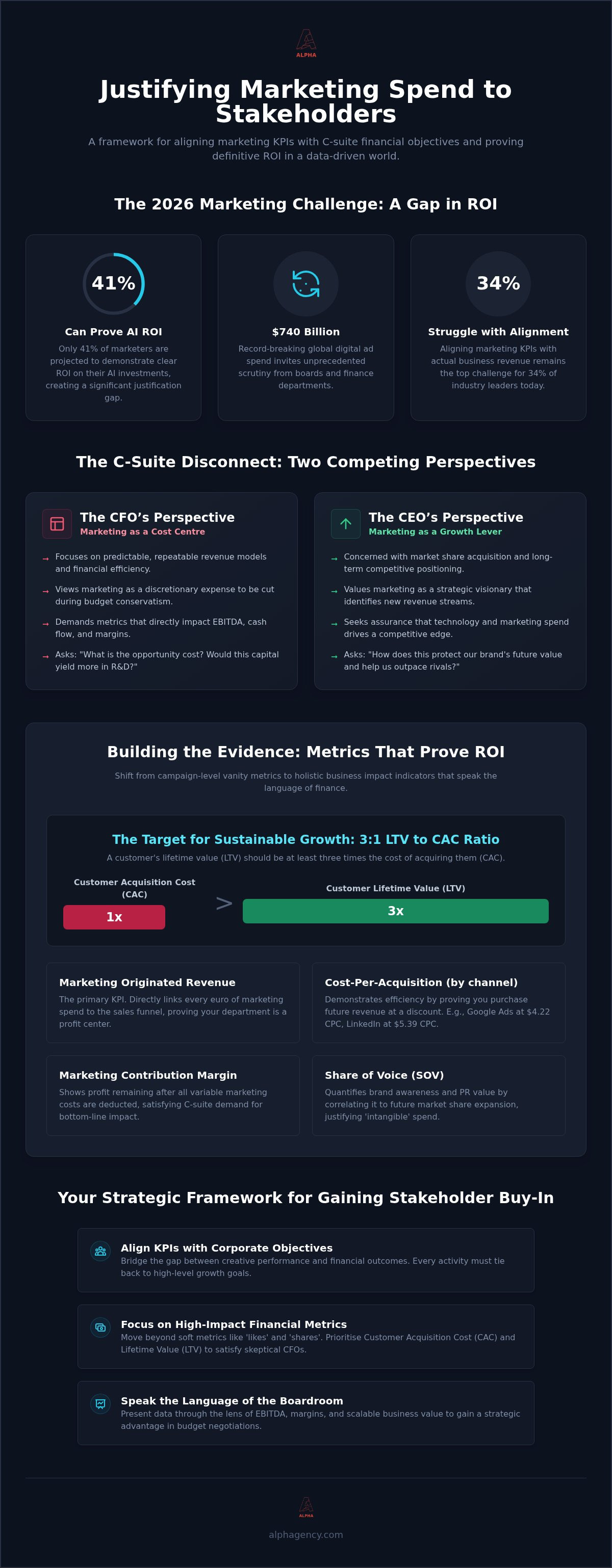
Only 41% of marketers can demonstrate clear ROI on their AI investments in 2026, despite global digital ad spend reaching a record $740 billion. This gap creates a significant barrier when justifying marketing spend to stakeholders who view every euro as a cost rather than a catalyst for growth. If you've ever faced a skeptical CFO who dismisses brand awareness as a soft metric or struggled to attribute sales across complex, multi-country campaigns, you're not alone. Aligning marketing KPIs with actual business revenue remains the top challenge for 34% of industry leaders today.
We understand that the pressure to prove impact is higher than ever, especially as regulatory shifts and media inflation tighten the margin for error. This guide will show you how to shift the conversation from defending budgets to presenting strategic growth opportunities. You'll learn a proven framework for reporting ROI that speaks the financial language of the C-suite, ensuring your next 360-degree launch campaign gets the green light. We'll explore how to use data transparency and metrics like the 3:1 LTV:CAC ratio to turn skeptics into long-term strategic partners.
Key Takeaways
- Bridge the gap between creative KPIs and financial outcomes by aligning every promotional activity with high-level corporate growth objectives.
- Move beyond soft metrics to focus on high-impact indicators like Customer Acquisition Cost (CAC) and Lifetime Value (LTV) that satisfy skeptical CFOs.
- Gain a strategic advantage in justifying marketing spend to stakeholders by presenting data through the lens of EBITDA, margins, and scalable business value.
- Quantify the intangible value of brand awareness and public relations by using Share of Voice (SOV) to predict future market share expansion.
- Leverage the transparency and objective reporting of a strategic media partner to validate the impact of complex, multi-channel integrated campaigns.
Table of Contents
- The Stakeholder Gap: Why Marketing Budgets Face Scrutiny in 2026
- Building the Evidence: Metrics That Prove Marketing ROI
- Justifying the 'Intangibles': Brand Equity and Public Relations
- The Presentation Strategy: Translating Data into Business Value
- Scaling Impact with a Strategic Media Partner
The Stakeholder Gap: Why Marketing Budgets Face Scrutiny in 2026
Justifying marketing spend to stakeholders isn't a verbal exercise; it's the rigorous alignment of every promotional activity with the firm's overarching financial objectives. In a year where global digital advertising investment has surged to $740 billion, the scale of spend has invited unprecedented scrutiny from the boardroom. Marketing leaders often find themselves trapped in a "C-Suite disconnect" where their language of engagement doesn't translate into the language of the balance sheet. According to recent data, 34% of marketers identify this lack of alignment with business outcomes as their primary professional challenge.
Market volatility in 2026 has fueled a culture of budget conservatism. When economic conditions shift, stakeholders instinctively look for "fat" to trim, and marketing is often the first target. This happens because many departments still rely on vanity metrics. Likes, shares, and impressions fail to move the needle for stakeholders because they don't directly correlate to liquidity or solvency. To survive a budget review, you must move beyond these superficial numbers and prove that your department is a revenue generator, not a cost center.
The CFO’s Perspective: Marketing as a Cost Centre
Traditional finance leaders often view marketing as a discretionary expense that can be paused without immediate operational failure. This perspective is rooted in a demand for predictable, repeatable revenue models. When a CFO reviews a budget, they're calculating the Return on Marketing Investment against the opportunity cost of that capital. They want to know if those funds would yield a higher margin if diverted to R&D or supply chain optimisations. To bridge this gap, you must present marketing as a system with fixed inputs and measurable financial outputs. If you can't demonstrate how a campaign contributes to the company's EBITDA or cash flow, the CFO will treat it as an avoidable cost.
The CEO’s Perspective: Marketing as a Growth Lever
While the CFO focuses on efficiency, the CEO is preoccupied with market share acquisition and competitive positioning. They're looking for long-term brand sustainability and the ability to outpace rivals in a crowded digital landscape. In 2026, where only 41% of marketers can demonstrate ROI on their AI investments, the CEO needs assurance that technology spend is actually driving a competitive edge. They value marketing when it functions as a strategic visionary that identifies new revenue streams and protects the brand’s future value. Strategic alignment is the essential bridge that connects creative execution to tangible business results.
"A marketing budget should not be justified by the volume of activity it creates, but by the business change it is designed to produce – whether that is revenue growth, stronger market position, greater customer value or long-term resilience. Once leadership agrees on the intended outcome, marketing becomes an investment decision rather than a debate about costs."
– Lauris Spillers, CEO, Alpha Agency
Building the Evidence: Metrics That Prove Marketing ROI
Evidence is the only currency stakeholders accept in a high-stakes budget review. When justifying marketing spend to stakeholders, you must pivot from campaign-level metrics to holistic business impact. This shift requires moving beyond simple Return on Ad Spend (ROAS) to a more sophisticated Marketing Contribution Margin. This metric shows the C-suite exactly how much profit remains after all marketing-related variable costs are deducted. It transforms your department from a budget consumer into a verified profit center.
A sustainable growth engine in 2026 is defined by a 3:1 LTV:CAC ratio. This means a customer's lifetime value is three times the cost of acquiring them. If you can't demonstrate this ratio, your budget is perceived as a liability rather than an asset. Using specific metrics to justify marketing spend allows you to speak the language of finance while protecting your creative resources. It provides the objective proof needed to secure future investment.
Hard Metrics: Revenue, Conversion, and Pipeline
Modern stakeholders demand "Marketing Originated Revenue" as a primary KPI. You need to link every euro of digital advertising spend directly to your sales funnel. With average costs rising in 2026, such as Google Ads at $4.22 CPC and LinkedIn at $5.39 CPC, efficiency is paramount. Measuring cost-per-acquisition across these channels allows you to prove that media buying isn't just about spending; it's about purchasing future revenue at a discount. Professional media and digital strategies ensure these funnels remain optimized and transparent, providing the granular data that CFOs crave.
Attribution in a Multi-Channel World
Measuring impact is notoriously difficult in cross-border, multi-channel campaigns. You must determine whether first-touch, last-touch, or multi-touch attribution best reflects your buyer's journey. While first-touch highlights brand discovery, multi-touch models are essential for 360-degree campaigns that include offline elements. Measuring the impact of TikTok advertising, which averages a $9.16 CPM in 2026, alongside traditional Outdoor or TV ads requires an integrated approach. This integrated media planning creates a data trail that connects high-level brand awareness to digital conversions. It removes the "black box" of marketing spend and replaces it with a clear, visual narrative of success.
Justifying the 'Intangibles': Brand Equity and Public Relations
Boardrooms often dismiss brand awareness as a "soft" metric that lacks immediate financial impact. This is a strategic oversight. In 2026, data shows that media effectiveness peaks when brand building constitutes 40% to 60% of your total marketing investment. When justifying marketing spend to stakeholders, you must frame brand equity as a financial asset that reduces price sensitivity and secures future cash flows. A strong brand allows a business to charge a premium, directly protecting your margins against inflation and competitive price wars.
Share of Voice (SOV) remains one of the most reliable lead indicators of future financial performance. If your SOV is consistently higher than your current Share of Market (SOM), you're positioned for organic growth. This predictive relationship provides a concrete "why" behind long-term brand spend. It's not about vanity; it's about market dominance. By dominating the conversation today, you're effectively purchasing tomorrow's market share at today's rates.
Reputation management is essentially an insurance policy for your balance sheet. A single PR crisis can wipe out years of brand equity, leading to immediate revenue loss and an increased cost of capital. Investing in proactive public relations builds a "trust reservoir" that protects the business against market shocks. This defensive value is just as critical as offensive growth when presenting a holistic budget to a risk-averse board.
Measuring Brand Strength and Market Presence
Quantifying the intangible starts with brand lift surveys and sentiment analysis. These data points provide a baseline for market perception and competitive standing. In fields like destination marketing, these metrics reflect long-term economic impact by tracking visitor intent and regional reputation. To keep stakeholders focused on value, utilise the following metrics:
- Brand Recall: Measuring how easily your name enters the consumer's mind during the decision-making process.
- Sentiment Analysis: Tracking the emotional tone of digital conversations to gauge brand health.
- Purchase Intent: Quantifying the likelihood of a prospect choosing your service over a competitor.
Brand Equity is the financial premium a business earns from a recognisable name compared to a generic equivalent.
The ROI of Public Relations and Influence
Public relations and influencer collaborations are the bedrock of modern trust. In 2026, influencer marketing delivers an average ROI of $6.50 for every $1 spent, making it a highly efficient growth lever within a $32.55 billion global market. When justifying a budget increase for these channels, shift from "Earned Media Value" to "Brand Trust" scores. High trust levels correlate with lower Customer Acquisition Costs and higher retention rates. PR also provides a significant boost to digital authority, ensuring your brand remains the primary choice in complex, multi-country campaigns.
The Presentation Strategy: Translating Data into Business Value
Data alone is silent. It requires a narrative that resonates with the financial priorities of your audience. When justifying marketing spend to stakeholders, you must adopt the 'Stakeholder Language' rule. This means abandoning marketing jargon like 'engagement rates' or 'click-throughs' in favor of EBITDA, contribution margins, and year-over-year growth. This shift in vocabulary signals that you are a business leader who manages marketing, rather than a creative professional disconnected from the bottom line. It reframes your budget from a request for funds into a proposal for profit.
One of the most difficult hurdles is addressing the objection: "What happens if we stop spending?" You must illustrate the decay of brand salience and the inevitable loss of market share that follows a dark period. Explain that stopping spend doesn't simply pause growth; it cedes territory to competitors who will capture your audience at a lower acquisition cost. Transparency is your greatest ally during these presentations. Admitting where certain channels require optimisation builds the professional credibility needed to protect the budgets that are actively performing. It shows you are a steward of the company's capital, not just a spender of it.
Step-by-Step: Preparing the Budget Defence
Success in the boardroom is the result of meticulous preparation. Follow these steps to build a bulletproof case:
- Step 1: Align marketing goals with the current year's corporate objectives. If the firm's priority is regional expansion, your budget must highlight specific media buying and PR activities in those target markets.
- Step 2: Aggregate data from all channels. Consolidate digital advertising, public relations, and event metrics into a single, cohesive source of truth.
- Step 3: Present a 'Conservative vs. Aggressive' growth scenario. This provides stakeholders with a clear view of the risk-to-reward ratio and gives them a sense of control over the investment level.
Visualising 360-Degree Campaign Impact
Complexity is the enemy of approval. When managing cross-border media buying or multi-channel launches, use unified dashboards to show the synergy between different marketing pillars. A visual narrative that connects a PR mention in one region to a conversion spike in another is far more persuasive than a fragmented spreadsheet. Case studies and social proof provide the emotional validation that complements your hard data, making the success of the campaign feel inevitable. Ready to transform your reporting? Partner with our experts in 360° Launch Campaigns to build a data-driven presentation that wins boardroom approval.
Scaling Impact with a Strategic Media Partner
Achieving boardroom consensus requires more than just internal enthusiasm. It demands an objective, third-party validation that only a seasoned media partner can provide. When justifying marketing spend to stakeholders, the presence of an external consultant transforms the conversation from a departmental request into a vetted business strategy. Alpha Baltic serves as this strategic pivot point, bringing 25+ years of regional expertise to the table. We don't just act as a service provider; we function as a high-level consultant that understands the holistic picture of brand building and market presence across the Baltics.
Our team provides a unified data story by leveraging integrated services across media, PR, and events. This integration eliminates data silos, allowing you to present a single, coherent narrative of success to your CFO. By managing complex, multi-country campaigns with integrated reporting, we provide the transparency needed to validate every euro spent. This holistic approach ensures that no marketing effort is seen in isolation, but as a vital component of a larger growth engine that drives enterprise value.
The Alpha Baltic Advantage in the Baltic Market
Access to advanced media planning and buying tools is a cornerstone of our regional capability. These resources allow for precise forecasting and performance tracking that internal teams rarely possess. We have a proven track record in 360° launch campaigns across Latvia and the wider region, ensuring your market entry or expansion is backed by hard evidence. We understand the nuances of the Baltic consumer and the specific media inflation rates of 2026, giving you a competitive edge in budget allocation. For more insights on this, read our Strategic branding for growth: A guide for market leaders.
Securing Your 2026 Marketing Future
A strategic partnership provides the stability and reliability derived from long-standing experience. Our globally recognised team delivers high-level reporting that stands up to the most rigorous stakeholder scrutiny. Justifying marketing spend to stakeholders becomes a seamless process when you have a partner that prioritizes efficiency and comprehensive solutions over fluff. We help you navigate the complexities of the current regulatory environment and media landscape with absolute confidence. Our goal is to ensure that every campaign is an investment in your company's future value. Contact Alpha Baltic to build your data-driven marketing strategy and turn your marketing budget into a strategic growth engine.
Mastering the Boardroom: Your Roadmap to Sustainable Growth
The process of justifying marketing spend to stakeholders is no longer a defensive act; it's a strategic demonstration of how your department fuels the company's future. Success in 2026 requires a shift from vanity metrics to the financial language of EBITDA and contribution margins. By aligning every campaign with corporate objectives and utilizing predictive tools like Share of Voice, you transform marketing into a transparent and repeatable revenue engine. Hard data remains the ultimate tool for silencing skepticism and securing the investment needed for market dominance.
You don't have to navigate this complex landscape alone. With 25+ years of Baltic market leadership and deep expertise in integrated 360° campaigns, we provide the objective reporting and strategic vision that international and regional market leaders trust. It's time to elevate your reporting and claim your seat as a strategic partner in the C-suite. Partner with Alpha Baltic to prove your marketing impact and unlock the full potential of your brand's growth. Your next successful presentation starts with the right data.
Frequently Asked Questions
What are the most important KPIs for justifying marketing spend to a CFO?
The most critical KPIs for a CFO are Customer Acquisition Cost (CAC), Lifetime Value (LTV), and Marketing Contribution Margin. These metrics translate promotional activity into the language of the balance sheet. A healthy business model in 2026 is indicated by a 3:1 LTV:CAC ratio. By focusing on these high level financial indicators, you demonstrate that your budget is a driver of profitability rather than a discretionary expense.
How do I calculate the ROI of a brand awareness campaign?
Calculating the ROI of brand awareness requires tracking Share of Voice (SOV) as a lead indicator for Share of Market (SOM). While immediate sales are harder to attribute, you can measure the brand premium by analyzing price elasticity. Brands with higher awareness can maintain higher margins. You should also monitor branded search volume and direct traffic spikes following campaign launches to quantify the top of funnel impact.
Can you justify marketing spend during an economic downturn?
Yes, justifying marketing spend to stakeholders during a downturn is essential because reduced competition often lowers media costs. Maintaining presence prevents the decay of brand salience, which is far more expensive to rebuild later. You should frame this spend as a defensive strategy to protect market share. Evidence suggests that brands that continue to invest during recessions recover faster and achieve higher long term profitability.
What is the difference between marketing as a cost and marketing as an investment?
Marketing as a cost is viewed as a line item expense that can be cut to save money. Marketing as an investment is treated as a capital allocation designed to generate a measurable future return. The distinction lies in predictability. When you can prove that spending one euro results in three euros of revenue, you have successfully shifted the stakeholder's perspective from viewing your department as a drain to seeing it as a growth lever.
How often should I report marketing performance to stakeholders?
You should provide high level tactical updates monthly and comprehensive strategic reviews quarterly. Monthly reports keep stakeholders informed on immediate campaign performance and budget pacing. Quarterly presentations allow for deeper analysis of long term trends like brand equity growth and competitive positioning. This rhythm ensures transparency without overwhelming the C-suite with granular data that doesn't impact their high level decision making processes.
What tools are best for tracking multi-channel attribution in 2026?
In 2026, the best tools are AI-driven attribution platforms that integrate data from digital, social, and offline channels. Unified dashboards that track cross-border media buying are essential for 360-degree campaigns. These tools help bridge the stakeholder gap by providing a single source of truth. Relying on professional agency tools ensures that your data is clean, objective, and capable of handling the complexities of modern multi-channel consumer journeys.
How do I explain the value of PR to a non-marketing stakeholder?
Explain PR as a form of reputation insurance and a trust building mechanism. Non-marketing stakeholders value risk mitigation and competitive advantage. Highlight how PR supports SEO authority and reduces Customer Acquisition Costs by building organic credibility. Use metrics like sentiment analysis to show how public relations efforts protect the brand's long term financial value and facilitate easier sales conversions through established authority.
What should I do if my marketing budget is rejected?
Justifying marketing spend to stakeholders becomes a process of negotiation when a budget is initially rejected. You must re-align your proposal with the firm's primary corporate objectives. Ask for specific feedback on which financial targets were not met. Presenting a conservative versus aggressive growth scenario illustrates the potential loss of market share. This approach shows you are a strategic partner focused on the company's bottom line.