
Why does a campaign that dominated your home market often trigger nothing but silence, or worse, costly ridicule, once it crosses a border? You've likely felt the friction between a global headquarters demanding absolute consistency and local teams warning that a literal translation will fail. It's a common frustration for marketing leaders who see their brand equity diluted by "lost in translation" moments that lead to expensive re-shoots and campaign restarts. Avoiding common brand message localization mistakes requires more than a dictionary; it demands a deep understanding of local semiotics and the shifting regulatory environment of 2026.
We understand that entering new markets like Estonia or the wider Baltic region requires a balance of authority and adaptability. This article provides a strategic framework to help you adapt your core message for maximum cultural resonance while maintaining brand integrity. We'll examine the critical pitfalls of international branding, from the impact of the EU AI Act's transparency rules to the September 2026 ban on unsubstantiated green claims. You'll learn how to reduce market entry risk through integrated media planning and creative adaptation, ensuring your brand speaks with a local heart and a global voice.
Key Takeaways
- Distinguish between linguistic accuracy and emotional resonance to ensure your core brand values remain intact during international expansion.
- Uncover the psychological impact of visual cues and cultural semiotics to prevent unintended brand alienation in new territories.
- Avoid expensive brand message localization mistakes by implementing a strategic audit framework that accounts for 2026 regulatory shifts and consumer expectations.
- Resolve the friction between centralised control and local relevance with a "Glocal" approach to media planning and creative strategy.
- Discover how an integrated 360° campaign model aligns PR, digital, and offline media to secure a cohesive presence across multiple borders.
The High Cost of Literal Translation: Why Direct Substitution Fails
Brand message localisation is the strategic adaptation of core values to local cultural contexts, moving far beyond mere word-for-word substitution. Many organisations fall into the "Literal Trap" where they produce grammatically correct text that fails to trigger any commercial action. This disconnect occurs because direct substitution ignores the emotional weight that specific words carry. A message that is technically accurate can still be culturally vacant, leading to a significant loss in campaign effectiveness.
One of the most frequent brand message localization mistakes is treating a campaign as a collection of strings to be translated rather than a narrative to be retold. Linguistic nuances like idioms, humour, and tone of voice are not universal. A witty headline that performs well in your home market might sound confusing or even abrasive when launched in the Estonian market. When you strip away the cultural context, you strip away the reason for a customer to care.
Linguistic Accuracy vs. Emotional Impact
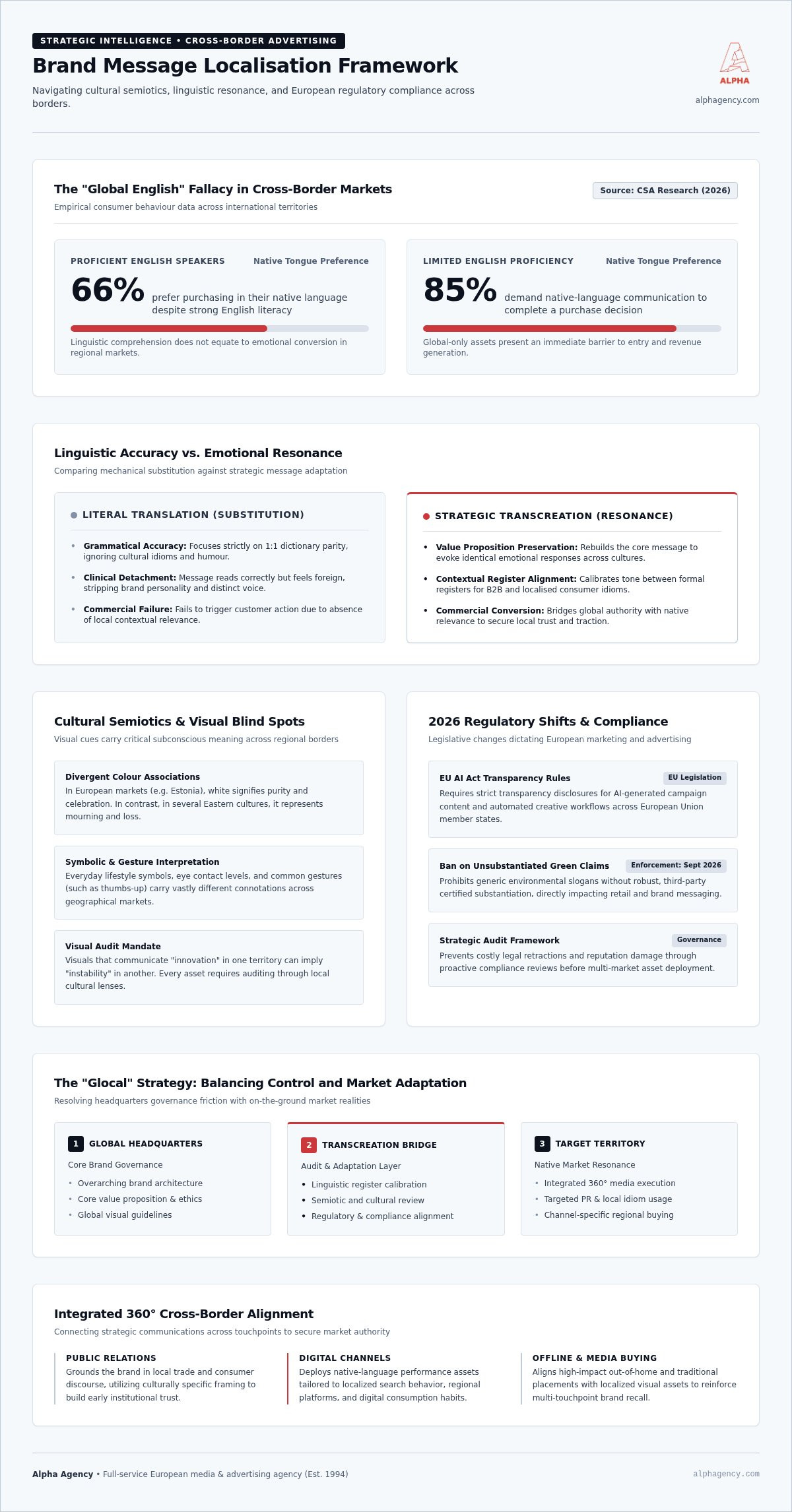
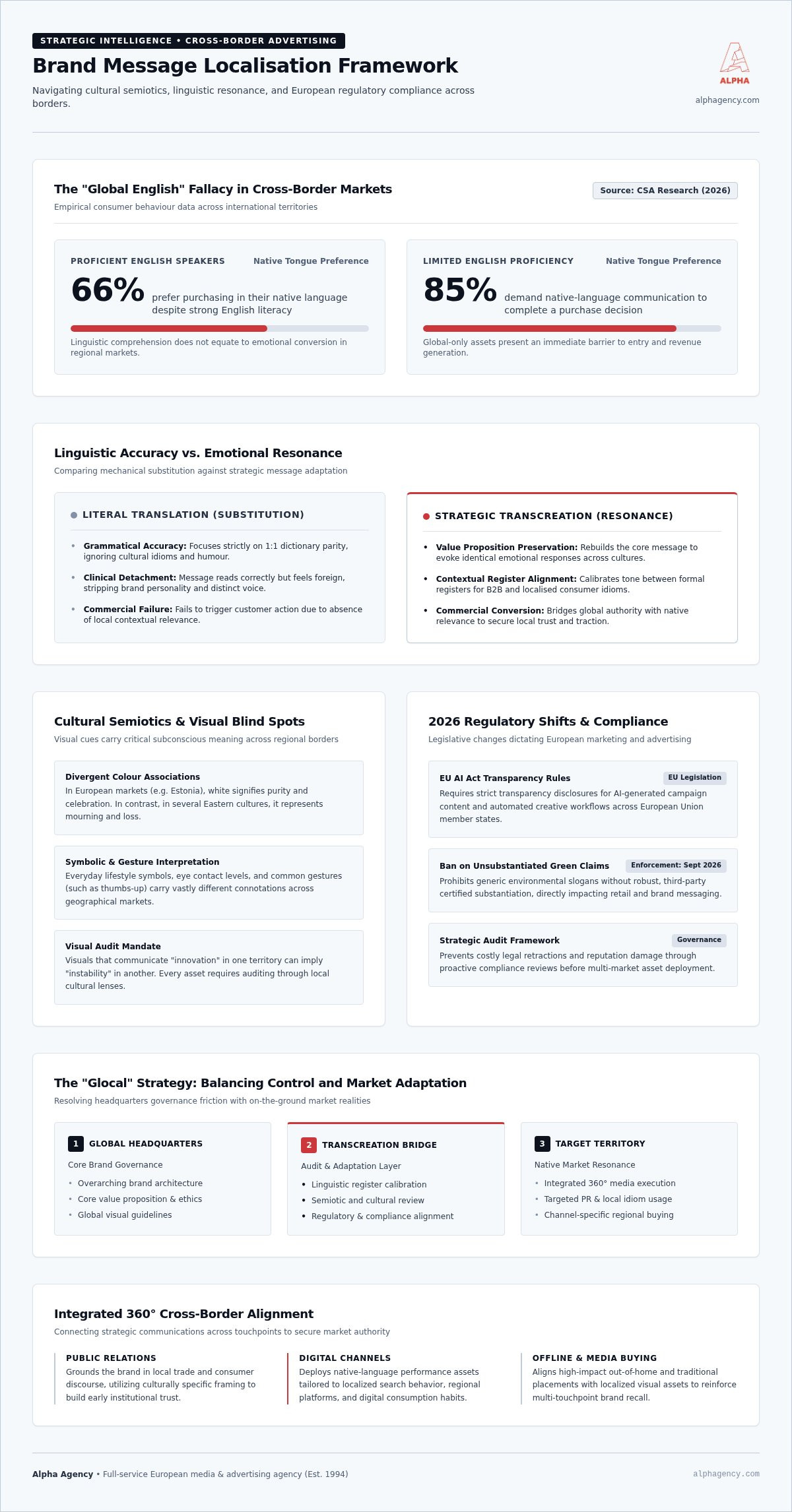
A 1:1 translation often strips a brand of its personality; it leaves the message feeling clinical and detached. While a translator focuses on accuracy, a strategist focuses on resonance. This is where transcreation becomes essential for cross-border growth. It ensures that the "feeling" of the brand survives the transition between markets without being diluted.
Transcreation is the process of rebuilding a message for a new culture while maintaining its original intent. This approach preserves the brand's unique value proposition. Without it, you risk losing the distinct voice that sets your organisation apart from local competitors. For example, a high-energy, informal tone might work for a retail brand in some territories, but business etiquette in other regions often requires a more grounded, professional register to establish trust and authority.
Common Linguistic Pitfalls in Cross-Border Advertising
Mistakes in naming remain a primary source of failure. A product name that sounds innovative in one language might carry unintended, negative meanings in another. Beyond names, the danger of "Global English" is often underestimated. Even in markets with high English proficiency, mother-tongue messaging performs significantly better. According to 2026 CSA Research, 66% of consumers with solid English reading skills still prefer purchasing in their native language; this figure surges to 85% for those with limited proficiency.
Relying on a single global version is one of the most avoidable brand message localization mistakes. Alpha Agency’s experience shows that true market penetration requires an integrated approach to branding and advertising. This involves shifting tone and register to match local expectations, whether that means adopting a formal address in B2B sectors or using specific local idioms in consumer-facing public relations. A message that doesn't sound local will never feel personal, and a message that doesn't feel personal will rarely convert.
Cultural Semiotics and Visual Blind Spots in Global Branding
Cultural semiotics is the study of how signs, symbols, and visual cues construct meaning within a specific society. While linguistic errors are easy to identify, visual brand message localization mistakes are often more insidious. They occur when a brand assumes that a "global" aesthetic will be interpreted identically across all borders. Visual cues carry immense psychological weight; ignoring this can lead to a campaign that feels foreign, insensitive, or entirely irrelevant to the target audience.
Failing to account for these symbolic shifts is one of the most frequent brand message localization mistakes made by expanding organisations. A visual that suggests "innovation" in one market might imply "instability" in another. For a brand to achieve true cultural resonance, every visual asset must be audited through a local lens to ensure the intended message isn't contradicted by its own imagery.
The Hidden Meaning of Colours and Symbols
Colours don't have universal definitions. In many European markets, including Estonia, white signifies purity and celebration; however, in several Eastern cultures, it's the colour associated with mourning. Similarly, lifestyle symbols like hand gestures or eye contact in advertisements carry vastly different connotations. A simple "thumbs up" or a "V" sign can be deeply offensive in specific regions. A comprehensive visual audit is a non-negotiable step before launching a campaign in a new territory. It identifies potential symbolic conflicts that a standard translation would miss, protecting the brand's reputation from avoidable blunders.
Adapting Creative Concepts for Local Relevance
Generic stock imagery represents a significant risk for brands entering the Baltic markets. Using models, architecture, or settings that feel distinctly "American" or "Central European" creates a psychological distance. In sectors like destination marketing, this failure is particularly acute. If the visual representation of "luxury" or "hospitality" doesn't align with local societal norms, the campaign loses its persuasive power. Representation and diversity must also be handled with precision, ensuring they reflect local realities rather than forced global templates.
Strategic visionary brands understand the need to balance global guidelines with local creative flair. This isn't about diluting the brand identity; it's about making it legible and trustworthy in a new environment. Alpha Agency leverages over 25 years of experience to ensure that integrated 360-degree campaigns are visually resonant. We help brands navigate these blind spots, ensuring that every icon, colour choice, and creative asset reinforces the intended message rather than creating friction with the local culture.
Strategic Trade-offs: Centralised Control vs. Local Relevance
Global headquarters often prioritise brand equity protection, while regional offices demand the flexibility required to avoid brand message localization mistakes. This creates the 'Glocal' dilemma. Total centralisation ensures a uniform visual identity but often results in messaging that feels sterile or culturally detached. Conversely, total decentralisation risks fragmenting the brand into a collection of unrelated local entities. Striking the right balance is a strategic exercise in resource allocation and risk management.
Media planning and buying across multiple markets requires a similarly nuanced approach. Centralised buying can secure better rates through volume, but it often overlooks local media consumption habits. In the Baltic region, for example, specific offline media channels or niche digital platforms might outperform global programmatic standards. Alpha Agency bridges this gap by providing strategic oversight from a central point while leveraging deep local market insights. This ensures that media spend is effective, not just efficient, across integrated 360-degree campaigns.
The Centralised Branding Model
This model prioritises total brand consistency and offers significantly lower production costs through economies of scale. It's an efficient way to manage a global presence with a lean team. However, the cons include a high risk of cultural tone-deafness and a slow response time to local trends or competitor moves. It's most effective in B2B industrial sectors where technical specifications and universal trust are the primary drivers of the long-term buying cycle.
The Decentralised Branding Model
Decentralisation allows for high cultural resonance and agility. Local teams can pivot quickly to capitalise on regional events or consumer shifts. The trade-off is the potential for brand dilution and fragmented messaging. Without strong strategic oversight, it's easy to make brand message localization mistakes that contradict the core values established at HQ. This model is best suited for FMCG and retail sectors where consumer behaviour is hyper-local and driven by regional preferences.
The choice between these models isn't binary; it's about finding the point on the spectrum that delivers the highest return on investment. Alpha Agency has spent 25+ years helping organisations navigate these trade-offs. By combining high-level strategy with local execution, we ensure that brands maintain their global authority while speaking with a local heart. This hybrid approach reduces market entry risk and ensures that your message resonates exactly as intended, regardless of the border it crosses.
Building a Resilient Localisation Workflow: A Practical Framework
A robust workflow acts as the final barrier against brand message localization mistakes. It transforms abstract strategy into a series of verifiable quality gates. Relying on intuition or unverified translations is a high-risk approach that leads to campaign friction. A resilient process ensures that every asset is culturally, linguistically, and legally sound before it reaches a single consumer.
The ISO 5060:2024 standard now provides an objective framework for evaluating translation output, moving beyond subjective feedback. While the "Back-Translation" method is useful for verifying literal accuracy, it has significant limitations for creative content. It often fails to capture the emotional resonance or the subtle "soul" of transcreation. To solve this, we supplement technical checks with local stakeholder interviews. These conversations validate that the brand messaging aligns with local sensibilities and business etiquette, ensuring the intent remains intact across borders.
The Localisation Audit Checklist
A strategic audit is essential before any international launch. This involves more than a spellcheck; it requires a deep dive into name availability and cultural associations. A product name that sounds innovative in one region might carry unintended negative connotations in another. Testing creative concepts with native focus groups provides qualitative data that automated tools cannot replicate. Compliance is equally critical. In 2026, brands must navigate the EU AI Act's transparency rules, enforceable from 2 August, and the strict ban on unsubstantiated green claims starting 27 September. Failure to audit for these regional regulations can result in administrative fines of up to €15 million or 3% of worldwide turnover.
Integrating Media Planning and Creative Adaptation
Effective localisation requires media and creative teams to work in lockstep. Local media consumption habits dictate the ideal length and format of your message. A long-form narrative that performs well on social media in one market may need to be condensed into high-impact outdoor advertising in another. Using the Alpha Campaign Builder, marketing leaders can plan cross-border objectives with transparent pricing and specialist review. This tool ensures that every campaign is reviewed by experts before launch, reducing the risk of brand message localization mistakes. Integrated analytics then track performance in real-time, allowing for rapid optimisation based on actual regional engagement data.
Plan your cross-border campaign objectives
Beyond Words: Alpha Agency’s Integrated Approach to Cross-Border Growth
Alpha Agency has functioned as a strategic visionary for international brand expansion since 1994. With over 25 years of expertise, we understand that cross-border growth requires more than just changing words on a page. It demands a total solution provider capable of navigating the intricate semiotic and regulatory landscapes of Europe. By moving beyond simple translation, we help organisations avoid the common brand message localization mistakes that drain budgets and dilute brand equity. Our role is that of a seasoned expert and mentor; we guide you through the complexities of multiple markets with professional confidence and a results-oriented focus.
Holistic Strategy for Multi-Market Entry
We provide integrated 360° marketing campaigns that align branding, digital marketing, and public relations for a unified launch. This holistic approach ensures that your message remains consistent across media planning and buying, social media management, and offline media buying. When entering a new region, fragmented communication is a primary risk. We mitigate this by ensuring every channel supports the core brand narrative while respecting local cultural nuances. You can review our portfolio of successful cross-border campaigns to see how we balance global standards with regional relevance. Working with an agency that possesses deep roots in the Baltic region and a wide international reach allows for a seamless transition into new territories without losing focus on the final objective.
Next Steps for Brand Leaders
A strategic partner provides far more value than a standard translation vendor. While a vendor focuses on linguistic output, a partner like Alpha Agency focuses on commercial outcomes and market presence. If your international messaging feels disconnected or fails to convert, it's time to initiate a comprehensive brand health check. This process identifies underlying brand message localization mistakes and provides actionable recommendations to restore cultural resonance. We help you navigate the trade-offs between centralised control and local impact, ensuring your investment is both efficient and effective.
Maintaining brand consistency across borders isn't just about protection; it's about building a stable foundation for long-term growth. We invite you to discuss your international brand strategy with Alpha Agency specialists to explore how our strategy, creativity, and media capabilities can accelerate your market entry. Whether you're a consumer brand or a public sector organisation, our experienced European perspective ensures your message lands with authority and impact. We're ready to help your brand grow.
Securing Your Brand's International Future
Successful cross-border growth in 2026 demands a shift from linguistic substitution to strategic cultural resonance. By prioritising transcreation over literal translation and auditing visual semiotics, you ensure your core values remain intact while speaking directly to local hearts. A robust framework that balances centralised oversight with regional agility is the most effective way to avoid brand message localization mistakes that result in campaign failure and regulatory friction. Compliance with new directives like the EU AI Act and the 2026 green claims regulations is no longer optional; it's a fundamental part of the creative process.
Alpha Agency provides the stable foundation and visionary counsel needed to navigate these complexities across the European landscape. With 25+ years of strategic expertise in multi-market entry, we deliver integrated 360° marketing solutions that turn international expansion into a predictable success. We help you manage the trade-offs of the "Glocal" model, ensuring that every campaign reflects your global authority while respecting local sensibilities. Your brand deserves a strategy that is as ambitious as its objectives.
Plan your next cross-border campaign with Alpha Agency
International expansion is a significant milestone for any organisation. We're ready to help you cross that border with confidence and clarity.
Frequently Asked Questions
What is the difference between brand translation and brand localisation?
Translation is a linguistic exercise in word substitution, focusing on grammatical accuracy. Localisation is a strategic exercise in cultural adaptation, ensuring core values and narratives fit a specific market context. Alpha Agency leverages 25+ years of experience to ensure these adaptations don't result in brand message localization mistakes. This process ensures the message resonates locally while maintaining global brand equity and emotional impact.
How can I avoid cultural mistakes when entering a new market?
Conducting a semiotic audit of all creative assets is the most effective safeguard. This involves testing signs, symbols, and lifestyle cues with native focus groups to detect unintended meanings. Validating messaging with local stakeholders ensures the brand respects local business etiquette and societal norms. This proactive approach prevents costly campaign failures and helps build immediate trust with audiences in territories like Estonia.
Is AI-powered translation sufficient for creative ad campaigns in 2026?
Generative AI lacks the cultural nuance required for creative resonance and carries specific legal risks. Under the EU AI Act enforced from August 2026, synthetic content often requires disclosure labels. However, meaningful human editorial review exempts written advertising from these transparency obligations. Human oversight remains the only way to safeguard cultural nuances, satisfy legal thresholds, and ensure your message feels personal rather than clinical.
What are the most common visual mistakes in global branding?
Common visual brand message localization mistakes include using stock imagery that feels foreign or using colours with conflicting symbolic weights. For example, a colour associated with celebration in your home market may signify mourning in another. A visual audit identifies these blind spots, ensuring every icon and creative asset reinforces your intended brand message rather than creating psychological distance with the local audience.
How do I maintain brand consistency while adapting to local cultures?
A hybrid "Glocal" model is the most effective framework for international growth. This involves centralising core brand positioning while allowing regional teams to adapt the execution. Alpha Agency uses this strategy to maintain global authority while ensuring integrated 360-degree campaigns speak with a local heart. This balance reduces the risk of fragmented messaging across borders and ensures a cohesive presence in every market.
What is transcreation and why is it necessary for marketing?
Transcreation is the process of rebuilding a message for a new culture while maintaining its original emotional intent. It is necessary for marketing because literal translation often strips a brand of its personality and persuasive power. Transcreation ensures that the "soul" of your campaign survives the border crossing, keeping your unique value proposition intact and ensuring the narrative remains compelling to a new audience.
How do advertising regulations differ across European markets?
Regulations vary significantly, particularly regarding sustainability and digital accessibility. As of September 2026, Directive (EU) 2024/825 (ECGT) prohibits generic environmental claims like "eco-friendly" or "climate neutral" without verified, certified excellence. Additionally, the European Accessibility Act (EAA) mandates that all digital touchpoints meet standard EN 301 549. Navigating these regional laws requires a strategic partner who can function as a cross-border compliance filter.
What is the difference between brand translation and brand localisation?
Translation is a linguistic exercise in word substitution, focusing on grammatical accuracy. Localisation is a strategic exercise in cultural adaptation, ensuring core values and narratives fit a specific market context. Alpha Agency leverages 25+ years of experience to ensure these adaptations don't result in brand message localization mistakes. This process ensures the message resonates locally while maintaining global brand equity and emotional impact.
How can I avoid cultural mistakes when entering a new market?
Conducting a semiotic audit of all creative assets is the most effective safeguard. This involves testing signs, symbols, and lifestyle cues with native focus groups to detect unintended meanings. Validating messaging with local stakeholders ensures the brand respects local business etiquette and societal norms. This proactive approach prevents costly campaign failures and helps build immediate trust with audiences in territories like Estonia.
Is AI-powered translation sufficient for creative ad campaigns in 2026?
Generative AI lacks the cultural nuance required for creative resonance and carries specific legal risks. Under the EU AI Act enforced from August 2026, synthetic content often requires disclosure labels. However, meaningful human editorial review exempts written advertising from these transparency obligations. Human oversight remains the only way to safeguard cultural nuances, satisfy legal thresholds, and ensure your message feels personal rather than clinical.
What are the most common visual mistakes in global branding?
Common visual brand message localization mistakes include using stock imagery that feels foreign or using colours with conflicting symbolic weights. For example, a colour associated with celebration in your home market may signify mourning in another. A visual audit identifies these blind spots, ensuring every icon and creative asset reinforces your intended brand message rather than creating psychological distance with the local audience.
How do I maintain brand consistency while adapting to local cultures?
A hybrid "Glocal" model is the most effective framework for international growth. This involves centralising core brand positioning while allowing regional teams to adapt the execution. Alpha Agency uses this strategy to maintain global authority while ensuring integrated 360-degree campaigns speak with a local heart. This balance reduces the risk of fragmented messaging across borders and ensures a cohesive presence in every market.
What is transcreation and why is it necessary for marketing?
Transcreation is the process of rebuilding a message for a new culture while maintaining its original emotional intent. It is necessary for marketing because literal translation often strips a brand of its personality and persuasive power. Transcreation ensures that the "soul" of your campaign survives the border crossing, keeping your unique value proposition intact and ensuring the narrative remains compelling to a new audience.
How do advertising regulations differ across European markets?
Regulations vary significantly, particularly regarding sustainability and digital accessibility. As of September 2026, Directive (EU) 2024/825 (ECGT) prohibits generic environmental claims like "eco-friendly" or "climate neutral" without verified, certified excellence. Additionally, the European Accessibility Act (EAA) mandates that all digital touchpoints meet standard EN 301 549. Navigating these regional laws requires a strategic partner who can function as a cross-border compliance filter.