
Running influencer marketing campaigns across Europe requires brands to navigate different languages, consumer behaviours, media habits and advertising regulations. Brands seeking scale must account for the differences between Western European markets, the Nordic countries, Central and Eastern Europe, and the Baltic states. When brands expand across borders–whether working with a European influencer marketing agency or coordinating campaigns internally–they quickly discover that treating Europe as a single, homogeneous market guarantees wasted media spend. A campaign that performs well in the United Kingdom or Germany will rarely produce the same results in Poland, Sweden or Estonia without meaningful local adaptation.
Modern creator collaborations have evolved far beyond product seeding and occasional sponsored posts. Influencer marketing now supports performance, brand-building and public communication objectives. However, coordinating creator partnerships across multiple European jurisdictions requires careful planning, reliable measurement and integration with wider marketing activity. To build lasting brand value, marketing leaders must understand how European markets differ, select creators through a structured assessment process and connect creator-led content with the wider media strategy.
What Makes European Influencer Marketing Different
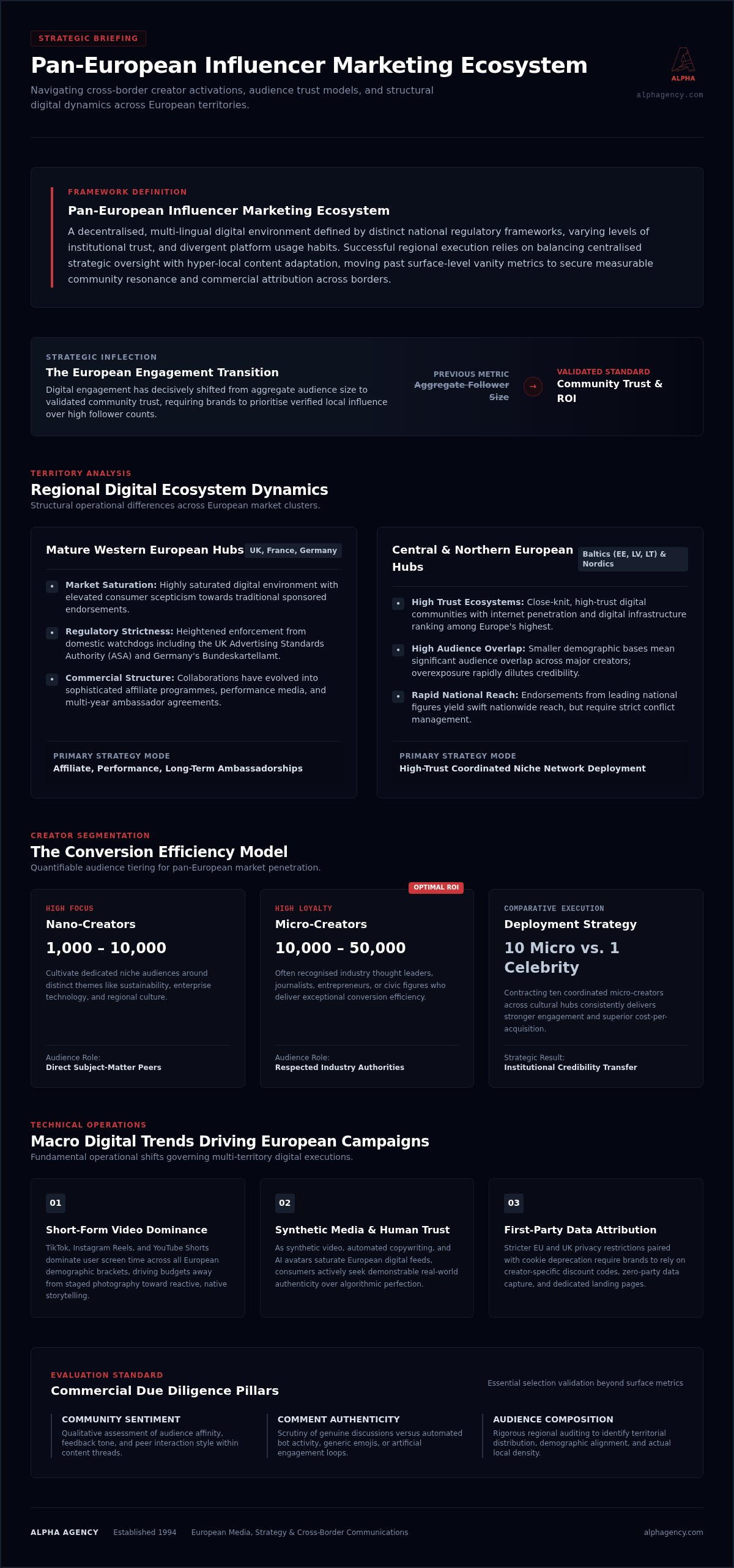
Europe's creator ecosystem is decentralised and multilingual, with different national regulations, levels of consumer trust and platform habits. Successful European campaigns balance central strategic oversight with meaningful local adaptation, while measuring outcomes beyond follower counts and surface-level engagement.
Understanding the European Influencer Landscape in 2026
Operating across European digital channels requires a clear understanding of regional media consumption. In established Western European markets such as the UK, France and Germany, audiences encounter a high volume of sponsored content and may be more sceptical of conventional endorsements. Advertising and consumer-protection rules also vary by country. In the UK, the Advertising Standards Authority (ASA) and Competition and Markets Authority (CMA) provide guidance on identifying commercial content, while Germany applies its own advertising and unfair-competition framework. In these markets, creator marketing increasingly includes affiliate partnerships, performance campaigns and long-term brand ambassador programmes.
Central and Northern European markets, including Estonia, Latvia and Lithuania, often have smaller and more closely connected creator communities. Internet use and digital public services are well established, but audience overlap between leading creators can be exceptionally high. A prominent national creator may deliver rapid reach, while frequent or conflicting sponsorships can quickly weaken credibility.
Cross-border reach is important for brands seeking regional growth, yet many organisations struggle to scale beyond their domestic market. Creator partnerships are often treated as isolated experiments rather than part of a wider communications strategy. When creator activity is disconnected from media buying, public relations and other marketing channels, results become inconsistent and the overall message becomes fragmented.
By 2026, successful European campaigns increasingly prioritise relevant local influence and audience trust rather than follower counts alone.
The Rise of Nano and Micro-Influencers
Across leading European consumer economies, smaller creators consistently outpace macro-influencers in conversion efficiency and audience loyalty. In markets like Germany, France and the Nordic countries, nano-creators (typically 1,000 to 10,000 followers) and micro-creators (10,000 to 50,000 followers) cultivate highly focused audiences around themes such as sustainable living, industrial design, enterprise technology and regional cuisine.
In smaller European markets and regional hubs, these creators are often recognised industry thought leaders, journalists, entrepreneurs or civic figures. Their audiences may view them as credible peers rather than simply as entertainers. For international consumer brands entering regional markets, coordinating several micro-influencers across different cultural areas frequently produces higher engagement, more sustainable website traffic and better cost-per-acquisition metrics than committing the entire budget to one celebrity.
Identifying these niche authorities requires evaluating quantitative data alongside cultural context. Brands must look beyond basic engagement rates to examine community sentiment, comment authenticity and audience composition. When an enterprise software vendor, public health body or retailer partners with a respected subject-matter expert, the collaboration can strengthen the organisation's credibility with a relevant audience.
Digital Trends Shaping the Region
Several broader trends are changing how creator campaigns are planned and produced across Europe:
- Short-Form Video Dominance: TikTok, Instagram Reels and YouTube Shorts have increased demand for platform-native video, reducing reliance on highly staged studio content.
- Synthetic Media and AI Content: The rapid emergence of artificial intelligence tools for virtual avatars, synthetic video, and automated copywriting has flooded European social feeds. Consequently, European consumers actively look for demonstrable human authenticity, rewarding unvarnished, transparent, real-world experiences over algorithmic perfection.
- First-Party Data Integration: Stricter platform privacy restrictions and the deprecation of third-party tracking have forced brands across the European Union and the UK to rely on creator-driven discount codes, zero-party data capture, and dedicated landing pages for attribution.
- Commerce Integration: Social commerce features continue to expand, though adoption remains uneven. While UK and Nordic consumers adopt native in-app shopping relatively quickly, German and Central European consumers frequently prefer purchasing via secure, local e-commerce checkouts that offer familiar payment methods like Klarna, PayPal, or local direct bank links.
How to Select the Right Influencers for Your National Campaign
Executing an effective multi-country campaign requires moving beyond instinct and vanity metrics towards evidence-based creator selection. International campaigns often struggle when brand teams choose creators with the largest national followings without checking where those audiences are located or whether they match the intended customer profile.
A creator based in Paris may have 40% of their audience outside France, while a popular creator in Tallinn may attract substantial viewership from Finland or Latvia. Without proper verification, cross-border budgets can be wasted on impressions outside the intended market. A consistent selection framework helps protect the investment:
- Define Strict Commercial KPIs: Establish clear primary conversion objectives before reviewing talent. Are you seeking brand search lift, physical retail store footfall, direct e-commerce conversions, or public awareness around a civic policy?
- Verify Audience Demographics and Authenticity: Use platform analytics to confirm that at least 65% of a creator's audience resides within the specific target territory, matching your customer age, gender, and language profiles.
- Review Brand and Values Alignment: Examine a creator's past twelve months of content, public positions and commercial partnerships to confirm that they align with your brand standards and regulatory obligations.
- Assess Language and Cultural Fluency: Confirm that the creator understands the language and culture of the market instead of relying on generic scripts translated for several countries.
- Evaluate Production and Distribution Reliability: Audit the creator's historical adherence to delivery timelines, editorial guidelines, and disclosure transparency in past commercial partnerships.
Vetting for Authenticity and Engagement
Audience fraud remains an operational challenge across European social media ecosystems. Creator accounts frequently suffer from purchased bot followers, engagement pods (informal syndicates of creators commenting on each other's posts to manipulate ranking algorithms), and sudden, unnatural spikes in historical follower growth.
To identify genuine audience engagement, look closely at the relationship between views, likes, and qualitative comments. In genuine interactions, user comments discuss the actual subject matter of the content rather than relying on generic praise, emojis, or one-word replies. Furthermore, agencies and corporate brand managers should evaluate historical view-to-follower ratios on video content. On platforms like Instagram and TikTok, a creator whose average organic video views consistently represent less than 5–8% of their total follower count often indicates an inactive, inflated, or unengaged audience base.
It is equally critical to review past brand partnerships. If a creator regularly promotes competing consumer electronics, FMCG products, or cosmetic brands within days of each other, audience trust rapidly erodes. Audiences recognise indiscriminate promotion, sharply lowering the commercial return of future brand endorsements.
Language and Cultural Nuances
A primary error made by international brands executing pan-European strategies is assuming that English-language creative messaging or simple linguistic translation suffices across non-English speaking European markets. While English proficiency is high across the Nordics, the Netherlands, and urban business hubs in Germany and Central Europe, consumer purchasing decisions, public sector messages, and lifestyle considerations remain deeply tied to national languages.
Consider the European landscape: executing a cohesive campaign across Germany, Poland, and the Baltic region involves five distinct primary languages (German, Polish, Estonian, Latvian, and Lithuanian) across three entirely separate linguistic families. A literal translation of a British or North American advertising script usually sounds artificial or culturally out-of-touch when delivered by a European creator.
Brands must grant local creators creative freedom within strict brand boundaries. The creator knows the colloquialisms, regional references, and emotional cues that resonate with their audience. An effective partner coordinates the overarching strategic goals and compliance rules centrally, while empowering the local creator to interpret the narrative in their authentic voice.
Developing a High-Impact Influencer Strategy: A Step-by-Step Guide
Scaling creator collaborations across several European territories requires an operational framework that minimizes administrative friction and protects the brand's reputation. Whether managing talent directly or working through a specialised partner, campaigns must follow a structured, multi-phase execution process.
-
Phase 1: Strategic Planning and Budget Allocation
Define target territories and allocate budgets based on media cost variations across Europe. Creator fees in the UK, Germany, and France sit at a significant premium compared to Central, Eastern, or Baltic European markets. Determine your allocation across nano, micro, and macro tiers to balance broad regional awareness with localised conversion. Establish cross-border attribution frameworks, including trackable URLs with UTM parameters, custom promo codes, and dedicated landing pages.
-
Phase 2: Creative Briefing and Flexibility
Develop structured creative briefs that define clear campaign goals, mandatory brand messages, product claims, prohibited terms, and regulatory disclosure mandates, while leaving room for the creator's personal style. Avoid writing rigid, line-by-line scripts. Instead, provide creators with core thematic pillars, product demonstration objectives, and explicit calls to action tailored to each European market.
-
Phase 3: Contracts and Content Approval
Issue clear contracts covering intellectual property ownership, usage rights across paid media channels (such as whitelisting or dark posting), exclusivity timeframes, payment schedules, and regulatory compliance. Establish a multi-tier review workflow where brand teams verify factual accuracy, technical claims, and legal disclaimers before any asset goes live.
-
Phase 4: Campaign Rollout and Active Community Engagement
Coordinate publishing dates across markets to maximise search visibility, press coverage, and complementary offline media. Monitor live comment sections closely during the first 48 hours post-launch to answer product questions, gauge sentiment, and address any customer inquiries or misinformation quickly.
-
Phase 5: Attribution Modelling and Post-Campaign Optimisation
Analyse performance data past vanity likes and video impressions. Measure direct conversions, referral traffic quality, engagement duration, brand search volume changes, and sentiment shifts across each European market. Identify top-performing creators to retain for long-term ambassador partnerships or content licensing arrangements.
Crafting the Perfect Creative Brief
The creative brief serves as the operational bridge between corporate strategy and creative expression. A brief that is too restrictive results in stiff, corporate advertorials that audiences ignore; a brief that is too loose risks off-brand messaging or regulatory violations.
Every international brief must include a distinct visual direction section, product handling instructions, clear examples of effective calls to action, and explicit deadlines for initial concepts, draft submissions, revisions, and publication dates. For cross-border activations, provide creators with locally available product variants, correct pricing in local currencies (such as EUR, GBP, PLN, or SEK), and verified links to local e-commerce stores or regional distributors. Providing creators with clear operational parameters enables them to deliver their best creative work while protecting your brand's standards.
Measuring What Matters
Measuring the commercial return of influencer campaigns across diverse markets requires isolating vanity metrics from concrete commercial indicators. High view counts do not necessarily indicate commercial success if those views fail to drive downstream action.
A robust European measurement framework tracks performance across three distinct tiers:
- Top-Funnel Brand Lift: Tracked via branded search query volume increases in the target market during and immediately following the campaign, aided and unaided brand recall studies, and qualitative sentiment analysis of audience comments.
- Mid-Funnel Commercial Intent: Tracked via outbound link clicks, average session duration, bounce rates on dedicated campaign landing pages, and engagement with interactive features like polls, link stickers, and direct messages.
- Bottom-Funnel Commercial Attribution: Tracked via custom promotional discount codes, dedicated affiliate links, conversion rates on local e-commerce checkouts, and incremental sales lift analyses comparing exposed versus unexposed regional markets.
To calculate the true commercial return of a multi-market European campaign, calculate your Net ROI by dividing the gross profit generated directly from creator-attributed channels–minus all creator fees, agency management retainers, and product sampling costs–by the total campaign expenditure, expressed as a percentage.
Integrating Influencers into a 360-Degree Media Strategy
A common weakness in influencer marketing is treating creator collaborations as a separate, one-off tactic. Used alone, creator content may produce a short increase in attention that quickly fades. To create longer-term value, organisations should integrate creator assets into the wider media strategy.
Across European retail, tourism and consumer-goods markets, brands increasingly reuse creator-generated content in their wider advertising. An authentic short-form video from a trusted local creator frequently outperforms more expensive studio content when used as a paid asset on Meta, TikTok or programmatic platforms. Creator content can connect brand advertising with the credibility of a familiar voice.
Creator marketing can also support public relations, events and traditional media. When a brand enters a new European market, coordinating creator content with pop-up events, digital out-of-home media and targeted trade PR can sustain visibility and support the customer journey.
Amplifying Content through Media Buying
Organic creator posts reach only part of the potential audience. Paid amplification–often described as creator licensing, partnership ads or whitelisting–allows brands to extend the reach of suitable creator content.
With the creator's permission and the appropriate platform access, a brand can run paid advertising through or in association with the creator's account. This offers several advantages for European campaigns:
- Hyper-Targeted Regional Audience Reach: Brands can use the creator’s authentic handle to target specific demographic segments, postcodes, or professional interests far beyond the creator's organic follower base.
- Precise Budget Optimization: Brands can allocate paid media spend behind the top-performing organic creative assets, ensuring advertising budgets support messages with proven conversion power.
- Direct E-Commerce Calls to Action: Paid creator ads can support click-to-shop buttons, destination URLs and product catalogues that may not be available in the same way through organic posts.
- Extended Asset Lifespans: High-performing creator content can remain active as a paid acquisition asset for months, long after the original organic post has dropped off followers' primary feeds.
Legal Compliance and Disclosure Standards
Operating across Europe requires strict adherence to digital consumer-protection legislation and advertising-disclosure standards. The regulatory environment is shaped by European Union rules–including the Unfair Commercial Practices Directive–and by the national laws and guidance that apply in each market.
In Germany, commercial relationships should be labelled clearly with terms such as "Anzeige" or "Werbung", where required. In the United Kingdom, guidance from the ASA and Competition and Markets Authority (CMA) calls for prominent, upfront identifiers such as #Ad or #Advertisement and warns against vague or hidden disclosures.
Across Europe, national consumer-protection and advertising rules address hidden commercial endorsements, misleading environmental claims and non-compliant pricing information. Whether an organisation manages creators internally or works with a European influencer marketing partner, advertising disclosures should be clear, prominent and appropriate for the language and market in which the content appears.
For organisations operating in the public sector, healthcare or regulated B2B industries, compliance requirements can be even more demanding. Content must be factually accurate, supported by appropriate evidence and free from misleading claims. Poorly managed compliance can expose a brand to legal and reputational risk in several jurisdictions at once.
Scaling Your Brand with an Expert European Marketing Partner
Managing multi-market campaigns internally can stretch in-house marketing teams. Working across languages, legal frameworks, currencies and creator networks quickly creates operational bottlenecks. An experienced full-service European marketing partner can provide the coordination, local knowledge and cross-border capabilities required to scale efficiently.
Established in 1994, Alpha Agency helps brands and organisations navigate complex markets through integrated strategy, creative work, media planning and cross-border communications. Rather than treating creator marketing as a separate service, Alpha Agency connects creator partnerships with the broader marketing mix.
With a network spanning Northern, Central and wider European markets, Alpha Agency combines central strategic management with local cultural knowledge. This approach keeps the core brand message consistent while allowing creators to communicate it naturally in their own language and cultural context.
The Value of Full-Service Integration
The primary advantage of an integrated, full-service agency model lies in eliminating operational silos. Specialist boutique influencer agencies often focus exclusively on creator management, leaving the brand to handle media buying, public relations, creative production, and analytics integration separately. This fractured approach leads to inconsistent brand messaging, duplicated agency fees, and lost opportunities for cross-channel media amplification.
When creator marketing is developed in direct alignment with integrated agency services–including digital performance marketing, offline and digital out-of-home media buying, public relations, and website analytics–every creator asset works to achieve measurable business results. Content produced by regional creators can be used for paid social funnels, repurposed for out-of-home billboards, featured in retail point-of-sale environments, and supported by coordinated PR campaigns.
This integrated methodology reduces overall customer acquisition costs, secures commercial usage rights up front, and guarantees unified messaging across every consumer touchpoint, as evidenced across Alpha Agency’s multi-market portfolio of client work.
Building Sustainable Cross-Border Growth
Achieving durable market share across Europe requires shifting away from one-off, transactional creator posts toward long-term strategic partnerships. Isolated campaigns rarely build lasting brand affinity; sustained commercial growth is built through repeated, authentic endorsements over time.
Long-term brand ambassadors become genuine advocates for your brand. They develop deep familiarity with your products or civic initiatives, weave brand narratives into their regular editorial cadence, and deliver higher conversion rates over extended sales cycles. For brands operating in complex consumer goods, tourism, enterprise B2B, and public awareness sectors, an integrated European partner provides the strategic guidance and operational stability necessary to build, manage, and scale these collaborative networks over years, rather than weeks.
Frequently Asked Questions
How do I choose between an influencer marketing agency and a full-service agency?
Boutique influencer agencies focus specifically on talent casting and social-native campaign management, which can work well for isolated, single-channel activations. However, for organisations looking to scale internationally, enter new regional markets, or align creator content with broader corporate goals, a full-service agency is usually the stronger choice. Full-service agencies integrate creator collaborations directly into cross-border media planning, paid advertising, public relations, and performance measurement, ensuring consistent messaging and better cost efficiency across every marketing channel.
What are the current influencer marketing regulations across European markets?
Influencer marketing across Europe is governed by European Union consumer-protection rules and the national laws and guidance applicable in each market. In the UK, relevant bodies include the ASA and CMA, while Germany applies its advertising and unfair-competition framework through the relevant courts, authorities and industry bodies. Paid, gifted or otherwise incentivised content generally needs to be clearly and prominently identified using explicit labels such as #Ad, #Advertisement or an appropriate local-language equivalent such as Werbung. Disclosures should be visible before the user interacts with the content and should not rely on ambiguous abbreviations. Health, financial and environmental claims may be subject to additional requirements.
Can I run a single, unified influencer campaign across Europe or regional market clusters?
While you can establish a single overarching creative concept, messaging framework, and budget centrally, content execution must be adapted to each individual market. Europe is culturally, linguistically, and commercially diverse. Direct translations of creative concepts rarely succeed across different markets like the UK, Germany, Poland, and the Nordic-Baltic regions. Successful campaigns use a centralised strategic brief while allowing local creators the autonomy to communicate key brand values in their own language and cultural style.
How much should an organisation budget for a multi-country European influencer campaign?
Budgets vary widely based on target territories, creator tiers, and the campaign's operational scope. Media and creator fees in mature Western European economies like the UK, Germany, and France sit at a significant premium compared to Central Europe, Southern Europe, or regional hubs in the Baltic states. A credible multi-country campaign should budget not only for upfront creator production fees, but also for content licensing rights, paid media amplification (whitelisting), translation and localisation management, and analytical attribution tracking.
What is the operational difference between micro and macro-influencers in regional European markets?
Macro-influencers (typically 100,000 to 1,000,000+ followers) deliver rapid top-of-funnel reach and high-profile visual awareness across broad national demographics, though their engagement rates are often lower and audiences may be geographically dispersed. Micro-influencers (10,000 to 50,000 followers) generally command higher engagement rates, lower audience crossover, and deep community trust within specific geographic, linguistic, or topical niches. In smaller European markets, micro-creators are often respected civic figures, business professionals, or community leaders, offering exceptional conversion efficiency for targeted campaigns.
How do I measure the true commercial success of an influencer campaign across borders?
Measuring true commercial return requires tracking indicators beyond surface-level likes and impressions. Implement a structured attribution framework using unique promotional codes, trackable UTM links, dedicated landing pages, and point-of-sale customer surveys. Review middle-funnel metrics like link clicks, landing page dwell time, and bounce rates alongside bottom-funnel e-commerce sales or direct inquiries. Furthermore, measure broader brand impact by tracking changes in regional branded search volume and organic traffic before, during, and after the campaign across each target market.
Is influencer marketing effective for industrial and B2B brands in Europe?
Yes, when deployed with a tailored B2B strategy. Rather than using lifestyle consumer creators, B2B influencer campaigns partner with industry thought leaders, management consultants, technical specialists, academics, and key executives on platforms like LinkedIn and YouTube. In European B2B sectors, creator marketing works effectively through co-authored whitepapers, executive podcast appearances, video product demonstrations, and event keynotes, helping shorten complex, multi-stakeholder enterprise sales cycles by building credible third-party trust.
Planning an integrated, multi-market campaign across Europe? Connect with Alpha Agency to discuss your strategic objectives, explore cross-border media execution, and build a coordinated marketing program tailored to your target markets.
How do I choose between an influencer marketing agency and a full-service agency?
Boutique influencer agencies focus specifically on talent casting and social-native campaign management, which can work well for isolated, single-channel activations. However, for organisations looking to scale internationally, enter new regional markets, or align creator content with broader corporate goals, a full-service agency is usually the stronger choice. Full-service agencies integrate creator collaborations directly into cross-border media planning, paid advertising, public relations, and performance measurement, ensuring consistent messaging and better cost efficiency across every marketing channel.
What are the current influencer marketing regulations across European markets?
Influencer marketing across Europe is governed by European Union consumer-protection rules and the national laws and guidance applicable in each market. In the UK, relevant bodies include the ASA and CMA, while Germany applies its advertising and unfair-competition framework through the relevant courts, authorities and industry bodies. Paid, gifted or otherwise incentivised content generally needs to be clearly and prominently identified using explicit labels such as #Ad, #Advertisement or an appropriate local-language equivalent such as Werbung. Disclosures should be visible before the user interacts with the content and should not rely on ambiguous abbreviations. Health, financial and environmental claims may be subject to additional requirements.
Can I run a single, unified influencer campaign across Europe or regional market clusters?
While you can establish a single overarching creative concept, messaging framework, and budget centrally, content execution must be adapted to each individual market. Europe is culturally, linguistically, and commercially diverse. Direct translations of creative concepts rarely succeed across different markets like the UK, Germany, Poland, and the Nordic-Baltic regions. Successful campaigns use a centralised strategic brief while allowing local creators the autonomy to communicate key brand values in their own language and cultural style.
How much should an organisation budget for a multi-country European influencer campaign?
Budgets vary widely based on target territories, creator tiers, and the campaign's operational scope. Media and creator fees in mature Western European economies like the UK, Germany, and France sit at a significant premium compared to Central Europe, Southern Europe, or regional hubs in the Baltic states. A credible multi-country campaign should budget not only for upfront creator production fees, but also for content licensing rights, paid media amplification (whitelisting), translation and localisation management, and analytical attribution tracking.
What is the operational difference between micro and macro-influencers in regional European markets?
Macro-influencers (typically 100,000 to 1,000,000+ followers) deliver rapid top-of-funnel reach and high-profile visual awareness across broad national demographics, though their engagement rates are often lower and audiences may be geographically dispersed. Micro-influencers (10,000 to 50,000 followers) generally command higher engagement rates, lower audience crossover, and deep community trust within specific geographic, linguistic, or topical niches. In smaller European markets, micro-creators are often respected civic figures, business professionals, or community leaders, offering exceptional conversion efficiency for targeted campaigns.
How do I measure the true commercial success of an influencer campaign across borders?
Measuring true commercial return requires tracking indicators beyond surface-level likes and impressions. Implement a structured attribution framework using unique promotional codes, trackable UTM links, dedicated landing pages, and point-of-sale customer surveys. Review middle-funnel metrics like link clicks, landing page dwell time, and bounce rates alongside bottom-funnel e-commerce sales or direct inquiries. Furthermore, measure broader brand impact by tracking changes in regional branded search volume and organic traffic before, during, and after the campaign across each target market.
Is influencer marketing effective for industrial and B2B brands in Europe?
Yes, when deployed with a tailored B2B strategy. Rather than using lifestyle consumer creators, B2B influencer campaigns partner with industry thought leaders, management consultants, technical specialists, academics, and key executives on platforms like LinkedIn and YouTube. In European B2B sectors, creator marketing works effectively through co-authored whitepapers, executive podcast appearances, video product demonstrations, and event keynotes, helping shorten complex, multi-stakeholder enterprise sales cycles by building credible third-party trust.