
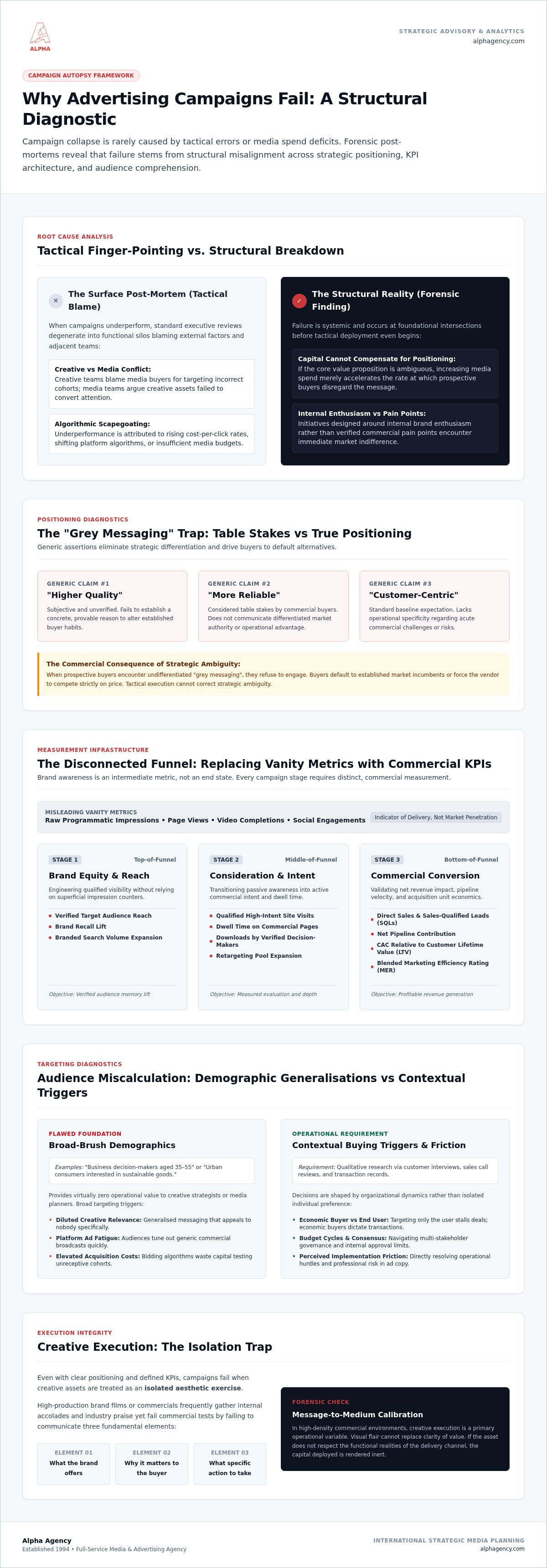
When an advertising campaign underperforms or fails entirely, the immediate reaction is predictable. Marketing directors review media dashboards, executives question the budget, and agencies point to changing platform algorithms or rising cost-per-click rates. The post-campaign review can quickly descend into finger-pointing: creative teams blame media planners for targeting the wrong audiences, while media buyers argue that the creative failed to turn attention into action.
For brand leaders and commercial directors managing multi-market campaigns, understanding why an advertising campaign failed requires looking beyond surface-level metrics. Campaigns rarely fail because of one tactical error or an insufficient budget. Failure is almost always structural. It occurs when strategic positioning, cross-channel execution, media planning, or knowledge of regional markets breaks down.
A useful campaign autopsy requires objective analysis. By isolating the systemic problems that derail campaigns, organisations can identify what went wrong, protect the brand equity they have built, and create a stronger foundation for predictable, profitable growth.
The Strategic Foundation: Why Positioning Trumps Budget
When an advertising initiative produces a negligible return on ad spend (ROAS) or fails to generate qualified leads, leadership often assumes the budget was too small to cut through the noise. Budget determines potential reach, but it cannot compensate for unclear positioning. If the value proposition is indistinct, increasing media spend simply exposes more prospective customers to a message they can ignore.
Brand positioning is the distinct place a product, service, or organisation occupies in the buyer's mind compared with alternative solutions. Many campaigns rely on generic claims such as "higher quality," "more reliable," or "customer-centric." These are not meaningful points of difference; customers already expect them. Faced with generic claims, buyers tend to choose an established provider or compare offers primarily on price.
A strategic autopsy should determine whether the campaign gave people a clear reason to change their existing behaviour and choose the brand. When campaigns are built around internal enthusiasm rather than verified customer problems, the market responds with indifference. Strong execution cannot rescue an unclear strategy.
The Pitfalls of Vague Objectives and Key Performance Indicators
A primary cause of campaign failure is the absence of clearly defined, mutually agreed objectives. Multi-channel initiatives often unravel because leadership and delivery teams evaluate success against different targets.
Treating "increasing brand awareness" as a standalone commercial objective without supporting performance benchmarks makes the campaign difficult to evaluate. Awareness is an intermediate outcome, not the final business result. When objectives are vague, reporting tends to fall back on vanity metrics–impressions, page views, video completions, and social engagement–to suggest progress. These figures may confirm delivery, but they do not show market penetration, pipeline velocity, customer acquisition cost (CAC), or revenue impact.
To align expectations, each stage of the campaign requires distinct, measurable key performance indicators (KPIs):
- Top-of-Funnel (Brand Equity & Reach): Measure verified target audience reach, brand recall lift, and branded search volume rather than raw programmatic impressions.
- Middle-of-Funnel (Consideration & Intent): Track qualified site visits, dwell time on high-intent commercial pages, content downloads from verified decision-makers, and retargeting pool expansion.
- Bottom-of-Funnel (Commercial Conversion): Monitor direct sales, sales-qualified leads (SQLs), pipeline contribution, customer acquisition cost relative to customer lifetime value (LTV), and the marketing efficiency ratio (MER).
When sales pipelines fail to reflect the high impression volumes reported by media platforms, the stages of the funnel are disconnected. Awareness must build intent, and people showing intent must have a clear path to conversion.
Misunderstanding the Target Audience
Modern advertising campaigns frequently fail because they rely on demographic generalisations rather than contextual behavioural triggers. Defining a target audience as "business decision-makers aged 35–55" or "urban consumers interested in sustainable goods" provides virtually no operational value to creative strategists or media buyers.
Effective campaigns target specific buying triggers, operational pressures, and risk profiles. In B2B or high-consideration consumer environments, purchase decisions are rarely driven by individual preference alone; they are shaped by internal consensus, budget cycles, perceived professional risk, and implementation friction. If campaign messaging addresses only the end user and ignores the economic buyer, the transaction stalls.
Messaging resonates when it reflects the prospect's immediate problems, anticipated objections, and operating reality.
Broad personas lead to broad targeting. That weakens creative relevance, accelerates ad fatigue, and drives up acquisition costs as platforms spend budget testing unreceptive audiences. A successful turnaround begins with qualitative research: customer interviews, sales-call reviews, and transaction data that reveal how customers describe their problems in their own words.
Creative Miscalculation: When the Message Fails the Medium
Even with distinct positioning and clear KPIs, an advertising campaign will fail if the creative assets do not command attention, establish relevance, and respect the functional requirements of the media channel. In high-density advertising environments, creative execution represents a major performance variable.
A frequent error among brand managers is treating creative production as an isolated aesthetic exercise. A television commercial or high-production digital film may win internal accolades and industry praise, yet fail completely to communicate what the brand offers, why it matters, or what action the viewer should take. If your audience finishes watching an advertisement without a clear understanding of the commercial proposition, the creative has failed.
Campaigns also fall into the "uniqueness gap." Brands spend heavily explaining why they are slightly better at the same task instead of showing how they are meaningfully different. People are more likely to remember a distinct alternative than a claim of marginal superiority. A recognisable difference is therefore more memorable–and commercially valuable–than another promise of being slightly better.
The Danger of Inconsistent Visual Identity
Visual and conceptual fragmentation erodes commercial campaign effectiveness. When an organisation runs outdoor billboards, programmatic display banners, paid social video, and search marketing that look, sound, and feel like they originate from different companies, consumer memory retention collapses.
Advertising works via memory structures built through repetition and consistency over time. Distinctive brand assets–such as logomarks, proprietary typography, specific colour palettes, sonic branding, and recurring brand characters–act as psychological shortcuts. When these assets are applied inconsistently, prospective customers fail to attribute individual impressions to the parent brand. The media spend of one channel fails to compound the impact of another.
Maintaining a cohesive identity across a complex, multi-channel campaign requires disciplined execution. Professional branding and advertising services ensure that every asset–regardless of its format, scale, or channel–reinforces one recognisable visual system and is clearly attributed to the brand.
Creative Adaptation vs. Simple Translation
One of the most persistent causes of campaign failure in international or multi-market expansions is the assumption that high-performing domestic creative can simply be translated into a new language and deployed abroad. This practice, common among brands scaling across borders, regularly results in commercial failure.
Language carries cultural context, humour, social conventions, idiomatic nuance, and historical references. Direct translation can strip a creative hook of its emotional impact, producing copy that is technically correct but unnatural to a native audience.
International campaigns require transcreation: adapting a concept so that it retains its original intent, commercial tone, and impact while fitting the cultural and linguistic context of the target market. Use the following checklist before approving creative for international deployment:
| Creative Element | Direct Translation Risk | Transcreation Requirement |
|---|---|---|
| Headlines & Hooks | Loss of wordplay, cultural puns, or rhetorical cadence. | Rewrite using local idioms, colloquial phrasing, and native metaphors. |
| Visual Semiotics | Symbols, gestures, or lifestyle imagery that clash with local norms. | Audit visual references against regional societal and visual expectations. |
| Tone of Voice | Appearing overly aggressive, excessively familiar, or inappropriately dry. | Calibrate directness and formality to local commercial communication norms. |
| Calls to Action (CTAs) | Using generic prompts that misalign with local consumer buying stages. | Align CTAs with how local buyers prefer to initiate commercial relationships. |
Media Planning Friction: The Invisible Budget Drain
Even exceptional creative supported by precise positioning will fail if the media plan does not reach the right prospects often enough. Media planning is more than purchasing digital or offline advertising space; it is the strategic management of audience attention, reach, frequency, and context.
One of the main operational causes of poor performance is media wastage. It occurs when advertising reaches people outside the addressable market, oversaturates a narrow audience, or appears in environments where the audience has no purchase intent. When left on default automated settings, digital platforms tend to optimise for efficient delivery rather than meaningful business outcomes. Without firm controls, a platform can spend the daily budget on impressions from low-quality inventory.
Media planners must balance reach–the number of unique people exposed to the campaign–with effective frequency–how often each person encounters the message. Running a broad-reach campaign at a frequency of 1.2 in a competitive category guarantees that the vast majority of the audience will forget the message within hours. Excessive frequency, however, produces diminishing returns, ad fatigue, and a higher cost per acquisition.
Optimising Media Buying and Placement
High-performance campaigns rely on disciplined cross-channel media planning that unifies digital performance channels with broad-reach offline media. Operating digital channels in isolation from traditional channels often limits overall effectiveness.
Offline media–including Out-of-Home (OOH), Digital Out-of-Home (DOOH), terrestrial radio, and connected television (CTV)–builds broad-market legitimacy, drives mental availability, and lowers customer acquisition costs across digital search and social channels. When potential buyers encounter an authentic brand in physical space or premium broadcast environments, their propensity to click and convert on direct-response digital ads increases significantly.
Securing high-impact inventory requires experienced negotiation, market intelligence, and continuous optimisation while the campaign is live. If early results show that a network, publisher, or geographical area is underperforming, budget must be reallocated to stronger channels without delay.
The Attribution Problem: Why You Think It Failed
Sometimes, an advertising campaign did not actually fail; rather, flawed measurement systems made a successful campaign appear ineffective. This misdiagnosis is common when marketing leaders evaluate performance through rigid attribution models.
The widespread reliance on "last-click" or "last-touch" attribution gives 100% of the commercial credit to the final touchpoint the buyer engaged with prior to conversion–typically branded search, direct navigation, or retargeting banners. Consequently, brand-building initiatives, PR coverage, top-of-funnel video, and OOH media receive zero attribution credit, leading finance and marketing leaders to deem them unprofitable and terminate their funding.
Terminating these awareness drivers invariably causes the performance of bottom-of-funnel conversion channels to collapse in subsequent quarters. Without continuous top-of-funnel demand generation, the pool of high-intent prospects dries up.
To accurately assess campaign effectiveness, modern organisations must adopt a balanced measurement framework:
- Marketing Efficiency Ratio (MER): Compare total revenue with total marketing or advertising expenditure across all channels, using one consistently defined calculation throughout the reporting period.
- Incrementality Testing: Run geo-targeted holdout tests where advertising is withheld from specific territories to measure true incremental revenue generated by media exposure.
- Marketing Mix Modelling (MMM): Use econometric analysis to understand how varied channels (both online and offline) interact and contribute to baseline sales.
- Qualitative Self-Reported Attribution: Include a simple, open-ended "How did you hear about us?" field on digital lead forms and checkout pages to capture non-trackable touchpoints like word of mouth, podcasts, or physical events.
Regional Realities: Navigating Central European Cross-Border Complexities
For brands expanding internationally, Central Europe offers substantial opportunity but also significant complexity. Many Western brands encounter problems when they treat the region as one uniform economic bloc. Deploying the same strategy and creative campaign across Poland, the Czech Republic, Slovakia, and Hungary without local adaptation is a frequent cause of market-entry failure.
Although these countries are geographically close, their competitive structures, historical contexts, purchasing behaviour, and digital ecosystems differ considerably. Navigating those differences requires strategic judgement and genuine cross-border expertise.
Understanding regional dynamics is central to our advisory approach. Backed by decades of cross-border operational experience, Alpha Agency helps organisations navigate cultural and media differences across international markets and build campaigns that can succeed locally.
Localisation Failures in Central European Markets
Campaigns across Central Europe regularly fail because brands overlook local infrastructure, retail habits, and purchasing behaviour. A campaign that succeeds in Germany or the UK cannot simply be translated into Polish or Czech and be expected to perform identically.
Consider several structural differences across key Central European economies:
Poland: As the largest market in Central Europe, Poland has an advanced digital ecosystem with strong domestic platforms. In e-commerce, Allegro remains a major marketplace alongside global competitors such as Amazon. Local payment preferences are equally important: failing to offer BLIK as a prominent checkout option will cause conversion rates to plummet, regardless of advertising spend. Campaigns therefore need a clear value proposition, locally relevant pricing, and familiarity with the platforms and payment methods Polish customers use.
The Czech Republic: Domestic platforms remain relevant within the Czech media landscape. Seznam.cz, for example, is an important complement to Google and may require dedicated search, display, and content-distribution planning. Pragmatic messaging, transparent product information, and locally appropriate humour can outperform creative that relies on boastful or high-pressure claims.
Slovakia and Hungary: Despite their proximity to Poland and the Czech Republic, Slovakia and Hungary have distinct purchasing cultures and media habits. Slovakia's use of the euro creates different pricing considerations from neighbouring non-euro markets. Hungary adds significant linguistic and regulatory complexity, and brands may need locally informed public relations and influencer activity to establish trust.
Deploying one pan-European campaign across these markets without detailed adaptation results in high bounce rates, poor conversion efficiency, and wasted media spend. Effective cross-border campaigns require local media knowledge, precise linguistic adaptation, and an understanding of how channel preferences vary by market.
Economic and Market Volatility Across Regional Borders
Cross-border campaigns also fail when strategic planners treat economic conditions as static. Central European markets operate under different macroeconomic pressures, including varying inflation rates, currency fluctuations–such as the Polish złoty, Czech koruna, and Hungarian forint against the euro–and distinct consumer-confidence cycles.
A premium value proposition that resonates in a high-income environment may fail in a market experiencing sharp inflation or falling consumer confidence. In that situation, the problem is not poor creative production but pricing misalignment and a failure to adapt the message to local purchasing power.
Agile international campaigns require contingency plans. If macroeconomic pressure increases in one market, teams must be able to redirect media investment towards more resilient markets or shift the message from luxury and aspiration to longevity, reliability, and cost-efficiency.
Turning Failure into Future ROI: The Integrated 360° Approach
When an advertising campaign misses its targets, the objective should be to identify the cause rather than assign blame. Failure is expensive, but it also produces evidence. Analysed correctly, that evidence reveals weaknesses in market positioning, wasted media investment, and the way the audience actually behaves.
Recovering from an underperforming campaign requires moving beyond disconnected marketing tactics towards an integrated 360° approach. When creative development, media buying, performance marketing, and public relations operate separately, gaps are inevitable. An integrated model aligns every activity with the same commercial outcome.
Multi-market turnarounds are built on integrated planning. Our work and case studies show how restructuring media distribution, sharpening brand identity, and coordinating cross-border communications can transform struggling regional campaigns into commercial successes.
The Audit: Questions to Ask Your Marketing Team and Agency Partners
To pinpoint the structural breakdown of a failed campaign, executive leaders should step away from standard dashboard metrics and present five diagnostic questions to their internal teams or external agency partners:
- Where did the drop-off occur along the buyer journey?
Did the campaign fail to generate interest (low click-through rate, poor reach), fail to engage on arrival (high bounce rate, low dwell time), or fail to close the sale (high cart abandonment, low form completion)? Isolating the point of drop-off identifies whether the issue was media targeting, creative resonance, or on-site conversion infrastructure. - Was media inventory audited for contextual relevance and brand safety?
Did programmatic buying algorithms place your assets on reputable, high-intent media properties, or was budget dissipated across low-quality inventory, MFA (made-for-advertising) websites, and inappropriate ad networks? - Did our creative assets respect channel-native consumption behaviours?
Were the creative assets designed specifically for the platform on which they were served, or did we deploy a static 16:9 television spot or print ad across vertical mobile feeds and fast-scrolling environments? - Was our pricing, offer, and messaging calibrated to regional market realities?
Did we account for local competitor pricing, domestic payment infrastructure, and cultural sentiment, or did we attempt to force an unadapted domestic playbook into an unfamiliar international market? - Did our attribution model reflect true commercial incrementality?
Are we declaring failure based solely on last-touch digital analytics, or have we assessed broader market impacts such as overall sales lift, branded search volume increases, and pipeline health?
Building a Resilient Multi-Market Campaign Architecture
Building future campaigns for predictable performance requires a resilient planning process based on four interdependent pillars:
1. Evidence-Based Market Research and Positioning
Before allocating creative production or media buying budgets, conduct rigorous qualitative and quantitative market testing. Confirm competitor positioning, establish target pricing thresholds, identify domestic payment expectations, and define a clear point of differentiation.
2. Channel-Native Creative and Transcreation
Develop creative concepts designed from inception to be adapted across formats and borders. Ensure distinctive brand assets are prominent, messaging avoids generic clichés, and international copy is transcreated by native market specialists rather than translated mechanically.
3. Balanced Omnichannel Media Planning
Balance long-term brand-building media with short-term conversion tactics. Ensure offline broad-reach channels support digital direct-response activations, and enforce strict frequency caps, negative audience exclusions, and rigorous domain whitelists to eliminate media waste.
4. Holistic Measurement and Iterative Optimisation
Deploy a multi-layered attribution framework combining blended media efficiency metrics, incrementality testing, and platform analytics. Establish clear pre-launch benchmarks and empower teams to reallocate investment while the campaign is live, based on meaningful commercial signals.
Architecting Your Next Campaign for Predictable Growth
A failed campaign provides critical operational feedback. It shows where generic messaging loses relevance, highlights weaknesses in media planning, and reinforces the need for regional adaptation when expanding internationally.
Correcting the course requires more than isolated tactical fixes. Long-term commercial success depends on an integrated approach that connects strategic positioning, high-quality channel-native creative, disciplined cross-border media buying, and transparent performance measurement.
When you are ready to audit an underperforming campaign, enter a new market, or improve commercial attribution, explore our integrated strategy, media, and creative services.
Why did my campaign get high clicks but zero conversions?
A high click-through rate (CTR) paired with negligible conversions points to a disconnect between the ad's promise and the destination experience. The creative may overpromise, or the landing page may fail to support its message. Technical friction–such as slow loading, a broken mobile interface, a complicated checkout, or the absence of a trusted local payment method such as BLIK in Poland–can also prevent motivated prospects from converting.
Is an insufficient budget the primary reason advertising campaigns fail?
Rarely. While an inadequate budget restricts total reach, it does not prevent a campaign from demonstrating initial commercial viability. A structurally sound campaign with clear positioning and relevant creative will convert profitably within a smaller, highly targeted audience. If a campaign fails to generate conversions at a moderate budget, increasing the budget simply amplifies the inefficiency. Verify the unit economics, positioning, and conversion journey before increasing spend.
How do I know if my creative assets caused the campaign failure?
Creative failure usually manifests in specific early-stage metrics: below-benchmark click-through rates, poor retention during the first three seconds of a video, a high cost per click across target audiences, and qualitative feedback showing that people do not understand the offer. If media delivery is reaching verified decision-makers within the addressable market but engagement remains absent, the creative has failed to capture attention or communicate value.
What is the most common mistake in cross-border advertising across Central Europe?
The most damaging mistake is treating Central European countries as one cultural and commercial market. Translating Western or German creative into Polish, Czech, or Hungarian without adapting the message to local purchasing behaviour, domestic platforms such as Seznam or Allegro, and regional payment preferences inevitably diminishes campaign effectiveness.
How long should an advertising campaign run before leadership decides it has failed?
The timeline depends on the campaign objective and the product's sales cycle. Direct-to-consumer e-commerce campaigns often provide actionable data within 14 to 21 days, allowing for statistical significance across landing page variants and ad creative. For high-consideration B2B, industrial, or enterprise solutions with multi-month buying cycles, declaring failure within 30 days is premature. B2B initiatives should be evaluated over 60 to 90 days against intermediate intent metrics (pipeline generation, qualified lead velocity, content engagement) before making major structural changes.
Can an underperforming campaign be salvaged while still live?
Yes, provided leadership acts on data rather than instinct. If early analytics indicate poor performance, conduct an immediate review: audit placement reports to eliminate low-performing programmatic domains, pause weak creative variations, narrow targeting to high-intent audiences, and align landing-page copy with the best-performing ad message. Real-time media optimisation and budget reallocation can restore performance before the campaign ends.
What role does media buying efficiency play in overall campaign profitability?
Media buying efficiency is critical to maintaining viable customer acquisition costs. Inefficient buying–such as bidding without frequency caps, failing to use exclusion lists, neglecting dayparting, or relying entirely on automated platform algorithms–inflates impression costs and drains marketing budgets on low-value traffic. Professional media planners secure advantageous rates, access premium inventory, and implement strict delivery controls that maximise the efficiency of working media.
Why is brand positioning critical for direct-response and performance advertising?
Performance advertising does not operate in a vacuum. When prospective buyers see a direct-response ad, their willingness to click and convert is shaped by brand perception and trust. Without distinctive positioning, a brand must rely more heavily on discounts and paid visibility to win the transaction. Clear, differentiated positioning creates mental availability, lowers customer acquisition costs, and drives organic and direct traffic that helps offset rising ad-platform auction prices.