
Comparing freelance invoices to a retainer is often the first mistake commercial leaders make. When evaluating hiring a freelance marketer vs an agency, the true question isn't just an accounting calculation; it's a structural decision about risk, governance, and operational scale.
You likely already understand the administrative friction of coordinating independent talent. Juggling separate contractors across creative production, paid media, and analytics quickly drains leadership bandwidth. When individual specialists work in silos, strategic alignment fractures, channel accountability blurs, and paper savings quickly erode under the weight of internal management drag.
This decision guide provides a clear framework to help you make an informed commercial choice between an agile freelancer and a full-service agency partner. We examine the true total cost of ownership, channel execution limits, and operational trade-offs so you can select the delivery model that best protects your growth trajectory.
Key Takeaways
- Assess organizational maturity and project complexity before deciding, as structural alignment outweighs raw skill sets.
- Compare total commercial ownership rather than baseline rates; internal management drag often inflates the true cost of disparate talent.
- Identify whether single-channel execution or integrated, multi-disciplinary infrastructure is required to reach your growth targets.
- Use our five-step governance audit to resolve the dilemma of hiring a freelance marketer vs an agency across domestic and cross-border initiatives.
- Discover practical hybrid delivery frameworks that balance agile tactical contractors with established strategic agency leadership.
Evaluating Freelancers and Agencies: Core Differences in Scope and Delivery
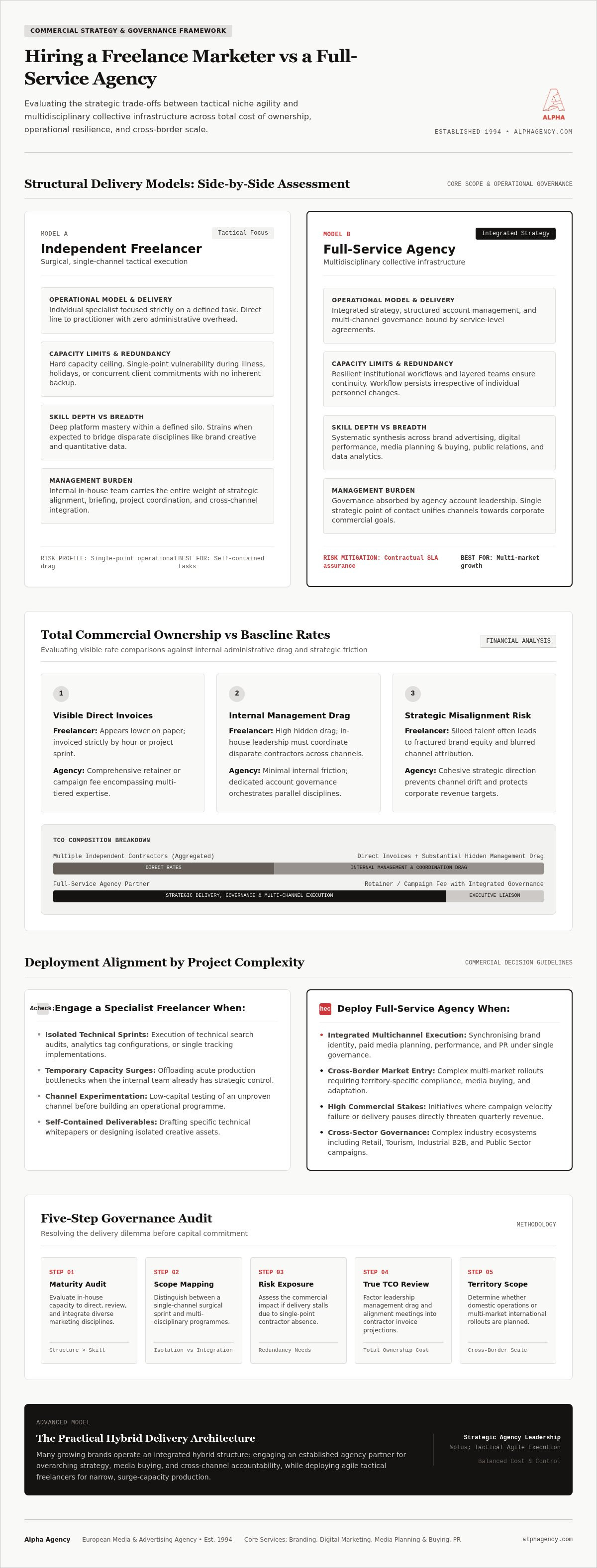
Commercial marketing outcomes depend on organizational structure as much as creative talent. When deciding on hiring a freelance marketer vs an agency, business leaders must separate individual execution from multidisciplinary collective infrastructure. A professional freelancer delivers tactical output within a tight scope; a full-service marketing agency provides integrated strategy, cross-channel governance, and scalable production capacity.
Project complexity reveals this structural divide immediately. Running an isolated performance campaign or drafting technical whitepapers requires narrow, highly focused attention. Conversely, launching integrated multi-channel campaigns, orchestrating public relations, and executing cross-border media buying demand cohesive alignment across distinct disciplines. Contractor models place the burden of strategic integration onto your in-house team. Agency partnerships absorb that governance into clear service-level agreements and unified accountability frameworks.
Operational Models and Capacity Limits
Individual operators face fixed capacity ceilings. When a contractor manages multiple concurrent client deadlines, falls ill, or takes leave, delivery stalls; there is no built-in redundancy to protect your campaign velocity. Established agency infrastructure mitigates this single-point vulnerability through shared institutional workflows, project governance, and layered teams. While independent specialists excel at tactical turnaround times, complex rollouts across retail, B2B, or regional territories require the operational resilience of structured account management.
Breadth of Skill Sets Versus Deep Niche Focus
Solo specialists offer distinct operational advantages when you need deep technical mastery of a single platform, such as auditing a tracking setup or developing isolated paid social assets. Friction arises when generalist freelancers attempt to bridge contradictory disciplines, such as combining high-level brand strategy with quantitative media analytics.
A full-service partner aligns these functions systematically. Through integrated services covering creative development, performance marketing, and media planning, an agency prevents strategic drift and ensures all channels drive towards unified commercial objectives. Balancing hiring a freelance marketer vs an agency ultimately centres on whether your growth roadmap requires an agile specialist or an integrated multi-market growth engine.
Assessing Project Complexity: When to Choose an Agency or a Freelancer
Strategic alignment begins by mapping marketing requirements against organisational maturity, campaign complexity, and commercial exposure. The decision between hiring a freelance marketer vs an agency isn't ideological; it's a structural response to business risk. If a campaign failure would jeopardise quarterly revenue or brand equity, the operational resilience of an integrated partner outweighs the nimbleness of an individual contractor. As detailed in executive discussions around choosing the right marketing partner, commercial maturity dictates whether tactical execution or multi-layered infrastructure is necessary.
Scenarios Where a Freelance Marketer Excels
Independent practitioners shine when tasks are self-contained and require surgical precision. Engaging a freelancer works best for:
- Conducting isolated technical sprints, such as search audits or bespoke tracking configurations.
- Absorbing surge capacity when an in-house team faces temporary production bottlenecks.
- Testing unproven channels with modest capital before building a permanent operational programme.
In these scenarios, direct access to the practitioner accelerates delivery without the overhead of enterprise-level account governance.
When Full-Service Agency Infrastructure Becomes Essential
Multi-faceted initiatives demand collective capability. Cross-discipline synchronisation becomes vital when coordinating concurrent initiatives: brand identity, media planning and buying, digital performance, and public relations. Aligning these moving parts internally creates immense administrative drag. Reviewing established Alpha Agency services demonstrates how cross-functional campaign orchestration connects strategic planning with creative production, outdoor media, and digital execution under unified oversight.
Cross-border expansion also demands multi-market presence. Entering new European territories requires local media buying networks, multilingual adaptation, and market-specific regulatory compliance, factors evident across international deployments in Alpha Agency client work. When resolving the dilemma of hiring a freelance marketer vs an agency for cross-border scale, an agency partner eliminates operational fragmentation and secures consistent brand positioning across borders.
The True Cost of Marketing Delivery: Beyond Hourly Rates
Superficial cost comparisons often derail marketing budget allocation. When weighing hiring a freelance marketer vs an agency, comparing a contractor's hourly rate directly against an agency retainer overlooks the total commercial cost of ownership. The headline fee on an invoice reflects only direct labour; it ignores the management hours, software overheads, and operational risk absorbed by your business.
Contractors require significant internal oversight to function effectively. Marketing leaders must brief them, track deliverables, manage conflicting schedules, and integrate separate outputs into a coherent strategy. This internal friction converts what appeared to be an economical hiring decision into an administrative burden that drains executive focus.
Hidden Management Overhead and Tooling Expenses
Managing multiple independent specialists introduces hidden operational expenses that quickly mount up across a quarter:
- Internal Management Drag: Marketing directors spend considerable high-value time reviewing drafts, resolving technical roadblocks, coordinating workflows between distinct contractors, and processing fragmented billing.
- Software and Data Licensing: Independent specialists rarely bring enterprise-grade tech stacks. Your organization must purchase and maintain standalone subscriptions for market research, SEO tracking, competitive intelligence, media analytics, and creative design software.
- Consolidated Infrastructure: Full-service agency partners absorb advanced media planning databases, reporting tools, and workflow automation into unified retainer or project arrangements, removing secondary software costs entirely.
Contractual Accountability and Business Continuity Risks
Direct freelancer relationships carry distinct institutional vulnerabilities. If an independent practitioner experiences illness, unexpected downtime, or prioritises a competing client, project momentum stops abruptly. In contrast, corporate agency agreements include enforceable service-level metrics, clear intellectual property guarantees, and built-in delivery redundancy.
Institutional continuity protects campaign momentum across shifting commercial environments. Structured agency governance ensures that documentation, project assets, and strategic learnings remain centralized within your business rather than isolated on an external contractor's laptop. To understand how long-term infrastructure safeguards strategic momentum, review the background and operating history documented about Alpha Agency. When evaluating hiring a freelance marketer vs an agency, remember that true commercial value lies in delivery certainty and overall net efficiency, not bottom-line invoice rates alone.
Strategic and Cross-Border Considerations for Growing Brands
Expanding across European and international markets turns marketing governance into an acute operational challenge. When deciding on hiring a freelance marketer vs an agency, scaling beyond domestic borders usually settles the debate. Independent contractors operate within localized boundaries; managing separate freelancers across multiple European markets multiplies administrative overhead, dilutes brand messaging, and fragments media planning.
Centralised strategic oversight protects your brand equity as you expand. Senior agency strategists connect campaign roadmaps directly to commercial board objectives, ensuring that messaging drives market share rather than vanity metrics. This overarching leadership unifies creative direction and media execution across jurisdictions while adapting each touchpoint for target audiences.
Managing Multilingual and Cross-Border Campaigns
Sourcing, vetting, and directing localized freelance talent across separate countries creates immense operational friction. Contracts differ, communication cadences stumble, and quality assurance demands constant oversight. An integrated agency coordinates cross-border media buying, outdoor advertising (OOH), and localized digital messaging through a single point of accountability. This structured approach maintains unified tone-of-voice standards and respects distinct European consumer behaviours, local compliance rules, and regional media nuances without creating client-side management fatigue.
Integrated Communications Across Paid, Earned, and Owned Media
Commercial returns multiply when brand advertising, performance marketing, and public relations reinforce one another. Isolated contractors inevitably optimize for their individual channel deliverables, whether that means paid clicks, press mentions, or social engagement. This fragmented approach creates disconnected functional silos that obscure attribution.
An agency infrastructure establishes cohesive cross-channel governance. Budget moves dynamically between offline media placements, PR initiatives, and digital performance channels based on net commercial yield. When assessing hiring a freelance marketer vs an agency for multi-territory growth, centralized strategic orchestration delivers the resilience and unified market presence required to capture sustained regional market share.
Explore integrated media and cross-border marketing services
Decision Framework: Selecting the Right Marketing Structure for Your Objectives
Selecting an execution model requires an objective audit of your internal capabilities and commercial goals. Resolving the choice of hiring a freelance marketer vs an agency does not require treating them as mutually exclusive absolutes. Many expanding organisations build adaptable delivery models that combine internal leadership, specialised contractors, and full-service agency infrastructure.
To determine the best operational structure for your pipeline, run your current setup through a structured diagnostic audit before signing contractor agreements or agency retainers.
The Five-Point Commercial Evaluation Audit
Evaluate your marketing operations against these five governance criteria:
- Leadership Bandwidth: Does your in-house team have the daily capacity to write briefs, direct creative iterations, and manage technical workflows, or do you need self-directed execution?
- Channel Breadth: Are you activating a single discipline like technical SEO, or orchestrating multi-channel programmes across branding, media planning, PR, and performance marketing?
- Growth Horizon: Is the immediate objective a short-term, three-week task sprint, or does it require sustainable multi-quarter market expansion?
- Risk Exposure: What is the financial cost if campaign delivery stalls or messaging misses the mark in critical markets?
- Financial Predictability: Does your governance favour variable, hourly contractor fees, or does budget management require consolidated retainer pricing with contractual commitments?
Constructing an Effective Hybrid Operational Model
High-growth businesses frequently adopt hybrid operational frameworks. Internal marketing directors maintain commercial strategy and brand ownership. Full-service agencies run complex cross-channel campaigns, media buying, and multi-market adaptations where shared infrastructure drives efficiency. In this setup, agile freelancers are deployed selectively for isolated, sprint-based tasks, such as specialised technical scripting or interim copywriting.
Governance determines whether a hybrid structure succeeds. Establish strict briefing standards, centralised asset storage, and unified reporting schedules across every external partner. When resolving the question of hiring a freelance marketer vs an agency, remember that your delivery structure should eliminate administrative friction, maintain strategic coherence, and protect executive focus as your business expands.
Aligning Your Marketing Infrastructure with Commercial Growth
Choosing the right operating model depends on operational scope and internal governance capacity. While independent specialists offer tactical speed for isolated projects, sustaining growth across competitive territories requires integrated multidisciplinary capability. When resolving the decision between hiring a freelance marketer vs an agency, look beyond baseline rates to evaluate the total commercial impact on your leadership bandwidth.
Operating across European and international markets since 1994, Alpha Agency delivers integrated solutions spanning strategic branding, performance digital marketing, and cross-channel media buying. With proven experience across consumer brands, B2B enterprises, tourism destinations, and public sector organisations, an established partner provides the institutional resilience needed to expand with confidence.
Frequently Asked Questions
What is the primary difference in cost structure between a freelance marketer and an agency?
A freelance marketer typically bills variable hourly rates or fixed project fees for individual execution, while an agency operates on monthly retainers or structured project agreements. Freelancers cover only direct labour, requiring clients to separately fund analytics tools, creative platforms, and management time. Agency pricing consolidates multidisciplinary teams, strategic direction, operational redundancy, and enterprise tooling into a single predictable commercial fee.
Can a freelance marketer handle complex cross-border or international campaigns effectively?
Freelance marketers rarely possess the operational infrastructure required to manage complex international campaigns across multiple territories. Cross-border growth demands localized market knowledge, relationships with regional media owners, multi-language adaptation, and compliance across national advertising laws. While a contractor can execute narrow tactical tasks in one market, orchestrating synchronized European campaigns across digital, out-of-home, and public relations requires an integrated agency with established cross-border delivery networks.
How do I determine if my business has enough internal resource to manage a freelance marketer?
Your business has sufficient resource only if you employ an experienced in-house marketing director with at least five to ten hours weekly to brief, supervise, and review each contractor's work. Independent specialists lack peer oversight; they require external direction to maintain quality and brand alignment. If leadership cannot provide continuous hands-on project management, the administrative burden quickly stalls internal operations, making an agency partnership the more practical choice.
What happens if a freelance marketer becomes unavailable during an active campaign?
When a solo contractor becomes unavailable due to illness or competing client commitments, project delivery usually halts immediately. Freelancers have no built-in operational redundancy, leaving your campaigns vulnerable to abrupt delays. When evaluating hiring a freelance marketer vs an agency, institutional continuity is a critical factor. Full-service agencies mitigate this operational vulnerability through layered account teams, shared institutional documentation, and cross-trained specialists who maintain workflow momentum.
Is it feasible to combine both freelancers and an integrated agency within one marketing department?
Yes, deploying a hybrid operational structure is a proven strategy for expanding brands that need both tactical flexibility and strategic scale. In this model, internal marketing leadership defines core business objectives, while an integrated agency handles high-stakes cross-channel media buying, branding, and cross-border rollouts. Niche freelancers are brought in selectively for temporary sprint work, such as technical copywriting or isolated asset design, operating under clear governance protocols.
How do marketing agencies justify higher fees compared to individual contractor hourly rates?
Agencies justify higher headline fees by providing complete operational ecosystems rather than isolated billable hours. Agency fees encompass cross-functional specialists, senior strategic leadership, proprietary data access, media buying negotiation power, and campaign governance. When weighing hiring a freelance marketer vs an agency, total commercial value lies in removing internal management drag, absorbing software overheads, and eliminating the financial risk of campaign misfires through contractual delivery guarantees.
Which model offers better data security, intellectual property protection, and contractual reliability?
Full-service agencies offer significantly stronger institutional security, intellectual property protection, and contractual accountability than independent freelancers. Established agencies sign comprehensive Master Services Agreements containing clear non-disclosure provisions, enforceable service-level metrics, and immediate IP ownership transfer. They maintain corporate professional indemnity insurance alongside strict GDPR-compliant data governance workflows, insulating your commercial enterprise from external operational and legal liabilities.
What is the primary difference in cost structure between a freelance marketer and an agency?
A freelance marketer typically bills variable hourly rates or fixed project fees for individual execution, while an agency operates on monthly retainers or structured project agreements. Freelancers cover only direct labour, requiring clients to separately fund analytics tools, creative platforms, and management time. Agency pricing consolidates multidisciplinary teams, strategic direction, operational redundancy, and enterprise tooling into a single predictable commercial fee.
Can a freelance marketer handle complex cross-border or international campaigns effectively?
Freelance marketers rarely possess the operational infrastructure required to manage complex international campaigns across multiple territories. Cross-border growth demands localized market knowledge, relationships with regional media owners, multi-language adaptation, and compliance across national advertising laws. While a contractor can execute narrow tactical tasks in one market, orchestrating synchronized European campaigns across digital, out-of-home, and public relations requires an integrated agency with established cross-border delivery networks.
How do I determine if my business has enough internal resource to manage a freelance marketer?
Your business has sufficient resource only if you employ an experienced in-house marketing director with at least five to ten hours weekly to brief, supervise, and review each contractor's work. Independent specialists lack peer oversight; they require external direction to maintain quality and brand alignment. If leadership cannot provide continuous hands-on project management, the administrative burden quickly stalls internal operations, making an agency partnership the more practical choice.
What happens if a freelance marketer becomes unavailable during an active campaign?
When a solo contractor becomes unavailable due to illness or competing client commitments, project delivery usually halts immediately. Freelancers have no built-in operational redundancy, leaving your campaigns vulnerable to abrupt delays. When evaluating hiring a freelance marketer vs an agency, institutional continuity is a critical factor. Full-service agencies mitigate this operational vulnerability through layered account teams, shared institutional documentation, and cross-trained specialists who maintain workflow momentum.
Is it feasible to combine both freelancers and an integrated agency within one marketing department?
Yes, deploying a hybrid operational structure is a proven strategy for expanding brands that need both tactical flexibility and strategic scale. In this model, internal marketing leadership defines core business objectives, while an integrated agency handles high-stakes cross-channel media buying, branding, and cross-border rollouts. Niche freelancers are brought in selectively for temporary sprint work, such as technical copywriting or isolated asset design, operating under clear governance protocols.
How do marketing agencies justify higher fees compared to individual contractor hourly rates?
Agencies justify higher headline fees by providing complete operational ecosystems rather than isolated billable hours. Agency fees encompass cross-functional specialists, senior strategic leadership, proprietary data access, media buying negotiation power, and campaign governance. When weighing hiring a freelance marketer vs an agency, total commercial value lies in removing internal management drag, absorbing software overheads, and eliminating the financial risk of campaign misfires through contractual delivery guarantees.
Which model offers better data security, intellectual property protection, and contractual reliability?
Full-service agencies offer significantly stronger institutional security, intellectual property protection, and contractual accountability than independent freelancers. Established agencies sign comprehensive Master Services Agreements containing clear non-disclosure provisions, enforceable service-level metrics, and immediate IP ownership transfer. They maintain corporate professional indemnity insurance alongside strict GDPR-compliant data governance workflows, insulating your commercial enterprise from external operational and legal liabilities.