
Destination marketing has reached a critical turning point across Europe and international travel corridors. For decades, national, regional, and municipal tourism boards relied on photographic catalogues of scenic landscapes, sunlit shorelines, historic monuments, and hotel infrastructure. In a media environment defined by visual saturation, algorithmic social feeds, and increasingly discerning travellers, this transactional approach to destination promotion no longer drives competitive advantage.
When every national tourism board promises crystal-clear water, historic town squares, and warm hospitality, functional attributes cease to differentiate. Travellers do not book journeys solely because an airport has opened a new terminal or because a mountain range exists. They make commitments based on what a place represents, how an encounter with that culture will change them, and whether the ethos of the location resonates with their personal values. This is why brand storytelling for destination marketing has shifted from a discretionary creative exercise to a foundational commercial strategy for destination marketing organisations (DMOs) and public sector bodies across Europe.
What is Brand Storytelling for Destination Marketing?
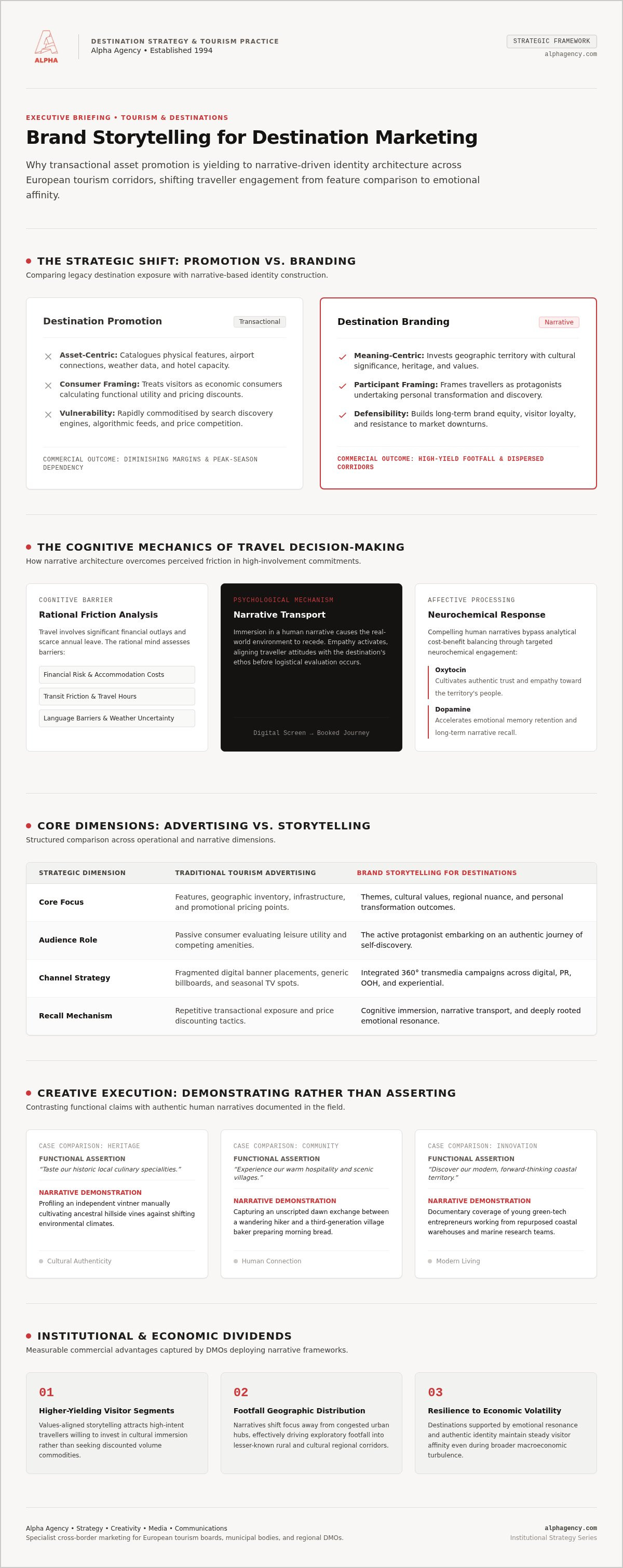
Brand storytelling for destination marketing is the deliberate, strategic use of narrative architecture to invest a geographic territory with cultural meaning, emotional resonance, and a coherent brand identity. Rather than listing tourism assets, storytelling frames the destination as the setting for a personal journey of discovery, transformation, or belonging.
This approach marks the decisive distinction between destination promotion and destination branding:
- Destination Promotion (Transactional): Focuses on features, pricing, flight connectivity, and immediate seasonal offers. It treats the traveller as an economic consumer evaluating a leisure utility.
- Destination Branding (Narrative): Focuses on values, identity, cultural heritage, and human transformation. It treats the traveller as a participant in a living story, cultivating affinity, long-term brand equity, and sustainable visitor volume.
The strategic objective of storytelling in tourism is to induce what cognitive psychologists term "narrative transport"–a psychological state in which an audience becomes so immersed in a narrative that their real-world environment recedes, emotional empathy activates, and their attitudes shift to align with the story. Narrative transport operates as the psychological bridge between a digital screen in Frankfurt, London, or Paris and a plane ticket to an unfamiliar European territory.
In modern European tourism marketing, generic promotional campaigns face diminishing returns. Search engines, generative discovery engines, and social media algorithms rapidly commoditise unbranded travel claims. Destination leaders who articulate a distinct narrative capture higher-yielding visitor segments, distribute footfall across lesser-known rural or cultural corridors, and build loyalty that withstands economic turbulence.
The Psychology of Travel Narratives
Travel decisions involve significant financial cost, limited annual leave and the uncertainty of visiting an unfamiliar place. Prospective travellers consider practical factors such as travel time, accommodation costs, language barriers and weather, but they also respond to how a destination makes them feel.
Stories can make destination information easier to understand, remember and connect with emotionally. By presenting a place through people, experiences and meaningful situations, destination campaigns help prospective travellers imagine themselves there while still providing the practical information needed to make a decision.
Instead of comparing destinations only through prices and amenities, prospective travellers begin to picture their own experience within the story. This emotional connection can ensure that, when the practical planning stage begins, the destination is already a strong consideration.
Storytelling vs. Traditional Advertising
Traditional destination advertising is built upon functional claims: "Visit our beaches," "Taste our local culinary specialities," or "Explore our mediaeval castles." These messages rely on assertion rather than demonstration, demanding that the consumer believe the destination's self-assessment.
By contrast, brand storytelling adheres to the narrative maxim of "show, don't tell." Instead of claiming that a European region is hospitable, a narrative campaign illustrates an unexpected, authentic interaction between a wandering hiker and a village baker at dawn. Instead of asserting that a country is modern and forward-thinking, a documentary-style digital short profiles young green-tech entrepreneurs working out of repurposed coastal warehouses.
| Strategic Dimension | Traditional Tourism Advertising | Brand Storytelling for Destinations |
|---|---|---|
| Core Focus | Features, geography, amenities, and price points. | Themes, values, cultural nuance, and emotional outcomes. |
| Audience Role | Passive consumer evaluating functional benefits. | The protagonist embarking on a personal transformation. |
| Channel Strategy | Fragmented banner ads, billboards, and generic TV spots. | Integrated 360° transmedia campaigns across digital, PR, OOH, and experiential. |
| Recall Mechanism | Repetition and discounting. | Cognitive immersion and narrative transport. |
| Long-Term Value | Short-lived seasonal demand spikes. | Durable brand equity and pricing resilience. |
Extensive cognitive research indicates that information delivered through narrative structures is retained substantially longer than disconnected facts and claims. When destination marketing organisations anchor their campaigns in narrative structure, their return on media spend compounds over multi-year cycles.
Core Elements of a Compelling Destination Narrative
Crafting an effective destination brand story requires rigorous strategic discipline. A romantic, beautifully shot video that fails to reflect the destination's operational reality will create an expectation gap, leading to negative reviews and damaged credibility. Conversely, a literal list of tourist attractions fails to provoke emotional engagement. Strategic brand storytelling requires four balanced structural elements.
- The Hero (The Traveller): A common mistake in municipal and national marketing is positioning the destination itself as the hero. The destination is never the protagonist; the visitor is. The traveller must see themselves reflected in the narrative, facing a relatable dilemma and seeking an emotional resolution.
- The Conflict (The Internal or External Friction): Narrative requires tension. In destination storytelling, this tension stems from the pressures of modern life: sensory burnout, constant digital noise, superficial social interactions, or creative exhaustion. The narrative must articulate this pain point before presenting a solution.
- The Setting as a Mentor (The Territory): The destination serves as the setting and the guiding force. Its landscapes, traditions, historical structures, and citizens act as catalysts that help the protagonist overcome their friction and achieve perspective.
- The Transformation (The Value Proposition): What does the visitor become after experiencing the destination? They do not simply return with photographs; they return restored, culturally enlightened, creatively invigorated, or spiritually grounded. The transformation is the ultimate product of the destination brand.
Developing the "Signature Plot"
Every nation, region, and city possesses an authentic narrative identity rooted in history, geography, and social evolution. DMOs must identify a "Signature Plot" that aligns with the destination's character while addressing the aspirations of target international demographics. In European destination marketing, two primary narrative frameworks prove consistently effective:
- The Quest: The traveller embarks on a physical and intellectual expedition to discover something rare, remote, or intellectually demanding. This plot suits destinations with dramatic topographies, active sports infrastructure, artisanal craft heritage, or deep academic and creative histories. The narrative emphasises personal endurance, curiosity, and the acquisition of rare perspectives.
- The Rebirth: The traveller arrives depleted by professional strain, personal disconnection, or urban claustrophobia. Through immersion in unhurried community rhythms, wild natural environments, geothermal wellness traditions, or quiet village hospitality, the traveller sheds their burdens and rediscovers their equilibrium.
Selecting the right narrative plot requires balancing authentic heritage with contemporary expectations. DMOs must resist the temptation to present a sanitised, folkloric caricature of their communities. Modern international travellers appreciate authentic European life: historic town centres hosting contemporary technology workshops, or traditional farming cooperatives employing regenerative, high-tech ecological practices. Authenticity arises from the honest interplay between living heritage and present-day reality.
Sensory and Emotional Anchors
A destination narrative cannot rely on conceptual rhetoric alone; it must be anchored in tangible sensory details. Sensory details convert an abstract geographic coordinate into a vivid mental destination long before a trip is booked.
In high-calibre branding and advertising, sensory anchors are integrated across all creative assets:
- Visual Cinematography: Rejecting over-saturated stock photography in favour of deliberate, natural-light visual storytelling that captures atmospheric weather, tactile architecture, textured stone walls, and unfiltered human expressions.
- Sonic Landscapes: Audio is one of the most immediate cognitive triggers of emotion. Authentic destination marketing employs natural soundscapes: the acoustic resonance of church bells in a misty valley, the crisp crunch of snow under boots on an alpine trail, the hiss of espresso machines in a bustling morning arcade, or the rhythm of waves breaking on a northern headland.
- Local Voices and Accents: Rather than using a generic mid-Atlantic voiceover, sophisticated campaigns elevate authentic local voices. Hearing regional dialects, unscripted reflections from local craftsmen, and genuine laughter grounds the narrative in place-based truth.
3 Frameworks for Destination Brand Storytelling
To understand how narrative principles can work across European destinations, consider three practical storytelling frameworks. They are not fixed templates; the right approach depends on the destination's identity, audiences and strategic objectives. Examples of Alpha Agency's destination work include campaigns for Batumi, Georgia, Lithuania and Pärnu.
Framework 1: The Cultural Immersion Narrative
The Cultural Immersion narrative addresses the growing global demand for "slow travel." It directly counters the superficiality of checklist tourism, where visitors rush through capital cities to photograph recognisable landmarks before departing. Instead, this narrative positions the territory as an interconnected living ecosystem best experienced over extended durations.
Strategic Execution: The campaign narrative highlights regional artisans, multigenerational food producers, independent winemakers, and village restoration societies. Media assets follow a traveller spending several days apprenticing with a stonemason, learning heritage culinary techniques, or cycling between family-run farmstays. The tone is observational, respectful, and reflective.
Commercial Impact: This storytelling model attracts high-value, low-impact visitors who stay significantly longer, spend more in rural and secondary municipal economies, and respect local heritage. It cushions rural economies from seasonal peaks and troughs and mitigates urban over-tourism in capital hubs. It shifts the primary brand identity of a nation from a collection of postcard monuments to a sanctuary of living, human-scale European culture.
Framework 2: The Adventure and Transformation Story
The Adventure and Transformation model targets the high-yield "active seeker" demographic–affluent, educated professionals seeking rigorous physical challenges, outdoor wilderness, and personal resilience. This narrative appeals to northern, central, and western European outbound travellers looking to escape comfortable, sedentary corporate lifestyles.
Strategic Execution: The narrative deliberately introduces conflict: harsh weather, steep elevations, biting coastal winds, and physically taxing journeys across unpaved paths. The campaign does not sugarcoat the terrain; it highlights its raw, unyielding nature. The traveller is shown overcoming physical fatigue, navigating remote wilderness, and ultimately achieving an unvarnished sense of clarity and accomplishment beside a sub-arctic campfire or on an alpine ridge.
Commercial Impact: By reframing unpredictable weather and challenging terrain as assets rather than liabilities, this narrative turns seasonal low points (such as autumn and winter) into premium travel periods. It elevates outdoor equipment partnerships, sports events, and eco-lodges, positioning the territory as a testing ground for personal rejuvenation and self-discovery.
Framework 3: The Urban Innovation and Creative Identity Tale
Many European regions struggle with an outdated international perception, seen solely through the lens of industrial decline or historical events, obscuring modern achievements in technology, design, and culture. The Urban Innovation framework re-engineers destination perception to attract international tourists as well as MICE (Meetings, Incentives, Conferences, and Exhibitions) delegates, remote knowledge workers, and creative entrepreneurs.
Strategic Execution: The narrative weaves together historical preservation and cutting-edge urbanism. Visual stories explore former industrial docks turned carbon-neutral cultural districts, historical libraries housing advanced digital laboratories, and open-air public art installations. The protagonist is the mobile intellectual: a researcher attending an international congress, an independent software architect designing applications from a restored café, or a design director exploring contemporary gallery networks.
Commercial Impact: This model bridges the gap between leisure tourism and commercial inward investment. Business travellers convert into extended-stay leisure visitors ("bleisure"), expanding hotel occupancy across mid-week schedules. Furthermore, it strengthens the national brand, presenting an agile, forward-looking society capable of hosting world-class professional conventions and fostering creative capital.
Implementing Storytelling Across the 360-Degree Marketing Mix
A compelling narrative needs coordinated execution across channels. Destination marketing leaders cannot rely exclusively on digital video or social media creators to carry an entire national brand. To build international awareness and influence travel behaviour, the narrative must be applied consistently across an integrated marketing mix.
Alpha Agency's experience with international and pan-European campaigns shows that narrative consistency must be protected across five implementation phases.
- Phase 1: Brand Identity Development (The Narrative Core): Before producing outward-facing assets, the DMO must codify a comprehensive brand identity and narrative framework. This internal document defines the core themes, the protagonist profile, tonal guidelines, colour palettes, and acceptable message parameters. It establishes the criteria against which all creative output, regional stakeholder contributions, and vendor partnerships are evaluated.
- Phase 2: High-Production Content Creation: Content production must yield assets tailored to specific stages of the traveller journey. Long-form documentary shorts and television commercials establish emotional narrative transport; mid-form episodic content introduces regional personalities, local food systems, and outdoor pursuits; while short-form vertical assets capture sensory details for social discovery. Every piece must feel like a natural chapter in the same core book.
- Phase 3: Strategic Media Planning and Buying: Storytelling campaigns require deliberate, sophisticated media planning and buying across European territories. Rather than dispersing small ad budgets across dozens of markets, DMOs must concentrate high-impact digital out-of-home (DOOH), connected TV (CTV), and programmatic video in key source markets where air and rail routes match the target narrative. Flighting must align with consumer planning cycles, reaching travellers when seasonal booking considerations peak.
- Phase 4: Public Relations and Strategic Communications: PR provides third-party credibility that paid media cannot buy. DMOs must equip European travel journalists, lifestyle editors, and respected cultural essayists with direct access to the people and places featured in the brand story. Instead of generic press trips, journalists should experience curated narrative itineraries that mirror the protagonist's journey.
- Phase 5: Experiential Activations and Events: Bringing the narrative to physical life in primary feeder markets cements memory retention. Immersive pop-up installations in London, Paris, or Berlin–featuring authentic soundscapes, culinary tastings with featured artisans, and interactive cultural exhibitions–allow prospective visitors to step inside the destination's story before stepping onto an aircraft.
Multi-Channel Narrative Consistency
The principal challenge of modern cross-border campaigns is narrative fragmentation. When marketing directors manage multiple agencies, freelance creators, and local municipal stakeholders, the message frequently disintegrates into contradictory themes. A traveller might see an ethereal, slow-travel video on YouTube, followed immediately by an aggressive, price-slashing banner ad offering budget weekend getaways, and a generic, influencer-led selfie tour on Instagram.
To avoid this, DMOs must implement transmedia storytelling principles. In transmedia design, each channel plays a distinct, complementary role in advancing the overall narrative:
- Connected TV & Cinema: Establishes the overarching emotional themes, visual atmosphere, and narrative tension of the destination.
- Digital OOH in Transit Hubs: Acts as an ambient visual disruption during daily urban commutes, displaying powerful sensory anchors that invite reflection.
- Specialist Editorial & PR: Provides depth, historical context, and the long-form journalistic human interest stories behind the campaign.
- Social Media & Creator Collaborations: Offers dynamic, real-time proof of the narrative, with local residents and selective international travellers demonstrating how the story unfolds in everyday life.
- Destination Web Platforms: Function as the conversion engine, organizing itineraries, transport logistics, and accommodation options directly around the campaign's thematic story chapters rather than administrative county lines.
Furthermore, running campaigns across multiple European jurisdictions requires an agency partner versed in cross-border advertising regulations, digital consumer privacy standards (including GDPR and European ePrivacy directives), and cultural nuances in how narrative claims are interpreted across different linguistic markets.
Measuring Narrative Success
One of the most pervasive objections to brand storytelling in public sector tourism organisations is the perceived difficulty of measuring return on investment (ROI). Because narrative campaigns prioritize long-term brand equity over instant e-commerce transactions, traditional performance metrics like click-through rates (CTR) fail to capture their true commercial impact.
DMO leaders must establish a measurement framework that captures both brand perception shifts and downstream commercial outcomes:
| Stage of Impact | Key Metric | Measurement Methodology |
|---|---|---|
| Attitudinal Transport | Sentiment shifts and narrative recall. | Pre- and post-campaign brand lift studies, natural language processing (NLP) of earned media and social discussions. |
| Engagement Quality | Dwell time and content consumption depth. | Video completion rates (VCR), average time on narrative web pages, organic search volume for thematic terms. |
| Travel Consideration | Search and route planning intent. | Growth in flight searches, carrier bookings from target media corridors, and partner itinerary downloads. |
| Economic Yield | Visitor quality, length of stay, and dispersal. | Aggregated payment-card spending data, where lawfully available through approved research partners, regional hotel occupancy figures outside primary capital hubs, and total visitor spend per trip. |
By monitoring both perception metrics and transactional data, destination directors can demonstrate to government funding bodies and private stakeholders that narrative branding yields measurable, premium economic returns.
Choosing a Strategic Partner for Destination Branding
Executing an international destination storytelling campaign requires coordination across consumer research, brand strategy, video production, cross-border media buying, public relations, multilingual content and performance analysis. When these disciplines are divided among several suppliers, maintaining a consistent destination narrative becomes more difficult.
Founded in 1994, Alpha Agency is a European full-service media and advertising agency that helps brands, institutions and public sector organisations communicate clearly across borders. For three decades, our teams have developed cross-border campaigns designed to build lasting market presence and commercial growth across Europe and beyond.
Our Approach to Destination Marketing
Every territory has a distinctive story that can be uncovered, refined and shared. Our approach combines local cultural insight, strategic planning and consistent creative standards rather than relying on generic tourism slogans.
- Strategic Clarity: We work alongside tourism boards, municipal leaders, and economic development agencies to uncover the distinctive truth of their destination, articulating a Signature Plot that cuts through competitive European noise.
- Integrated Capabilities: We eliminate agency friction by unifying brand strategy, high-end video production, digital communications, PR, and complex multi-market media planning under a single, accountable structure.
- Cross-Border Precision: Our media planning specialists leverage pan-European consumer data to negotiate, place, and optimise media investments in high-yield source markets, ensuring every euro spent delivers measurable awareness and booking intent.
- Authentic Storycraft: We prioritise human-centric storytelling over transactional visual clichés, collaborating with local communities, cultural custodians, and contemporary innovators to capture the living spirit of the territory.
Whether introducing an emerging European destination to global travellers, changing perceptions of an industrial city or distributing visitor volume across rural areas, our team combines strategic insight, creative development and cross-market coordination to deliver measurable campaign outcomes. Explore our recent work and learn more about Alpha Agency.
Launch Your Narrative with Alpha Agency
In a global travel market overflowing with commodity tourism advertising, the destinations that will flourish over the next decade are those that possess the courage to tell authentic, coherent, and emotionally captivating stories.
If you are an executive leader at a national tourism board, regional development agency, or municipal marketing organisation preparing to redefine your global presence, we invite you to discuss your project with our senior strategic team. Together, we can build a brand narrative that will capture the imagination of international travellers for years to come.
Frequently Asked Questions
What is the difference between destination marketing and destination branding?
Destination marketing encompasses the tactical, promotional activities designed to generate immediate interest and tourist bookings–such as seasonal discounts, flight route announcements, and events calendars. Destination branding is the long-term, strategic practice of developing the territory's overarching identity, emotional promise, cultural values, and reputation. Marketing drives short-term volume; branding builds durable equity, pricing power, and visitor loyalty.
How do you measure the ROI of brand storytelling in tourism?
Brand storytelling ROI must be assessed through an integrated framework tracking both sentiment and economic impact. Key indicators include brand lift studies measuring shifts in perception and narrative recall, increases in organic search volume for regional destinations, growth in flight and rail search volume from targeted outbound media corridors, and an increase in average visitor spend and length of stay reported by hotel federations and card network analytics.
Can storytelling work for destinations that don't have "famous" landmarks?
Storytelling is precisely the strategy that allows destinations without iconic global landmarks to outcompete traditional tourist centres. While landmark-heavy cities often suffer from over-tourism and transactional visits, emerging destinations can build compelling narratives around unhurried discovery, untouched natural wilderness, distinctive culinary heritage, and intimate local hospitality. Travellers increasingly seek authentic, personal experiences over crowded sightseeing checklists.
How long does it take to see results from a destination storytelling campaign?
While digital engagement metrics and sentiment shifts can be observed within weeks of campaign deployment, significant shifts in traveller perception and international arrival numbers typically mature over a 12-to-24-month horizon. Because travel planning involves considerable lead times, narrative positioning campaigns compound in value over multi-year cycles as awareness translates into booking cycles.
What role does influencer marketing play in destination storytelling?
When used strategically, digital creators and cultural influencers act as authentic third-party witnesses to the destination's narrative. Rather than engaging in generic sponsored posts or superficial glamour photography, creators should be invited to immerse themselves in specific cultural, culinary, or adventure chapters of the overarching brand story, interpreting the territory through their own genuine creative lens to engage niche communities.
Is brand storytelling effective for B2B tourism (MICE) marketing?
Yes. Corporate conference planners, incentive travel managers, and association boards are human decision-makers who respond to compelling narratives. In MICE marketing, brand storytelling frames the destination not merely as an exhibition hall with hotel rooms, but as an energetic hub of intellectual capital, scientific innovation, green infrastructure, and cultural vitality that will elevate delegate attendance and inspire convention participants.
How do you maintain story consistency across different international markets?
Story consistency requires a clear Brand Book that defines the non-negotiable core themes, protagonist journey, visual tone, and narrative ethos of the territory. However, while the core narrative remains unified, the specific execution must be carefully adapted to local source markets. Local execution should be guided by market research, travel behaviour, transport accessibility, cultural context and audience testing rather than assumptions based solely on nationality.
Why is a 360-degree marketing approach necessary for destination storytelling?
Human memory is built through repeated, multi-sensory reinforcement across varied contexts. A single viral video or occasional billboard will quickly fade from consumer awareness. A 360-degree approach ensures that the traveller encounters complementary facets of the same narrative across television, digital video, contextual out-of-home advertising, press features, and immersive real-world events, creating an integrated impression that drives decisive booking action.